Get Full Government Meeting Transcripts, Videos, & Alerts Forever!
Get email alerts on the Liquefied Natural Gas topic
No spam. Unsubscribe anytime.
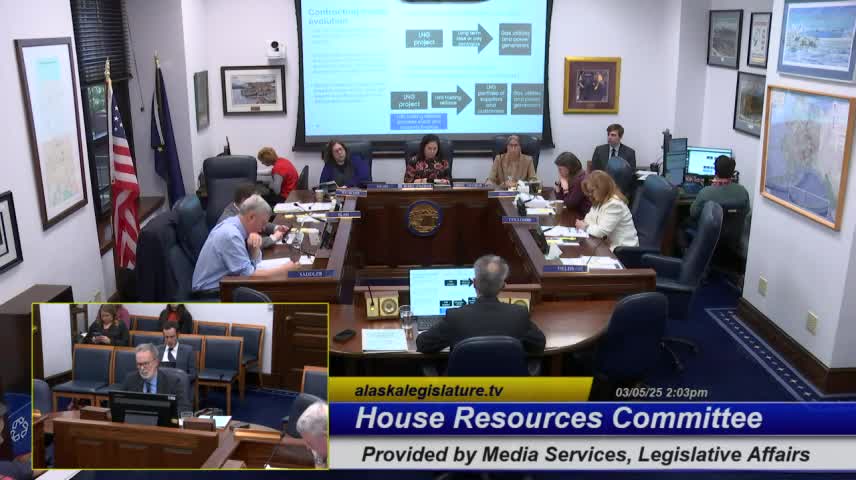
House Resources Committee hears LNG market briefing; consultant outlines costs, risks and potential state revenues
Summary
Nick Fulford, senior director at GaffneyCline & Associates, told the Alaska House Resources Committee on March 5 that liquefied natural gas projects require a long-term approach and present both major revenue potential and material financial risk for Alaska.
Nick Fulford, senior director at GaffneyCline & Associates, told the Alaska House Resources Committee on March 5 that liquefied natural gas projects require a long-term approach and present a mix of strategic opportunity and material risk for Alaska.
Fulford briefed committee members including Co-Chair Representative Burke and Co-Chair Representative Maxine Divert in Capitol Room 124, Juneau, about the global LNG market, cost drivers for major projects and policy tools that can affect whether an Alaska LNG development reaches a final investment decision (FID).
Why it matters: Fulford said the scale of an Alaska LNG project — the pipeline, processing and liquefaction investment — would be large enough to be a multi-decade, transformative fiscal event for the state while also exposing Alaska to capital-cost and schedule risk. He summarized how different contracting and financing structures shift risk among producers, plant owners and lenders and highlighted carbon mitigation, enabling legislation and potential federal support as decisive factors for investors.
Fulford described LNG as predominantly methane that is refrigerated to about one-six-hundredth of its gas volume so it can be shipped internationally. He said the industry has an “excellent safety record” and that LNG is widely traded: roughly one-eighth of the world’s gas supply is moved as LNG and about one-third to one-half of internationally traded gas moves via LNG. He said current global liquefaction capacity is about 400 million tonnes per annum (Mtpa).
On demand and competition, Fulford said forecasts diverge: some models that assume rapid decarbonization show declining demand, while most commercial forecasts and energy-company outlooks show continued growth — particularly across South Asia. He told the committee that Qatar and U.S. Gulf Coast supply will be primary future supply drivers, and that U.S. Gulf Coast prices increasingly act as a market reference point.
Costs, delivered price and state share: Fulford presented comparative delivered-cost scenarios. He said U.S. Gulf Coast projects are sensitive to Henry Hub gas prices, while Alaska’s delivered cost is more sensitive to capital-cost inflation. In scenario work he presented, a 25% state equity participation — framed as the state exercising royalty-in-kind and taxes-in-kind to fund equity — translated into roughly a $12 billion state investment (about 25% of the quoted $40+ billion infrastructure cost). He said that, if the state held a 25% equity interest and the project performs as modeled, the resulting long-term free cash flow to the state “would be of the order of $2 to $3 billion” per year once capital is written down.
Fulford cautioned that large projects tend to run over initial budget and schedule estimates. He reviewed a historical sample of LNG projects showing common cost and schedule overruns and said remote locations, labor shortages and supply-chain constraints have been prominent drivers of overruns in past projects.
Project structures and finance: Fulford described three common structures: fully integrated projects (sponsors own upstream through sales), merchant projects (liquefaction and trading separated from producers) and tolling models (liquefaction owners earn a fee per unit processed). He said the lowest commercial risk typically comes when commercial interests across the chain are aligned. He noted that tolling contracts can provide a predictable, contract-style return that lenders often favor and that lenders’ environmental and sustainability commitments are increasingly shaping which projects obtain finance.
Carbon mitigation and enabling policy: Fulford discussed ‘‘low-carbon’’ LNG approaches — including lifecycle emissions measurement, low-emission production practices, certified-low emission gas, carbon capture and sequestration (CCS), and nature-based offsets — and said carbon content is increasingly a commercial differentiator. He told the committee that passage of Alaska carbon-capture legislation (discussed in the hearing) “is a material change” for Alaska’s ability to present low-carbon attributes to buyers and lenders and that 45Q tax benefits and a potential federal loan guarantee could materially improve project economics.
Risks and lessons: Fulford reviewed international examples where projects were delayed or impaired by security problems, domestic demand dislocations, technical issues or fiscal instability. He advised that enabling legislation for a project of Alaska’s scale typically includes fiscal-stability provisions and other tailored rules investors expect before committing capital, and he cited LNG Canada as an example where coordinated provincial and federal measures helped unlock FID.
Committee follow-up and next steps: Committee members asked about Wood Mackenzie assumptions, pipeline spur lines, the effect of renewables on demand, FSRU utilization and specific cost sensitivities. Fulford offered to provide targeted follow-up analyses and the committee directed members to route questions through committee aide Calvin Zullo for responses.
Ending: The committee adjourned at 2:55 p.m. and scheduled additional hearings on related bills and resolutions; members said they will continue to seek more detailed cost and financing analysis before any state investment decision.