Get Full Government Meeting Transcripts, Videos, & Alerts Forever!
Get email alerts on the State Budget topic
No spam. Unsubscribe anytime.
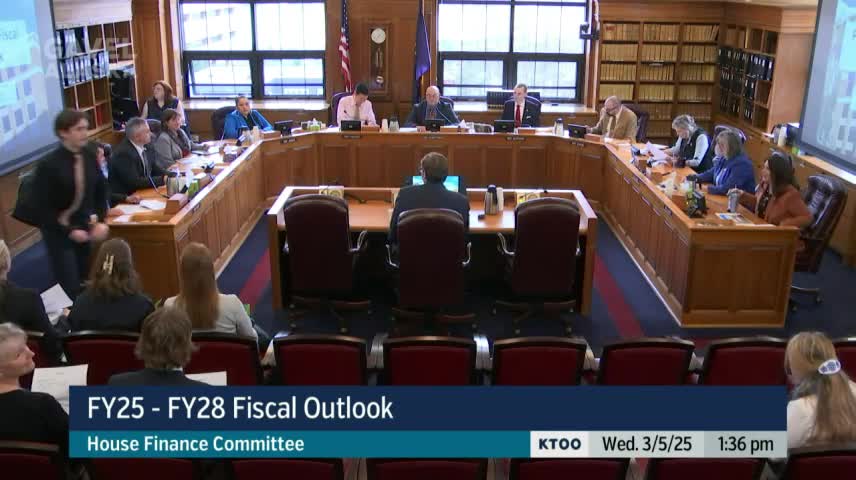
House Finance hears three‑year budget outlook as PFD choices drive shortfalls
Summary
Legislative Finance presented a three‑year revenue and spending outlook showing an FY2026 shortfall under several Permanent Fund Dividend (PFD) scenarios, with oil prices, federal funds and new salary and K‑12 costs identified as the largest revenue and cost risks.
The House Finance Committee on Wednesday heard a three‑year budget outlook from the Legislative Finance Division that projects a sizable FY2026 budget shortfall under multiple Permanent Fund Dividend scenarios and identifies oil prices, federal receipts and rising personnel and K‑12 costs as the principal drivers.
Lehi Painter, legislative fiscal analyst, told the committee the Department of Revenue fall forecast used in the staff scenarios assumes a $70 per barrel Alaska North Slope oil price and roughly 470,000 barrels per day of North Slope production. "Oil can be extremely volatile," Painter said, adding: "I would not at all be surprised if this forecast is $10 off for a year from now." Painter quantified the sensitivity: each $1 per barrel change in the oil price alters unrestricted general fund revenue by roughly $35 million–$40 million.
The nut graf: choices about how large to make the PFD and whether to use reserves or raise new revenue will determine whether the Legislature sends a balanced FY2026 budget to the governor. Under the scenarios Legislative Finance presented, higher dividends substantially increase projected deficits; lower dividends reduce them but do not eliminate all risk unless paired with other changes in revenues or spending.
Most important facts first: Legislative Finance showed a FY2026 unrestricted general fund revenue baseline of about $6.2 billion under the $70 oil price assumption. Federal funds are also a large part of the state budget; Painter noted federal receipts for FY2026 across operating and capital budgets are on the order of $6.1 billion. Using those assumptions and the governor's amended operating budget as the baseline, staff produced several scenarios that vary only by the PFD amount. Under one scenario, a PFD sized to the Legislative Finance example (about $1,400 per recipient in that illustration) left a FY2026 deficit of roughly $440 million. A $1,000 PFD lowered the gap to about $169 million. A $2,000 PFD raised the gap to about $808 million. A full statutory (PFC/POMV) dividend in the presentation—about $3,800 per recipient under the Permanent Fund Corporation estimate—produced a near $1.9 billion deficit in FY2026.
Painter also outlined the FY2025 position: based on the fall forecast the committee faces an FY2025 shortfall (before supplementals) of about $81.5 million; the governor’s supplemental requests then raised the FY2025 gap when combined with unpaid items to roughly $165 million that the Legislature must address. He pointed out that the governor has proposed using the Constitutional Budget Reserve (CBR) as one option, which requires a three‑quarters legislative vote to withdraw.
Committee members asked about options beyond adjusting the PFD, including closing tax exemptions and the status of the spring revenue forecast. Painter said the spring revenue forecast is expected next week and could alter the baseline modestly but that, under prevailing market signals, a materially higher spring oil price would be unlikely without dramatic global changes.
The presentation included other fiscal uncertainties that will affect the three‑year outlook: new collective bargaining and salary survey results (Legislative Finance used a placeholder that staff said may be on the low side), greater K‑12 fiscal notes and one‑time items that appeared in FY2025 but are not guaranteed for FY2026, and potential federal changes (for example, shifts in Medicaid funding rules) that are difficult to quantify.
Ending on process: Painter and committee members emphasized this was an illustrative set of scenarios, not policy decisions. The spring revenue forecast and subcommittee closeouts scheduled this week will narrow the choices the Legislature faces for FY2026. Chair Josephson closed the hearing after the committee agreed to reconvene for subcommittee closeout reports the next day.