Get Full Government Meeting Transcripts, Videos, & Alerts Forever!
Get email alerts on the Foreign Malign Influence topic
No spam. Unsubscribe anytime.
Security consultants warn Alaska public officials of foreign malign influence tactics
Summary
Presenters warned Alaska public officials that foreign adversaries use social media, trade and research channels, and personal outreach to gather information and influence officials. They cited examples including marketplace knockoffs, social‑media scraping, the Thousand Talents program and China’s social‑rating tools.
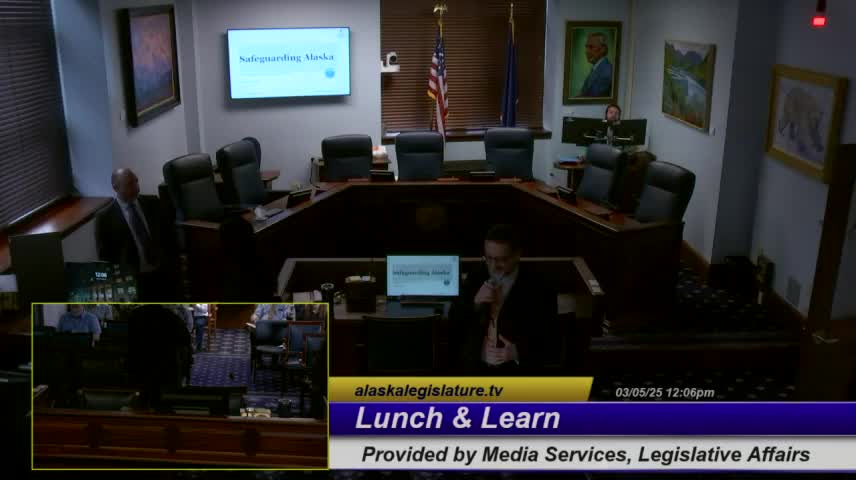
Delray, co‑founder of a private security consulting firm, and Tyler Vose, a former FBI agent and Army CID investigator and co‑founder of the same firm, warned Alaska public officials during a briefing that foreign governments are collecting personal and professional data to gain access to and influence local officials.
Delray said public accessibility makes officials “a prime target for our adversaries,” and that online posts, family locations and routine activities provide pathways for influence and intelligence collection. “Everything you put out there, they're collecting in the hopes of using it against you guys again someday,” Delray said.
The presenters described several common tactics. They said adversaries use social media and community groups — for example, pet meetups or booster clubs — to build rapport with targets. They described offers to test technology (for example, connected kayaks) or gifts as lures. Delray warned that attackers will look for personal levers such as family members’ online activity: “your children are probably the easiest way to get to you,” he said.
The briefing used commercial examples to illustrate intellectual property and supply‑chain risks. Delray described buying a knockoff cup on an online marketplace and comparing it to the brand product; he said the marketplace items sometimes undercut U.S. products because of lower prices and manufacturing in China. He referenced the U.S. customs “de minimis” rule as an enabler for low‑cost shipments under $800, which he said contributes to the volume of inexpensive, look‑alike goods. He framed such market activity as part of a broader pattern of economic and technology competition.
On academic and research channels, the presenters cited the Thousand Talents program as an example of state efforts to acquire overseas research and technical knowledge. Delray said the program sends researchers abroad who then bring knowledge back to China and that such efforts have targeted natural‑resource research relevant to Alaska. “China declared it would improve the development and application of rare earth and change the resource advantage into economic superiority,” he said, quoting a 1999 statement referenced in the briefing.
The speakers also discussed cyber and infrastructure risks. They described social‑platform manipulation (clickbait and false information) and said China’s social‑monitoring tools and mass data collection enable large‑scale analysis of public behavior. They noted Russian activity can be stealthy, including influence campaigns and disruption to infrastructure such as undersea cables. The presenters said adversaries share tactics and sometimes cooperate on objectives.
Tyler Vose summarized his background and framed the briefing: “what we're gonna talk about today, specifically, [is] foreign malign influence,” he said, identifying China, Russia and Iran as principal examples and urging vigilance. Both presenters offered to stay after the briefing for more detailed questions.
The presentation did not include formal votes or policy decisions. The material consisted of examples, warnings, and suggestions for awareness and further discussion. The presenters did not specify new local policies, assigned tasks, or funding requests during the session.
Officials and staff in attendance asked few questions during the recorded excerpt. The presenters advised that officials balance public accessibility with security practices and monitor personal and family online exposure.
The presenters recommended individual and organizational steps including limiting unnecessary personal data shared publicly, scrutinizing offers from unfamiliar contacts, and treating unusually cheap or unsolicited commercial offers with caution. They also encouraged follow‑up briefings and one‑on‑one consultations for officials who want specific guidance.
Delray closed by highlighting China’s long‑term planning and data collection capabilities: “China has a 10 year plan,” he said, and urged attendees to take the threat seriously. The presenters offered to answer additional questions after the session and to provide more in‑depth briefings on cyber and artificial intelligence topics later.