Get Full Government Meeting Transcripts, Videos, & Alerts Forever!
Get email alerts on the Education Funding topic
No spam. Unsubscribe anytime.
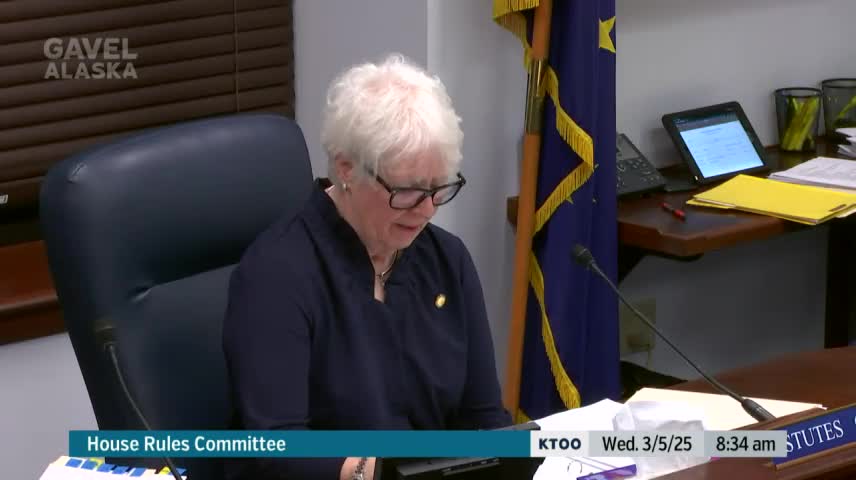
House Rules Committee advances amended HB 69 to increase education funding, debate centers on open enrollment, charter rules and reading grants
Summary
The House Rules Committee approved a committee substitute for House Bill 69 and reported the bill out of committee 5–2 after adopting an amendment to expand the Alaska Reads program. Several amendment proposals — including ones to raise correspondence-student funding and require districts to post budgets online — failed.
Juneau — The House Rules Committee on Wednesday moved a committee substitute for House Bill 69, a broad education funding and policy bill, out of committee with individual recommendations and attached fiscal notes after amending the substitute to keep and expand the Alaska Reads program and other targeted programs.
Representative Rebecca Himshoot, sponsor of HB 69 (version G), told the committee the bill’s central aim is to “restore funding that has been eroded over the years” and to inflation-proof the state’s base student allocation. The committee substitute the panel considered and amended would increase the base student allocation (BSA) by $1,000 in the first change described in the bill and make several linked policy changes affecting open enrollment, charter schools, correspondence study reporting, wireless device rules, and a short-lived legislative task force on education funding.
The substitute was adopted as the working document by unanimous consent. Committeemembers debated multiple amendments on funding formulas, transparency and program-specific grants. The committee adopted one amendment — carried by Representative Costello — to expand reading proficiency grants under the Alaska Reads framework and passed the bill out of committee 5–2. Several other proposed amendments failed on roll call votes.
Why it matters: HB 69 would change both how education dollars are distributed and several school policies statewide. Supporters framed the bill as restoring purchasing power in school budgets and targeting money to priorities such as reading proficiency, vocational education, teacher recruitment and retention, and transportation. Opponents raised concerns about the long-term fiscal cost of placing permanent increases inside the formula and the risk of creating new statutory requirements without clear funding sources.
Key provisions described to the committee
- BSA increase and inflation proofing: The committee substitute increases the base student allocation by $1,000 (the CS text cites an increase from $5,960 to $6,960 in one section) and contains phased inflation-proofing language through FY 2028–29. Representative Himshoot described the change as an attempt to restore funding eroded since roughly 2011 while acknowledging the committee trimmed larger restoration proposals in the sponsor’s original draft as a compromise.
- Open enrollment: The CS adds intra-district open-enrollment language (including sibling preference, lottery-based enrollment when space is limited, data reporting, and an appeal process). Open-enrollment provisions in the CS are set to sunset three years after enactment (repeal effective 07/01/2028 in the CS).
- Charter schools: The substitute shortens the State Board of Education decision deadline on charter-application appeals from 90 days to 45 days, requires written notice and an opportunity to remedy before local boards terminate a charter contract, allows renewal for successive terms, lets charters carry forward up to 10% of unreserved budget (with annual board review), and raises the allowable administrative deduction for local school boards when calculating charter budgets from 4% to 8%.
- Correspondence programs and reporting: The CS requires annual reporting from school districts and the Department of Education and Early Development on correspondence study programs (allotment, demographics, fund use, assessment scores and curriculum reviews) and requires the State Board to include that report in its annual report to the Legislature.
- Wireless devices: The bill directs the Department of Education and Early Development to create a model policy regulating non–school-issued wireless telecommunications devices in public schools, with exceptions for medical, emergency and educational use; districts must adopt and share a policy (they may adopt the model or their own).
- Task force and regulatory review: The CS establishes a temporary legislative task force on education funding to analyze funding and accountability and report recommendations by the start of the second regular session of the 30th Legislature; the task force expires 01/31/2026.
- Other items in the CS described during presentation: increased vocational/CTE multipliers, changes to boarding school stipends, temporary extension of school bond debt reimbursement suspension, transportation planning/appeal language, and reading proficiency incentive grants tied to the Alaska Reads effort.
Amendments and committee votes (at a glance)
- Amendment 1 (transparency amendment — require districts to post budgets and audits online; moved by Representative Vance): Failed on roll call, 3 yes, 4 no. Recorded yes votes: Representative Costello, Representative Vance, Representative Tilton. No votes: Representative Edgmon, Representative Shroggy, Representative Copp, Chair Stutes.
- Amendment 2 (raise correspondence-student multiplier from 0.9 to 1.0; moved by Representative Tilton): Failed on roll call, 3 yes, 4 no. Recorded yes votes: Representative Costello, Representative Vance, Representative Tilton. No votes: Representative Shroggy, Representative Copp, Representative Edgmon, Chair Stutes.
- Amendment 3 (comprehensive package including transportation, CTE increases, bonuses, reading grants, mobile-device rule and other targeted line items; moved by Representative Vance): Failed on roll call, 3 yes, 4 no. Recorded yes votes: Representative Vance, Representative Tilton, Representative Costello. No votes: Representative Shroggy, Representative Copp, Representative Edgmon, Chair Stutes.
- Amendment 4 (expand Alaska Reads reading-proficiency incentives to K–6 at $450 per qualifying student; moved by Representative Costello): Passed on roll call, 4 yes, 3 no. Recorded yes votes: Representative Tilton, Representative Copp, Representative Costello, Representative Vance. No votes: Representative Shroggy, Representative Edgmon, Chair Stutes.
- Final committee action: Representative Cupp moved to report the Rules Committee Substitute for HB 69 (LS0309\0) out of committee with individual recommendations and attached fiscal notes. After recorded objection(s) and debate, the motion to report the bill out passed on a recorded vote, 5 yes, 2 no. Recorded yes votes: Representative Shroggy, Representative Koff, Representative Edgmon, Representative Costello, Chair Stutes. Recorded no votes: Representative Vance, Representative Tilton.
What committee members said
Sponsor’s rationale: Representative Rebecca Himshoot summarized the CS and the intent behind key provisions, saying the bill both inflation-proofs the BSA and adds targeted increases so “we can maintain all the possible educational opportunities for our students that we can.” She described the $1,000 BSA increase as a compromise from a larger restoration package she had proposed earlier.
Support for reading funding: Representative Costello and other members urged retaining and expanding the Alaska Reads incentives, saying early-reading gains are essential: “Students who are not able to read are not set up for success in life,” Costello said during debate on the amendment she carried.
Concerns about fiscal sustainability and local control: Representative Edgmon and others cautioned that several proposed targeted line items (teacher bonuses, reading grants, transportation, CTE increases) add significant long-term fiscal obligations and argued many districts asked for a larger overall BSA so local boards can allocate funds to local priorities. Edgmon noted the state has not filled all the reading-specialist positions envisioned by the original REEDS/Alaska Reads rollout and questioned whether some districts could meet grant requirements.
Correspondence students: Supporters of equalizing the correspondence multiplier urged parity for homeschool/correspondence students, noting correspondence students make up a significant share of Alaska’s enrollment in some districts. Opponents said in-district brick-and-mortar schools have fixed facility and transportation costs that make equal funding difficult without further fiscal analysis.
Process notes and next steps
- The substitute adopted as the working document contains many cross-cutting policy changes that will now be reflected in the committee report and fiscal notes; the bill was reported out of Rules to the next procedural step with individual recommendations and attached fiscal notes.
- The CS contains a repeal/sunset for the new open-enrollment language in 2028, and it establishes a short-term legislative task force on education funding charged with delivering recommendations by the start of the second regular session of the 30th Legislature.
- Fiscal details: Committee debate repeatedly flagged the lack of a specified funding source for the permanent $1,000 BSA increase; Representative Himshoot described the $1,000 figure as a negotiated compromise and said funding decisions would be made by the full Legislature, including finance committees.
The committee adjourned after signatures; the bill will proceed through the legislative process with the Rules Committee’s recommendations and attached fiscal notes.