Get Full Government Meeting Transcripts, Videos, & Alerts Forever!
Get email alerts on the Seafood Marketing topic
No spam. Unsubscribe anytime.
Alaska Seafood Marketing Institute asks Legislature for $10M to chase U.S. market gap after Russia ban
Summary
The Alaska Seafood Marketing Institute told the Senate Finance Committee it is seeking a $10 million supplemental appropriation spread over three years to capitalize on a U.S. market opportunity created by a ban on Russian seafood, while industry revenues have fallen because of low ex‑vessel prices.
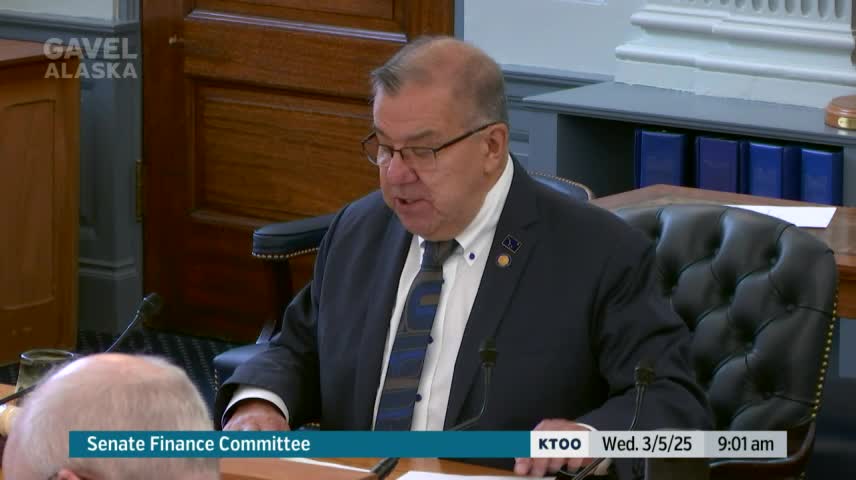
Jeremy Woodrow, executive director of the Alaska Seafood Marketing Institute, asked the Senate Finance Committee on March 5 for a $10 million supplemental appropriation spread over three years to expand U.S. marketing and shore up industry sales as ex‑vessel prices fall.
ASMI’s request aims to “capitalize on that Russian seafood ban and increase Alaska seafood sales in the U.S. marketplace,” Woodrow told the committee. He said the funds would be allocated mainly to U.S. retail and food‑service promotions and to amplify consumer public relations and brand work for Alaska seafood.
ASMI, established by statute as a state corporation under the Department of Commerce, Community and Economic Development, funds its work from three main sources: a seafood marketing assessment paid by the industry, federal overseas marketing grants, and occasional unrestricted general funds. Woodrow explained that the industry assessment is a voluntary levy on ex‑vessel value currently set at one‑half of 1 percent, and he defined the term for the committee: “Ex‑vessel value is that first sale that happens between a fisherman and a processor. Some might call it the dock price.”
Woodrow said ex‑vessel values have dropped sharply, reducing ASMI’s assessment receipts and prompting the supplemental request. He told senators ASMI’s current “spin plan” — the organization’s planned marketing spend — is at historically high levels (above $20 million) and that the requested $10 million would help maintain that program over multiple years rather than allow marketing to fall as industry receipts decline.
The presentation framed a near‑term market opportunity tied to U.S. trade actions affecting Russian seafood. Woodrow said an executive order banning new Russian seafood imports to the United States (effective May 2024) “provides about a $452,000,000 opportunity for the Alaska seafood industry” and left an estimated 70,000 metric tons of U.S. demand to be filled. He cautioned, however, that other seafood‑producing regions are also seeking to fill the gap and that ASMI will have to compete for that business.
Woodrow described how ASMI combines federal market access program funds and regional agricultural promotion funds (both administered by the U.S. Department of Agriculture Foreign Agricultural Service) with state resources to fund overseas and domestic marketing. He said federal funds must be used for overseas marketing and that federal programs are competitive: larger ASMI commitments improve the chance of securing federal match. Woodrow estimated that roughly $3 million of state/industry match historically helped ASMI secure about $4.5 million in Market Access Program funds plus $4.5–8 million from the regional program in some years.
Committee members asked timing and design questions. Senator Stedman and Woodrow discussed why the request was drafted as a FY25 supplemental rather than a FY26 appropriation: Woodrow said earlier passage would allow ASMI to start activities in the current fiscal year, amplifying campaigns in late spring and summer. Senator Stedman suggested the committee consider moving the appropriation into a FY26–FY27 vehicle given statewide budget constraints and the time needed for the governor to sign budgets.
Senator Kaufman asked whether the marketing angle tied to the Russian ban would be durable if trade circumstances change; Woodrow acknowledged that a lifted ban would create market turmoil and emphasized that price remains the leading consumer purchase driver. Senator Crump objected to using state dollars to promote some species (pollock/surimi), saying those sectors are large and can market themselves. Woodrow described programs focused on retail, digital tools (Chicory), couponing apps (Ibotta) and distributor promotions; he cited past returns such as $2.4 million in sales from a Chicory campaign and $120 million in sales driven by distributor promotions in FY24.
Woodrow also described ASMI’s Alaska Responsible Fisheries Management (RFM) program as a differentiator that can certify origin and sustainability, and said ASMI is active in cruise‑ship promotions and in expanding markets overseas (Southeast Asia, North Africa and parts of Eastern Europe).
No committee vote was taken on the supplemental request during the hearing. Woodrow concluded his presentation and offered to provide additional information to the committee on request.