Get Full Government Meeting Transcripts, Videos, & Alerts Forever!
Get email alerts on the Transit topic
No spam. Unsubscribe anytime.
City Commission adopts 10-year transit development plan to qualify for state and federal grants
Summary
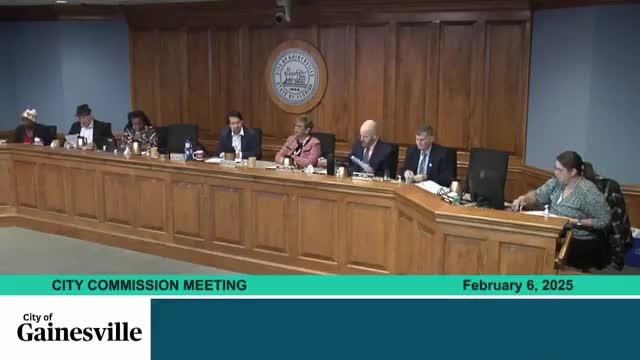
The Gainesville City Commission unanimously adopted a 10-year transit development plan on Feb. 6, a state- and federally-required planning baseline that staff said is necessary to qualify for grant funding to restore and expand Regional Transit System services.
The Gainesville City Commission unanimously adopted the 10-year Regional Transit System Transit Development Plan (TDP) for fiscal years 2025–2034, a planning document required as part of state and federal grant applications.
The plan, presented by Jesus Gomez of the city transportation department and consultant Taylor Cox of Benish, lays out phased route restorations (phase 2 and 3), three pilot mobility-on-demand zones, and proposed premium/express services including a rapid express between Santa Fe College and the airport. The plan is explicitly a non-binding vision and baseline for grant applications; staff said figures are estimates and will be updated annually.
Why it matters: adopting the TDP preserves Gainesville’s eligibility for FDOT and other grants the city intends to pursue to fund capital projects such as transfer centers, transit signal priority (TSP) equipment and electric or alternate‑fuel vehicles. The plan also frames possible service changes that affect frequency, span and route alignments across RTS fixed routes, campus service and county connections.
Key points - Purpose and scope: the TDP is a program-level planning document not a contract or budget; it identifies funded and unfunded needs and sets service priorities for RTS over the next decade. - Public outreach: staff and consultants reported about 1,400 public contacts through workshops, intercept surveys and a virtual engagement space; top rider requests included later service hours, higher frequency and more shelters/benches. - Short-term actions: Phase 2 (near-term) emphasizes UF routes and short-term network changes; Phase 3 expands to city, county and Santa Fe routes and deploys mobility-on-demand (MOD) zones (15‑minute service target) in lower-productivity corridors. - Premium services and infrastructure: the plan recommends express/premium corridors, bus-preferential treatments such as transit signal priority, and two transfer centers (Eastside and Northwest). Staff said the city will implement the short-term network in 2026 and the MOD pilot in 2027, contingent on grant awards and contract negotiations. - Funding: staff presented a 10-year operating projection (~$315 million) and ~ $118 million in capital needs; funding is a mix of federal, state and local dollars, plus grant awards RTS has secured. Staff emphasized that some large grant awards reduce near-term local operating needs but additional revenue will be necessary if the city wants later frequency increases projected in the plan.
What commissioners asked: commissioners pressed consultants and staff on operational details such as how MOD (microtransit) would be booked (app or call center), eligibility and accessibility for older riders and paratransit users, potential bus‑only or HOV lane infrastructure for express routes, and how redundancy reductions would affect transfers and reliability. Staff said MOD will be available via RTS call center and an app, will operate in geofenced zones, and can use ADA‑accessible vehicles; the Historic UF–airport express alignment was described as a long‑term premium option subject to ridership and annual updates.
Next steps: commissioners approved the TDP and staff will submit required documents to FDOT by the March 1 deadline; the plan will be updated annually and remain a living document subject to further public and commission review.