Get Full Government Meeting Transcripts, Videos, & Alerts Forever!
Get email alerts on the Floodplain Permits And Recovery topic
No spam. Unsubscribe anytime.
Port Richey officials defend flood‑plain permit tracking after residents report faulty stop‑work notices
Summary
At a Port Richey town hall, residents pressed city staff about stop‑work orders, permit rules and FEMA substantial‑damage tracking after recent floods. Staff said flood‑plain tracking is required to preserve community flood‑insurance benefits, while residents described inconsistent notices and burdensome procedures for minor repairs.
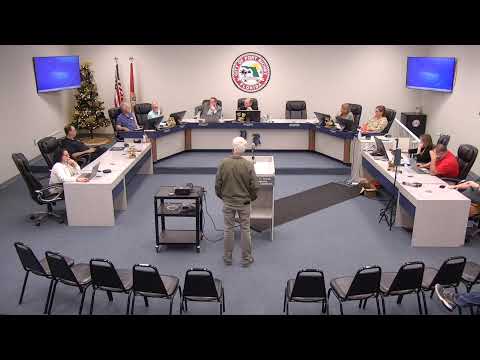
Port Richey officials and residents spent most of a city town‑hall session discussing post‑storm permitting, stop‑work orders and how the city is tracking repairs for FEMA damage assessments.
Veronica, a development‑services staff member who opened the discussion with a short flood‑awareness presentation, said Port Richey and Pasco County are highly vulnerable to flooding and storm surge. “Pasco County is one of Florida’s most flood‑prone areas with over a hundred miles of coastline and low‑lying neighborhoods,” Veronica said during her presentation.
The presentation was followed by extended public comment from homeowners who said they received inconsistent notices and, in some cases, stop‑work orders after performing limited repairs. Resident Clayton Arvidsson said he received a court notice ordering him to appear over an alleged stop‑work order despite an earlier city letter saying his home was not substantially damaged. “I get a court notice saying that we have to go to court on March 7 for a stop‑work order,” Arvidsson said, describing multiple rounds of notices, a later dismissal and continued difficulty getting clear guidance from city staff.
Other residents described similar experiences and asked why small, nonstructural repairs — painting, replacing baseboards or cabinets — appeared to trigger enforcement. One commenter said she spent under $5,000 repairing a rental cottage and was surprised the work drew enforcement attention: “I spent less than $5,000 fixing that house,” she said.
City staff and elected officials explained the city’s legal and administrative constraints. Staff told residents the city must track all repairs in flood hazard areas because FEMA and the state require documentation used to determine whether a building meets the legal definition of “substantial damage,” typically measured against a percentage of the structure’s appraised value. City staff said the municipal code currently compares repair or improvement costs against the property value and that a 50% threshold is the standard trigger for a “substantial damage” determination; staff also described a local one‑year “look back” rule that aggregates recent work toward that calculation.
City staff cautioned that failing to document storm‑related repairs can jeopardize the city’s Community Rating System (CRS) standing and, with it, the availability and affordability of federally backed flood insurance for local homeowners. Staff summarized the tradeoff: tracking permits and repairs protects the whole community’s access to flood insurance and federal reimbursement but can feel intrusive for individual homeowners doing small repairs.
Councilmembers and officials acknowledged communication problems during the immediate recovery period. Staff described a December damage‑assessment sweep and said damage assessors were instructed to document observed work and, where appropriate, post stop‑work notices on doors and take photos. Several homeowners said they did not receive mailed notices and that photographs used as proof of service were taken in public places rather than at the front door.
Officials offered several practical next steps. Residents with disputed notices were asked to make an appointment with City Manager Matthew Koppler (referred to in the meeting as “Matt”) or building officials to present documentation and request an interior inspection to revise an initial exterior assessment. Staff said the city will also review process changes to reduce burden, including removing or modifying the one‑year look‑back period and exploring a non‑fee “flood‑plain tracking” form or mass mailer so minor repairs can be reported without running through the full building‑permit intake when appropriate.
Mayor Tom Aaron Cooper and other council members emphasized that the city does not intend to block repairs and urged residents to contact staff. “We want homeowners to fix their homes,” Mayor Cooper said during the meeting, while also stressing the community‑level consequences if the city fails to track repairs properly.
City staff said some code clarifications and FAQ updates will be published and that staff would follow up with residents who asked for one‑on‑one meetings. Residents asked the city to publish clearer guidance distinguishing what requires a building permit, what requires a flood‑plain tracking entry, and what is exempt; staff said they would address the FAQs and consider a public presentation of state and federal assistance programs (including a newly mentioned program, “Elevate Florida”).
The town‑hall exchange left outstanding points for further work: residents said the city needs clearer, consistent notice procedures and more timely phone/email responses; staff said they would review case files, improve notice wording, and study options to make reporting and tracking less burdensome while still meeting FEMA documentation requirements.
The meeting closed with officials urging affected homeowners to schedule inspections and bring documentation so staff can reassess any initial exterior estimates.