
Nantucket speakers press Select Board on Vineyard Wind notification, blade break risks and ADLS testing
Get AI-powered insights, summaries, and transcripts
Sign Up Free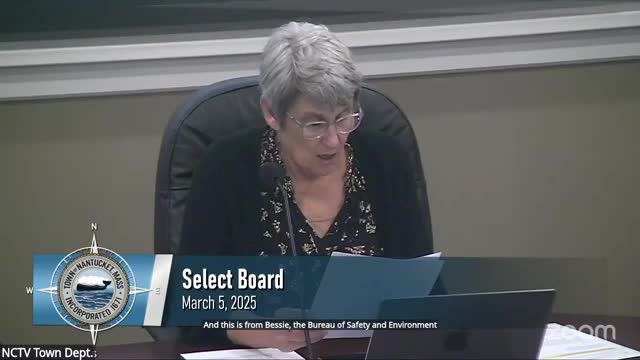
Summary
Residents pressed the Select Board about a Feb. 28 lightning strike and blade failure at the Vineyard Wind 1 offshore facility, questioned the timeliness of town notification and asked what the town is doing about financial risk, bonding and aircraft-detection lighting system testing.
Select Board members heard a string of public comments on March 5 urging more town action and clearer notification after a lightning strike and blade failure at Vineyard Wind 1 that occurred Feb. 28 and was reported to the town on March 2. The chair read two communications into the record: a Bureau of Safety and Environmental Enforcement (BSEE) notice that BSEE is requiring a comprehensive assessment of the affected turbine, and a Vineyard Wind update from Richard Smith reporting successful testing of the project’s aircraft detection lighting system (ADLS) and plans for follow-up helicopter confirmation flights.
The meeting’s public-comment speakers said the town was informed too slowly and pressed the board to demand clearer incident notification, stronger financial protections and more direct public engagement from Vineyard Wind. Mary Chalk said the town was not notified until social media and asked whether the town issued warnings to fishermen and recreational boaters about possible debris. Sandra Craig and others raised environmental concerns including fiberglass shards, microplastics and chemical releases from blade failures and from offshore installations, and called for tests of sediments and stronger monitoring. Cliff Carroll and other speakers urged the Select Board to press federal and state officials on bond and insurance questions and to require Vineyard Wind to appear in person so residents can ask direct questions.
Several speakers noted the Feb. 28 strike and the project’s history, including a prior July 13 blade failure. Amy Eldridge questioned why components from the earlier incident remained on a turbine for months and asked whether that could have increased the risk. Commenters also requested the town assess possible property-value and municipal financial exposure from recurring blade failures.
The board did not take a formal action at the March 5 meeting on Vineyard Wind but the chair said she had posted the correspondence from BSEE and from Vineyard Wind on the project information page. Vineyard Wind’s letter, read into the record by the chair, said ADLS testing confirmed that lights on 18 turbines were deactivated and that on March 3 an aircraft triggered the system and the lights flashed as intended; Vineyard Wind said continued testing and partner coordination remain necessary. BSEE’s communication said overflights and vessels found no initial debris in the water and that the affected turbine’s lightning protection system was not operational because of a prior July 2024 blade failure, and that BSEE is requiring a comprehensive assessment of the turbine and associated equipment to determine the full extent of damage.
Why it matters: Residents and municipal officials said delayed notification undermines public trust and may leave fishermen, beaches and coastal users at risk if debris is present. They also asked whether town financial exposure—from public land or town-owned real estate—has been properly assessed and whether bond or insurance measures negotiated during earlier project approvals still apply to the current corporate owner. The Select Board posted the agency and company communications and, during the meeting, encouraged further public engagement and said it will continue communications with state and federal offices.
What’s next: Several commenters urged the Select Board to invite Vineyard Wind to a future meeting so residents can question company representatives directly and to press state and federal regulators on bonding and incident-response requirements. The Select Board did not vote on any formal measure regarding Vineyard Wind during the meeting.