Get Full Government Meeting Transcripts, Videos, & Alerts Forever!
Get email alerts on the Land Development Code topic
No spam. Unsubscribe anytime.
Pensacola advisory board workshop focuses on stormwater, parking rules and tree policy in LDC rewrite
Summary
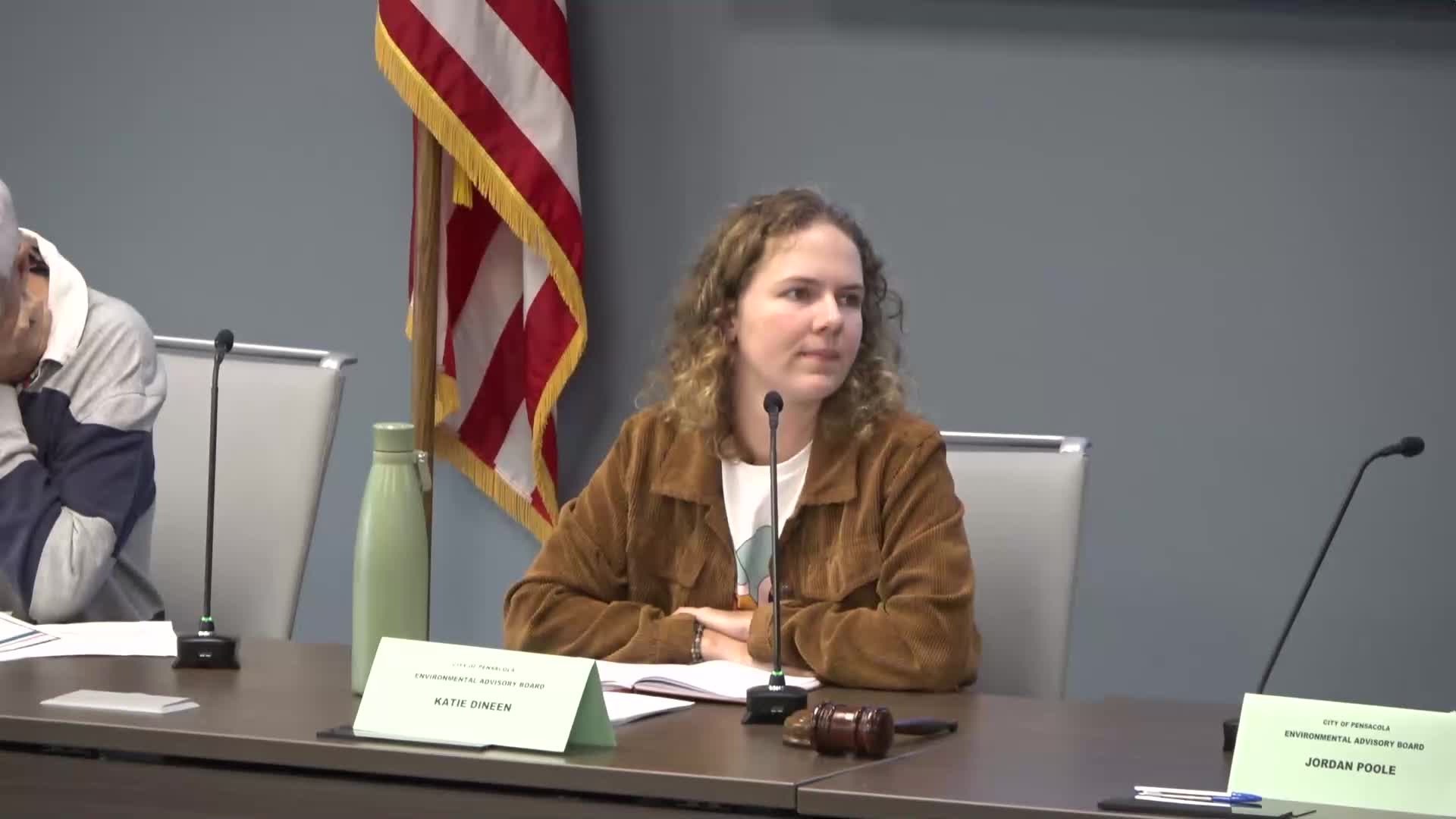
Pensacola’s Environmental Advisory Board met in a workshop to review the Phase 2 public-engagement materials for the city’s Land Development Code (LDC) update, discussing stormwater treatment standards, parking requirements for multifamily buildings, active-transportation and complete-streets guidance, and tree and landscaping rules.
Pensacola’s Environmental Advisory Board met in a workshop to review the Phase 2 public-engagement materials for the city’s Land Development Code (LDC) update, discussing stormwater treatment standards, parking requirements for multifamily buildings, active-transportation and complete-streets guidance, and tree and landscaping rules.
Board members and staff emphasized why the LDC matters: it governs how land may be used and developed across Pensacola, and the matrix provided by consultant Inspire and city staff will form the basis for public comment and the spring series of community workshops. Participants were encouraged to submit comments through the project website and attend workshops so ideas from the session would be captured in the public record.
Discussion points centered on four policy areas: stormwater and nutrient management, off-street parking and parking-study options for multifamily housing, integration of active-transportation and form-based standards, and tree/landscaping rules and the tree-planting trust fund. Several speakers warned that legacy exemptions and ‘‘grandfathering’’ of older paved sites can reduce the city’s ability to require modern stormwater treatment when redevelopment later occurs.
On stormwater, speakers noted the draft matrix includes multiple staff and consultant comments about parcel history and whether older development should remain exempt from current stormwater requirements. Participants said parcel-history allowances should not be used to avoid meeting city and water-management-district stormwater standards; staff and Inspire language in the matrix recommends clarifying the rules to prevent boundary manipulation and to require compliance with stormwater regulations when development occurs. Workshop participants also discussed permeable surfaces, on-site versus off-site treatment and paying into a master-stormwater fund as a compensatory option; the Inspire notes captured in the matrix include “allow partial off-site compensatory treatment” as an action recommendation.
Parking and multifamily development drew sustained attention. The matrix entries discussed minimum/maximum off-street parking, and included consultant recommendations tied to unit size. The draft material noted a 1 space-per-unit baseline as low for multifamily, recommended 1.5 spaces for efficiency and one-bedroom units and two spaces for two-bedroom units, and described use of a developer-submitted parking study or a variance process to adjust requirements. The consultant and several participants encouraged removing rigid citywide minimums in some urban areas to spur downtown redevelopment while preserving different standards for more suburban neighborhoods.
Participants also urged including requirements or incentives for secure, covered bicycle parking in larger multifamily projects and making it easier and safer to reach bikes from apartments than cars. The group discussed integrating the city’s active-transportation plan and complete-streets approaches into the LDC so sidewalks, bike lanes and street trees are paired with form-standards that orient buildings to the street and locate parking to rear or structured facilities.
Tree canopy and landscaping were another recurring topic. The draft matrix flags downtown exemptions for landscaping; workshop members recommended requiring or incentivizing urban landscaping that can occur in the right-of-way (including containers) when on-site planting is impractical. Several participants argued the city should prioritize public right-of-way trees and public landscaping investments to expand canopy equitably rather than only tightening removal rules on private property. The placement of the city’s tree-planting trust fund inside the tree chapter was questioned and described in the discussion as a candidate for reorganization or clearer cross-references.
Other recurring operational items included code enforcement capacity, better coordination on transitioning septic connections to sewer in neighborhoods, and communications to encourage public comment through the project website. CivicCon representative Ed Warder Lara announced two free public events tied to zoning and code reform that the group could use for outreach and learning about implementation approaches.
No formal votes or regulatory changes were taken in the workshop. Board members directed staff and attendees to submit written comments through the LDC project website and to participate in the scheduled public workshops so the board’s ideas would be considered during the consultant and staff review.
Next steps: the draft LDC matrix and the Inspire consultant’s recommendations will be open for public comment through the project page; board members and residents present at the workshop said they will return comments as individuals or bring items back to a future EAB meeting for a formal EAB position.
Ending: The workshop produced a broad list of topics for focused comment—stormwater treatment and grandfathering, multifamily parking and bike-parking requirements, active-transportation integration and tree/landscape policy—while underscoring that many technical refinements will be resolved in staff-consultant drafting and subsequent public sessions.