Get Full Government Meeting Transcripts, Videos, & Alerts Forever!
Get email alerts on the Homelessness topic
No spam. Unsubscribe anytime.
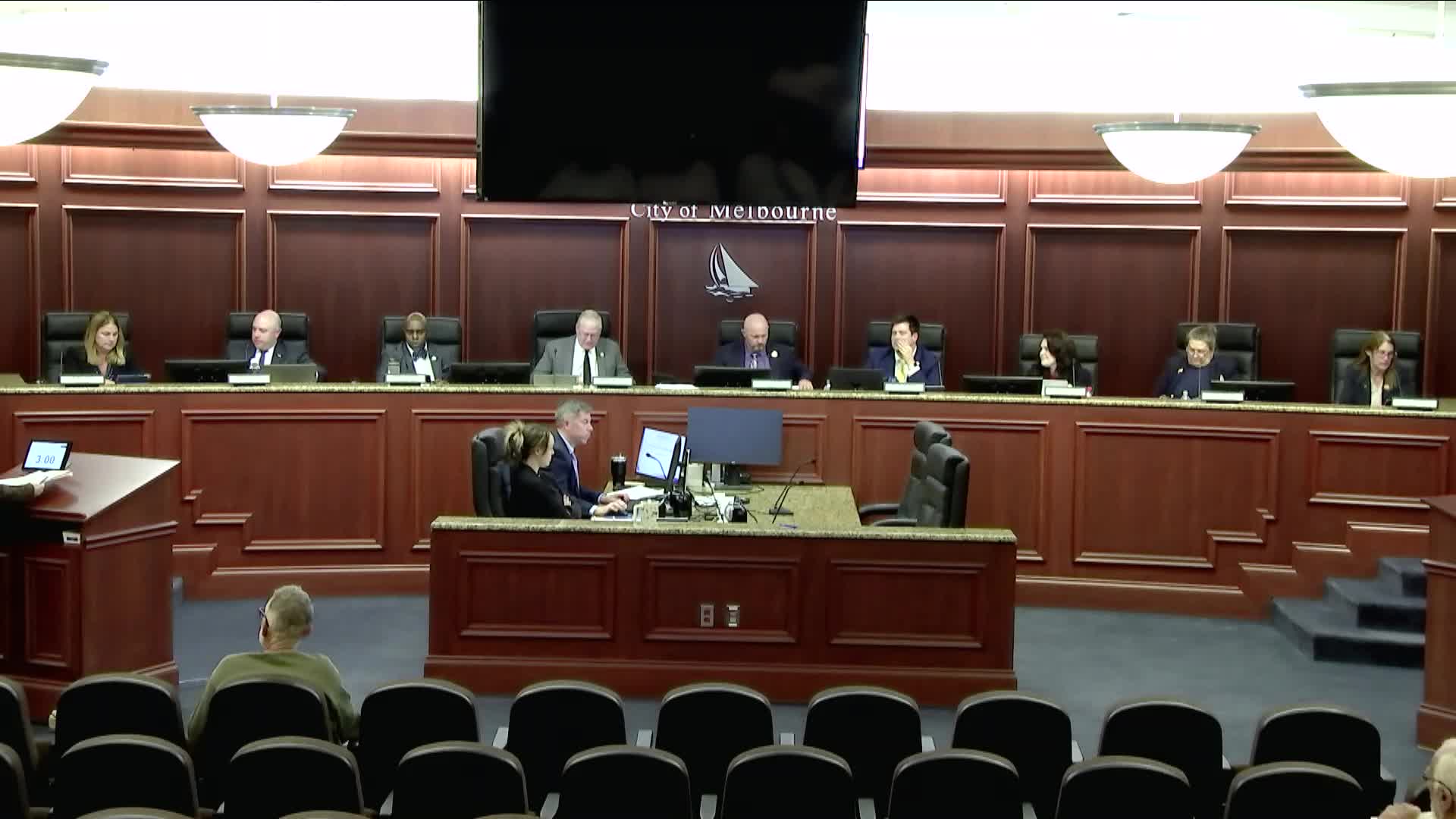
Melbourne council directs staff to negotiate amended Providence Place plan, sets timeline for Daily Bread transition
Summary
After hours of public comment, Melbourne City Council gave staff direction to negotiate an amendment to the 2023 Providence Place development agreement that would move the project to an Apollo Boulevard site, require priority for local residents, and accelerate closure of the Fee Avenue soup kitchen once conditions are met.
Melbourne City Council on Jan. 28 directed staff to negotiate revisions to the development agreement for Providence Place that would move the affordable-housing project from Sarno Road to a parcel on Apollo Boulevard and set parameters for how services and outreach are handled.
The Council’s action followed nearly three hours of public comment and presentations from Providence Place representatives, neighborhood residents and business owners who said homelessness and day-shelter activity around Fee Avenue and downtown have damaged quality of life and local commerce.
The direction from councilers instructs staff to draft an amendment that: (1) substitutes the Apollo Boulevard site for the Sarno Road parcel in the existing November 2023 development agreement; (2) requires the project to prioritize Melbourne residents for the new housing units; (3) treats the project site and the adjacent parcel as a single development area for restrictive covenants; (4) tightens limits on walk-up or day-use services tied to the site; (5) adds security, fencing and other site controls; and (6) sets a completion-deadline extension request to Dec. 31, 2027. Council also asked staff to include a target for the closure of the Fee Avenue soup-kitchen/day-shelter operations once the amended agreement’s conditions are met.
“We are not looking to hurt your business,” Mayor Alford told downtown business owners who opposed moving operations to Apollo Boulevard. “This is nothing more than affordable housing.”
Why it matters
Council members, residents and business owners described prolonged problems near Fee Avenue and downtown — from large daytime gatherings and litter to intimidation and property damage — and pressed for faster change. Providence Place and supporter groups told council the project would replace the traditional “soup kitchen” model with leased affordable apartments plus case management and wraparound services limited to residents of the building.
“I was challenged to come back to council with an accelerated rate of winding down the operation,” said Jeff Neuse, a Providence Place representative, adding that client deaths linked to street homelessness underscored the urgency. “Two weeks ago on Sunday night, one of our clients, Jason, lied down on the train tracks and died.”
What council asked staff to obtain
- A revised development agreement reflecting the Apollo Boulevard location and deed restrictions describing permitted uses and explicit prohibitions (no walk-up soup-kitchen services, no day-use drop-in that would be open to the public).
- Language that prioritizes Melbourne residents in placement decisions, implemented through coordinated-entry procedures with the Brevard Homeless Coalition.
- A clearer timeline tying the Fee Avenue day-shelter closure to a certificate of occupancy and other milestones, with council discussion of a 60‑day transition target from execution of the amendment.
- Specific limits on any commercial or community kitchen use, and written rules describing when and how any mobile outreach or food distribution tied to Providence Place may occur so that mobile services do not create a recurring daytime draw at Fee Avenue.
- Requirements for on-site security, controlled access (key-fob circulation), perimeter fencing or other buffers to reduce spillover into adjacent businesses and homes.
Council and public reaction
Business owners and residents urged faster action and tighter site controls. George Roman, who has operated a floor-covering store on Apollo Boulevard since 1978, told council the proposal would “take an existing problem and expand it.” Several downtown business owners said they feared loss of customers and long-term decline if day-shelter activity continued nearby.
Advocates and Providence Place partners said the model under discussion would be housing-first and focused on stability: residents would sign leases and receive case-managed services, not walk-in soup-kitchen meals. Amber Carroll, executive director of the Brevard Homeless Coalition, said coordinated entry and mobile, low-barrier sheltering would be part of a countywide mix of solutions.
“Everything we’re talking about is a ‘yes-and’,” Carroll said, describing countywide efforts to buy emergency-shelter buses and expand street-based outreach.
What the council did and did not approve
Council did not adopt a final amendment on Jan. 28. Instead members voted to give staff direction to negotiate the changes described above and return the revised agreement for a future public hearing. Council discussion produced general consensus on: prioritizing Melbourne residents, including both Apollo parcels in deed restrictions, adding on-site security and fencing, and spelling out limits on sidewalks/park feeding connected to the project. Council also agreed staff should explore the timing of Fee Avenue’s cessation of soup-kitchen operations and return with a concrete amendment for formal approval.
Granular details still to resolve
Council asked staff to: (a) produce model language on applicant vetting and local priority; (b) define in writing what “community kitchen” (resident amenity and workforce training) versus “commercial kitchen” (large-scale production supporting off-site distribution) would be allowed; (c) describe allowable mobile outreach — frequency, locations and permit rules — to reduce the risk of creating a permanent daytime draw at Fee Avenue; and (d) return with a schedule showing milestones and the closing timeline tied to certificate-of-occupancy conditions.
From the public record
Supporters of Providence Place emphasized the long-term housing approach and urged council to move from a soup-kitchen model to leased affordable apartments with onsite case management. “The soup-kitchen model doesn’t work. It’s outdated,” Providence Place supporters quoted Mayor Alford as saying at the meeting in support of housing-focused responses.
Resident speakers urged immediate action to restore downtown livability and to ensure any new project does not re-create the conditions currently reported near Fee Avenue.
What’s next
Staff will negotiate specific amendment language with Providence Place and return the amended development agreement to council for a public hearing and a formal vote. Council asked that staff bring back details on resident prioritization, site controls, limits on outreach tied to Providence Place and a concrete timeline for the Fee Avenue closure so that the public can review the amendments prior to any final approval.