Get Full Government Meeting Transcripts, Videos, & Alerts Forever!
Get email alerts on the Parliamentary Procedure topic
No spam. Unsubscribe anytime.
Commissioners receive parliamentary-procedure training on Robert’s Rules and county meeting practice
Summary
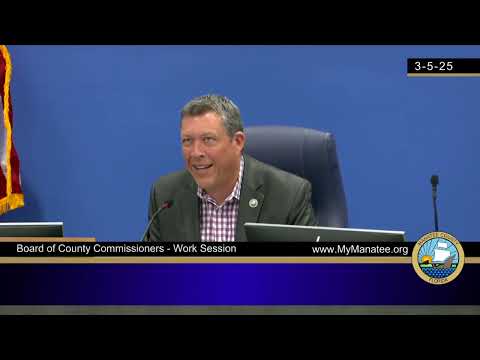
Carol Austin, a professional registered parliamentarian, led a workshop at a Manatee County Board work session to review Robert’s Rules of Order (newly revised, 12th edition) and the interaction between those rules, the board’s own procedures and Florida law.
Carol Austin, a professional registered parliamentarian, led a parliamentary-procedure workshop for the Manatee County Board of County Commissioners during a work session, reviewing Robert’s Rules of Order (newly revised, 12th edition) and how those rules intersect with the county’s own procedures and Florida law.
Austin said the basic principles of parliamentary procedure — “one person, one vote” and orderly consideration of one item at a time — are intended to make meetings efficient and fair. She emphasized that the board’s own procedures and state statutes take precedence where those documents differ from Robert’s Rules: “Your procedures supersede Robert’s Rules,” Austin advised, pointing to the county’s written board procedures.
Why this matters: Commissioners frequently raised procedural questions about when items may be debated, how to handle public-comment windows and time-certain agenda entries, and what constitutes a quorum or a binding vote. Those procedural details affect how quickly and predictably the board can move agenda items and how the public and applicants should plan to participate.
Key points from the workshop
- Quorum and majority: Austin reiterated that a quorum is a majority of the commissioners present and that, without a quorum, the board may hold information-only discussion but cannot act on business. She warned that some board rules define majority thresholds for specific actions.
- Parliamentary authority: The board’s parliamentary authority is Robert’s Rules of Order (newly revised, 12th edition), “except as otherwise provided” by the board’s own procedures or state law. Where board procedures are silent, Robert’s Rules apply. Where board procedures or state law conflict with Robert’s Rules, the county’s rules or state law control.
- Chair roles and motions: Under the county’s rules the chair cannot originate a motion while presiding without relinquishing the chair (passing the gavel); Austin explained that Robert’s Rules for small boards can allow the presiding officer to participate more freely, but the county’s written procedures override that if they state otherwise.
- Motions, seconds and order of business: Austin walked through the motion process: a member makes a motion, a member seconds it (a second means the motion will be considered), the chair states the motion, debate follows, and then the vote is taken. She urged the board to make a clear motion before prolonged discussion so debate is germane to a defined proposal rather than a freewheeling conversation.
- Limits on debate and recognition: Austin described the small-board defaults in Robert’s Rules: members generally may speak twice on a motion, with each speech limited to 10 minutes unless the board adopts different limits. She confirmed the county’s technology shows timers and that, under Robert’s Rules, a member’s second speech can still be up to 10 minutes (the two speeches are not aggregated to a single 10-minute total unless the board adopts that rule).
- Time-certain items and public notice: Commissioners asked how to handle time‑certain items when the board finishes earlier or later than planned. Austin and staff said the safest practice is to reconvene at the advertised time or to use a stated window (for example, “1:30 p.m. or soon thereafter”) but noted the board should avoid changing advertised times that the public relied on for statutory or advertised hearings (such as land‑use public hearings).
- Consent agenda and unanimous/general consent: Austin said consent or unanimous/general consent can speed meetings when members agree, but the board’s procedures and Florida law require recorded votes in many cases; staff and the county attorney noted unanimous consent is not always permitted under the county’s rules or state requirements.
Training exercise and examples
Austin ran a motion/amendment exercise to demonstrate the order of business. In the exercise a participant moved “I move that we fund a youth scholarship for computer camp,” another participant seconded, and the motion was amended during debate (the amendment to strike the word “youth” was adopted in the exercise). The workshop recorded the sample votes and showed the sequence: main motion → amendment → vote on amendment → vote on main motion as amended. (The exercise used workshop participants and role-played members to illustrate procedure.)
Follow-up requests and areas of uncertainty
Commissioners pressed staff and the parliamentarian for follow-up in several areas: which of the county’s procedures explicitly require seconds, whether Roberts’ small-board rules are implicitly part of the county’s adopted parliamentary authority, how to treat quasi‑judicial fact-finding versus debate (commissioners emphasized queries for public record and cross‑examination during quasi‑judicial proceedings), and how to reconcile technology-enabled meeting features (motions visible on screens, timers) with the formal verbal requirements in Robert’s Rules.
County attorney Pam (identified in the workshop) confirmed the county’s procedures and state law are the higher authorities, and recommended that commissioners review the board’s written procedures and consider whether the board wants to adopt any explicit changes (for example, limits on debate or time-certain windows) in a future rule update.
Ending
Austin concluded by encouraging the board to adopt clear, written modifications where the county wants to depart from Robert’s Rules and said staff could return with suggested edits to the county’s procedural rules. The workshop ended after a recessed and adjournment announcement; staff said they will prepare follow-up materials and suggested rule language for commissioners to review before any formal rule changes are adopted.