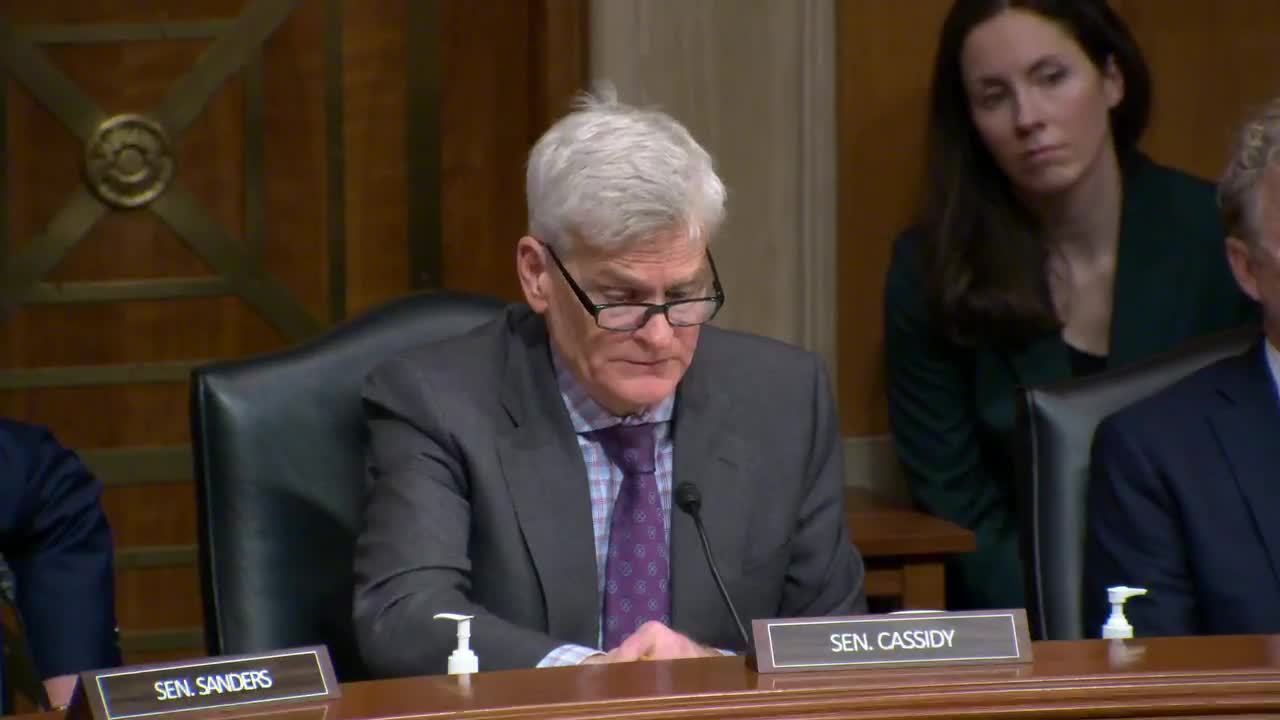
Senate HELP Committee questions Jay Bhattacharya on NIH vision, transparency and research priorities
Get AI-powered insights, summaries, and transcripts
SubscribeSummary
Dr. Jay Bhattacharya, President Trump’s nominee to lead the National Institutes of Health, told the Senate Health, Education, Labor and Pensions Committee he would prioritize chronic disease, reproducibility and a culture of scientific dissent; senators pressed him on recent staffing and funding decisions at NIH and his specific policy views.
Dr. Jay Bhattacharya, President Trump’s nominee to be director of the National Institutes of Health, told the Senate Health, Education, Labor and Pensions Committee on Oct. 12, 2025, he would make chronic disease, reproducibility and ‘‘free and open debate’’ central to NIH policy if confirmed.
Bhattacharya opened by calling NIH ‘‘the crown jewel of American biomedical sciences’’ and laid out five goals: (1) focus research on chronic disease, (2) improve replicability and research integrity, (3) foster free scientific debate, (4) invest in high‑impact rather than only incremental science, and (5) regulate or restrict research that might pose pandemic risk. "Dissent is the very essence of science," he told senators, saying the agency should encourage respectful disagreement among scientists.
The hearing focused early on the agency’s mission and on recent operational changes. Senator Sanders and others pressed Bhattacharya on drug pricing, the role of taxpayer‑funded research in creating medicines sold at high prices, and whether NIH should attach pricing conditions to grants. Bhattacharya said pricing rules would require action by Congress and the administration but suggested NIH can prioritize research into low‑cost, off‑patent drugs as a way to reduce costs.
Senators repeatedly raised concerns about recent personnel and grant review changes at NIH and asked what Bhattacharya would do on day one if confirmed. Bhattacharya said he would assess staffing and resource needs immediately, restore advisory committees and grant review activities, and ensure scientists supported by NIH have the resources ‘‘to do their life‑saving work.’’
Committee members also pressed him on scientific integrity and public trust. Bhattacharya repeated that the NIH must support replicable, generalizable research and cited recent research integrity problems in Alzheimer’s science as an example of why reliability matters. He said he would ‘‘expand the set of hypotheses’’ NIH examines for diseases such as Alzheimer’s and work to ensure negative results are reported and replicable work is funded.
Several senators, including Ricketts and Paul, praised his role in giving alternative advice during the COVID‑19 pandemic; others, including Murray and Baldwin, expressed alarm over recent funding pauses and staff reductions reported at NIH and sought assurances he would restore funding and staffing where appropriate.
The hearing produced detailed questioning across the committee but no formal votes on the nomination. Senators were unified in saying NIH must be transparent and must sustain clinical trials and long‑running research programs while they debated the nominee’s priorities.
Provenance: topicintro excerpt: "Sure. Thank you, Senator. Chairman Cassidy, ranking member Sanders, members of the Senate Health Committee, I'm honored to speak with you today and deeply humbled by President Trump's nomination." (block_id: block_1846.035) topfinish excerpt: "If confirmed, I'll carry out president Trump's agenda of making the public science institutions of this country worthy of trust and serve to make America healthy again. Thank you." (block_id: block_2121.6848)