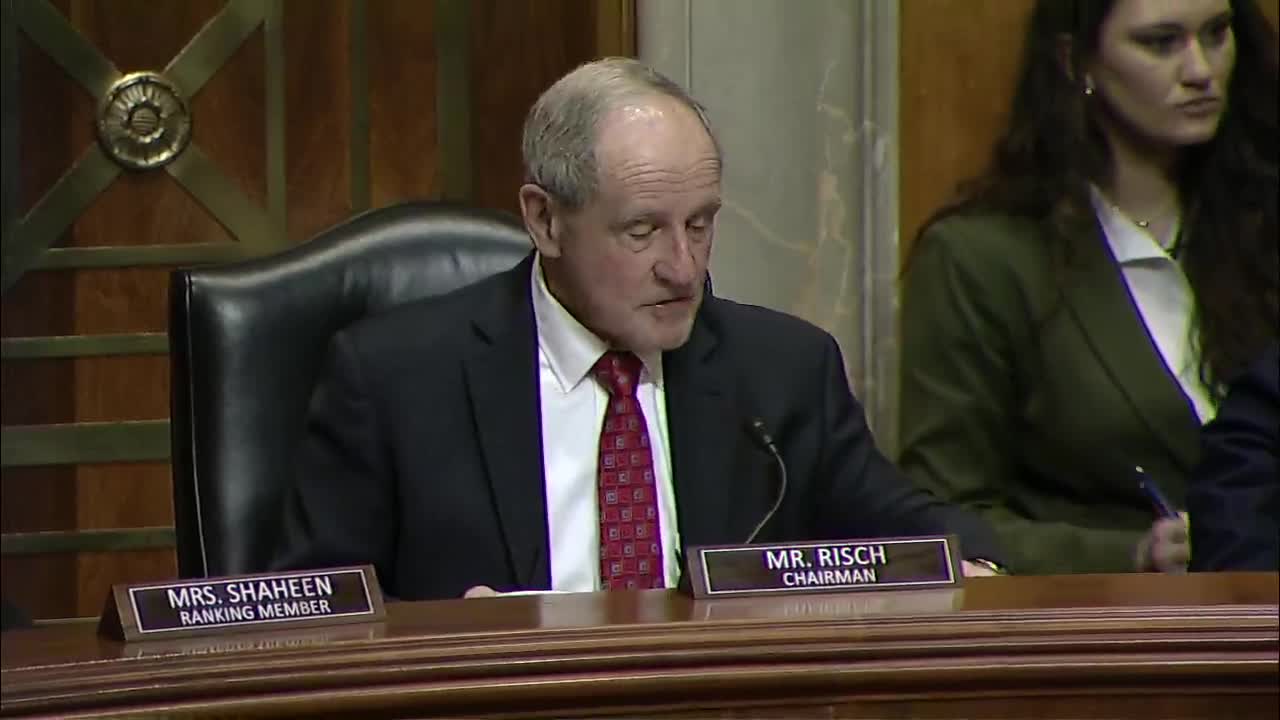
Senate Foreign Relations Committee questions three nominees on management, migration and NATO

2514374 · March 4, 2025

Get AI-powered insights, summaries, and transcripts

Subscribe
AI-Generated Content: All content on this page was generated by AI to highlight key points from the meeting. For complete details and context, we recommend watching the full video. so we can fix them.

Summary

The Senate Foreign Relations Committee held a confirmation hearing for the nominees to two deputy secretary posts at the State Department and the U.S. ambassador to NATO. Senators pressed nominees on USAID and State Department management, economic statecraft, migration enforcement, and NATO burden‑sharing.

The Senate Foreign Relations Committee convened to consider three nominees: the nominee for deputy secretary of state (management and operations), the nominee for deputy secretary for management and resources, and the nominee for U.S. permanent representative to NATO. The hearing featured opening statements by committee leaders and introductions by Senators Joni Ernst and Chuck Grassley, nominee remarks, and a robust round of questions about USAID, department management, alliances and global threats.

The nominees presented their credentials and top priorities. The nominee for deputy secretary (Landau) emphasized strengthening the “feedback loop” between foreign missions and Washington and said the State Department must prioritize defending U.S. sovereignty and enforcement of immigration laws. He told the committee he would “harness the State Department’s formidable worldwide footprint to make our country safer, stronger, and more prosperous.” The nominee for deputy secretary for management and resources (Regas) described plans to focus on staffing, skills and reducing waste, saying reducing “waste, fraud, and abuse will be a key area of focus” and stressing the need for “the right people with the right skills doing the right things in the right places.” Matt Whitaker, nominated to be U.S. permanent representative to NATO, said NATO must be strengthened through “peace through strength,” urged allies to spend more on defense and stated that he would press allies to commit to higher defense spending.

Why it matters: the three roles shape how U.S. diplomacy is resourced and executed. Committee members repeatedly tied staffing and management questions to the department’s ability to counter China, respond to crises in Ukraine and the Middle East, and maintain development and democracy programs worldwide. Ranking Member Jeanne Shaheen framed the hearing in the context of recent changes at USAID and the State Department, calling the current set of modifications a “wrecking ball” that had left some U.S. programs “dark.”

Key exchanges and positions

- Senator Joni Ernst introduced the NATO nominee and urged support, saying, “Matt Whitaker is the right person for this time and will be an excellent ambassador to NATO, and I urge you to support his nomination.”

- Nominee Landau said Washington must provide clear direction to overseas missions and “demand accountability,” and highlighted commercial diplomacy as a priority: “we must restore commercial statecraft as a pillar of our foreign policy.”

- Nominee Regas emphasized stewardship of taxpayer dollars: “Every day I will work to ensure that we are good stewards of the resources you entrust to the Department of State,” and cited prior experience at GSA, OPM and OMB as preparation for the role.

- Nominee Whitaker framed NATO as vital to U.S. and European security and urged allies to increase defense spending and production. He said the United States should push allies to prioritize modernization and interoperability and that “strength deters aggression.” He told senators he would press for allies to “meet a minimum defense spending level of 5%,” language he repeated during questioning.

Committee concerns and lines of questioning

Committee members pressed nominees on several recurrent themes: whether ongoing reviews of foreign assistance are in good faith; how to restore USAID programs and personnel if waivers are granted; how to align State Department and USAID priorities with broader U.S. strategy toward China; the legal limits on executive reprogramming of congressionally appropriated funds; protections for career civil servants; and how the United States should organize economic statecraft and development finance to better compete with China.

Several senators requested clear commitments from the nominees to work with Congress to restore or explain the status of life‑saving programs and to ensure waivers are implemented. Nominee Landau repeatedly said he would follow the law and pledged to work with senators to identify programs that “make America stronger, more prosperous and more secure.” Nominee Regas committed to look into reports that waivers had not been effectuated and to work with members to ensure funding follows approved waivers. Whitaker said he would “go there in the first 30 days” if confirmed and meet allies one‑on‑one to press for increased defense spending and interoperability.

Ending: The committee left the record open for additional submissions and questions for the nominees. No committee vote was recorded during the hearing.