Get Full Government Meeting Transcripts, Videos, & Alerts Forever!
Get email alerts on the Alcohol Sales Noise topic
No spam. Unsubscribe anytime.
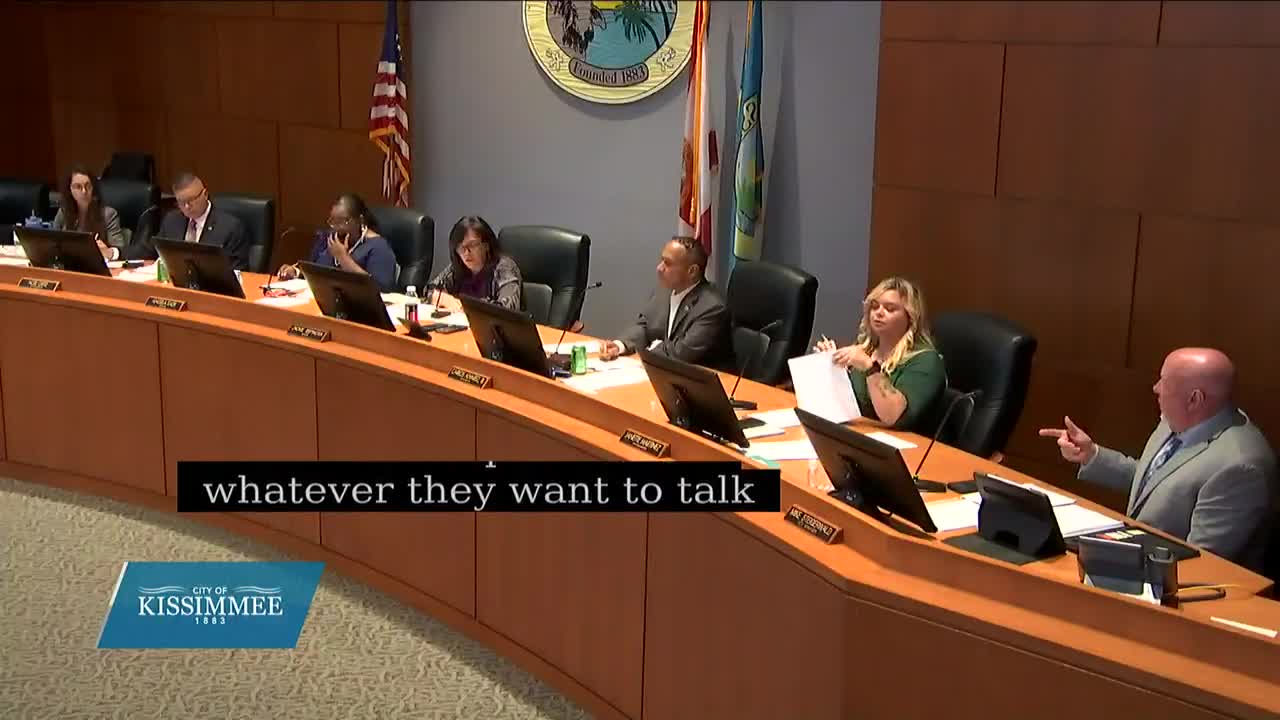
Kissimmee reviews downtown alcohol and noise rules after shootings, residents' complaints
Summary
City commissioners in Kissimmee opened a review of downtown alcohol-sales and noise rules after staff and residents raised safety concerns and business owners warned of economic harm from early closing proposals.
City commissioners in Kissimmee opened a review of downtown alcohol-sales and noise rules after staff and residents raised safety concerns and business owners warned of economic harm from early closing proposals.
Interim law-enforcement leadership described downtown call patterns and resource needs. City staff then outlined the city’s existing alcohol rules and several options used by other Central Florida cities, including late-night permit systems that require security, identification scanners, weapon-detection or occupancy monitoring.
Why this matters: commissioners said they were weighing competing goals — public safety for downtown residents, businesses and visitors versus the economic interests of restaurants and bars — and asked staff to return with proposed ordinance language, cost estimates and outreach plans rather than adopt immediate changes.
Interim Police leadership said the downtown corridor — roughly Neptune east, Ruby west, Church north and Pleasant south — produces the highest call volumes in the city’s 2024 heat map and that patrol activity has shifted over recent years. The chief said officers now put more proactive, “self-initiated” presence into the corridor on weekend late-night shifts (about eight to 12 officers) and that in 2024 there was one reported violent crime requiring follow-up in the downtown dataset cited to the commission.
Staff described current city rules for on-premises alcohol consumption: sales allowed in hotels, motels, restaurants, microbreweries, distilleries and specialty retail; no standalone bars since the 1970s; a downtown exemption for the 500-foot-from-school rule measured door-to-door rather than property-line to property-line; hours from 7 a.m. to 2 a.m. with no new patrons accepted within 15 minutes of closing and no customers allowed on premises after 2 a.m. Staff emphasized that alcohol taken off premises in an open container remains prohibited.
Craig Holland, the Development Services director, summarized three broad options: step up enforcement of the existing code; change hours or add a ‘‘limited hours’’ ordinance with no exemptions; or adopt an after-midnight permit system like Winter Garden or Orlando (staff noted Winter Garden requires proof of food sales, has a $250 permit fee and the chief or designee determines additional public-safety requirements). Orlando’s model imposes weapon-detection, ID-scanning and occupancy-load monitoring for late permits.
Public comment split: business owners, managers and some residents told the commission that late hours support jobs and downtown vitality and that more police presence and better lighting (not earlier closing times) are the solution. Other residents, local groups and safety advocates described a string of shootings and disturbances and urged stricter controls and stronger enforcement. Several speakers — including a downtown employee who said she had been shot — urged faster police response and more visible presence.
On enforcement and penalties, the interim police chief said education would be the first step and that the noise code’s fines can escalate substantially when code enforcement brings repeat cases before a special magistrate under state law. The chief also noted a nuisance standard in the ordinance: sound audible beyond the property line (or beyond the sidewalk for outdoor dining) is a violation even if a decibel meter reading is not available.
Ending: Commissioners did not adopt ordinance changes at the workshop. They asked staff to prepare draft ordinance language, estimated costs (including probable staffing and security costs), and plans for outreach and education; staff will present those proposals in subsequent hearings and workshops.