Get Full Government Meeting Transcripts, Videos, & Alerts Forever!
Get email alerts on the Municipal Governance topic
No spam. Unsubscribe anytime.
Kissimmee commission adopts criminal‑history screening ordinance, approves CRA grant changes and fills advisory seats
Summary
At its February meeting the Kissimmee City Commission adopted an ordinance allowing city HR to run state and national criminal‑history checks for certain positions, approved tiered increases to commercial property improvement grants for downtown and Vine Street CRA districts, and confirmed two advisory‑board appointments.
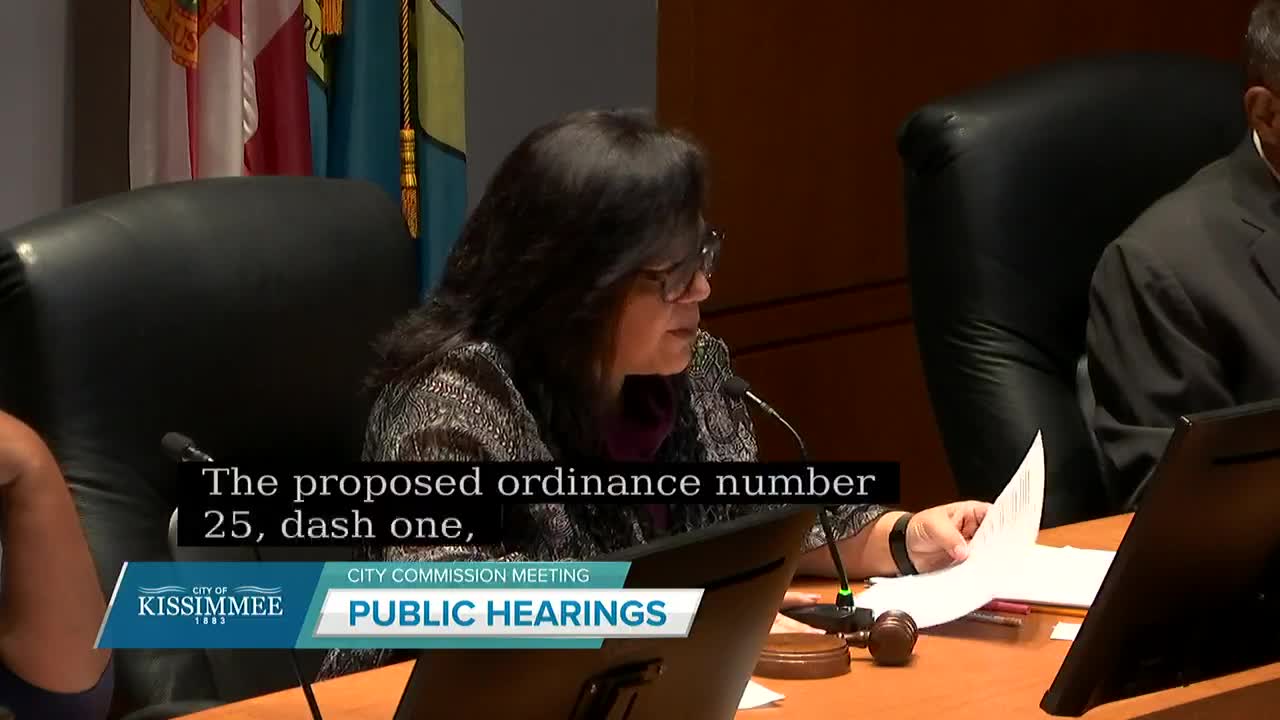
KISSIMMEE, Fla. — The Kissimmee City Commission on Feb. 4 adopted an ordinance to authorize state and national criminal history checks for certain city positions, approved amendments to commercial property improvement programs for two Community Redevelopment Agency (CRA) districts and confirmed two advisory‑board appointments.
The ordinance (Ordinance No. 3113) — presented to the commission as the second and final reading — directs city human resources to obtain criminal history screenings for positions specified in the city code and adds city commissioners to the list of roles subject to the checks. A staff presenter told the commission the ordinance implements authority granted by Florida Statute 166.0442 and will allow HR to use its own agency ID instead of a third party or the police department for checks.
Why it matters: The ordinance formalizes background‑screening authority and creates an administrative pathway for HR to run checks directly. The CRA grant changes increase potential awards and reduce matching requirements for longstanding downtown property owners and businesses, a move staff said is intended to spur reinvestment in the downtown and Vine Street redevelopment districts.
Votes at a glance: Ordinance No. 3113 — Background checks for certain city positions: Motion to approve by Commissioner Carlos Alvarez, second by Commissioner Jeanette Martinez; roll call votes recorded as ‘Aye’ for Commissioner Alvarez, Commissioner Martinez, Commissioner Ortiz and Vice Mayor Angela Eady; outcome: adopted (final reading). Downtown CRA Commercial Property Improvement Program amendments: Motion to approve; outcome: approved; the amendments create a four‑tier grant/match schedule with maximum awards increasing to $50,000 and match percentages decreasing for longer‑tenured property owners or businesses. Vine Street CRA Commercial Property Improvement Program amendments: Motion to approve; outcome: approved (same tiered structure applied to Vine Street CRA). Appointment — University of Central Florida Business Incubator Advisory Board: Commissioner volunteered to fill the seat; motion and second approved; outcome: filled by a commissioner designee. Appointment — Board of Adjustment: Motion by Commissioner Jeanette Martinez, second by Commissioner Carlos Alvarez; outcome: Ralph Rafael Lebron appointed. Consent agenda: Motion to approve the consent agenda passed.
Details on the CRA amendments: The commission approved a tiered grant structure that raises the maximum award and reduces required local matches the longer a property owner or business has operated in the CRA district. Under the adopted tiers, owners with 0–4 years of tenure remain eligible for up to $30,000 with a 50% match; owners with 20+ years are eligible for up to $50,000 with no local match required. Staff also added limited exceptions to the five‑year waiting period for additional CRA funding where a new project would significantly enhance a property and would not replace previously funded improvements.
Staff and next steps: City staff said the CRA policy changes aim to reward long‑term investment in the districts and to accelerate facade, landscaping and other exterior improvement projects. The downtown branding strategy presented at the meeting was tabled for further work and community review; staff will return with additional options.
The commission conducted votes by motion and roll call where noted. Several approvals passed unanimously; where individual roll call tallies were not read into the record the record shows the motions passed and were entered as carried.