Get Full Government Meeting Transcripts, Videos, & Alerts Forever!
Get email alerts on the Transportation Advisory Committee topic
No spam. Unsubscribe anytime.
Committee advances nominees for Metro transportation advisory panel after hour-long interviews
Summary
The Rules, Confirmations & Public Elections Committee interviewed candidates for five vacancies on the Advisory Committee on Transportation and voted to advance nominees to the full council for final action. Nominees emphasized equity, safety on high‑fatality corridors and better service frequency and amenities for riders.
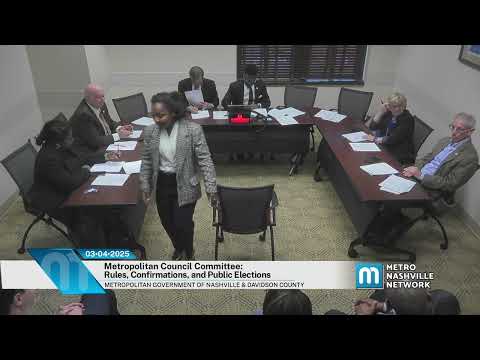
The Rules, Confirmations & Public Elections Committee on March 4 interviewed and voted to advance multiple nominees for five vacancies on the Advisory Committee on Transportation, sending each name to the full Metro Council for a final vote on March 18.
The advisory committee positions are meant to help guide implementation of the city’s Choose How You Move transportation improvement plan, a voter‑approved, multi‑year program to expand transit service, add sidewalks and make other right‑of‑way changes. Committee members interviewed nominees in a series of back‑to‑back presentations and recorded votes to forward each candidate to the council.
Kaylin Russell, advocacy manager at the Equity Alliance, told the committee she brought communications and community engagement experience tied to housing and transit equity. "I believe the transportation plan does have a great foundation to making Nashville more equitable and a more accessible city," Russell said, urging that implementation maintain broad community voice so "development doesn't happen to us and not with us." The committee voted 6–0 to advance Russell.
Trent Bench, a small‑media business owner and community advocate who cited Nolensville Pike as a priority, told members his nomination was driven by his experience growing up in an underserved corridor and his concern for youth riders. "This is a decade and a half long commitment to fighting for the vital life‑saving infrastructure that my community has desperately needed," Bench said. The committee advanced Bench by voice vote, recorded as 7 in favor.
Dr. Claudio Masa, a Vanderbilt University professor and organizer with the Tennessee Immigrant and Refugee Rights Coalition, emphasized health and air‑quality links to transportation policy. "Cities that walk more are healthier," Masa said, adding that some parts of the city have borne disproportionate pollution burdens. The committee advanced Masa (7–0).
Wesley Smith, advocacy manager at Walk Bike Nashville and a member of technical advisory groups for the Choose How You Move program, described the transit rollout as the city’s largest upcoming capital project and framed it as a public‑space and safety effort: "If we can cut in half, for example, the amount of fatalities on our pikes through this process, hopefully more, then that is gonna make a significant impact." The committee advanced Smith (7–0).
Other nominees who spoke and were advanced to the council included Matt Ingram (nominated by Councilmember Rutherford), Isaac Swofford (nominated by Chair Porterfield) and Dr. Randberg (nominated by Councilmember Coopin). Nominees raised a mix of implementation priorities: testing route and timing choices, improving paratransit and bus‑stop amenities, and ensuring community engagement in early project phases. Several nominees pressed for clearer timelines and communication about when specific corridor work will take place.
Dr. Randberg, who described himself as a longtime transit rider after losing the ability to drive, highlighted minor, practical improvements that matter to frequent users: better on‑time performance, functioning automated stop announcements and benches or shelters at stops. "Plopping down a bench...those are the kinds of things that in the scheme of this billion‑plus project aren't gonna cost a lot of money, but they're gonna make dramatic improvements to people who are on the system every day," he said.
Committee members repeatedly framed the advisory committee role as a mix of technical oversight and community accountability, saying the panel should hold the mayor’s office and implementing staff to the commitments made during the referendum and subsequent planning. Several council members asked nominees how they would balance neighborhood preferences with systemwide priorities and whether they would rely on objective metrics or the mayor’s plan to set priorities.
Each nominee’s committee approval was recorded as an advancement (the committee does not enact final appointments; the council will vote on the nominees on March 18). Discussion points from the interviews included equity in corridor prioritization, safety on high‑fatality pikes, the need for frequent crosstown routes, bench and shelter placement and additional outreach to historically underserved neighborhoods.
The committee concluded the panel‑by‑panel interviews and recorded votes to move the candidates forward to the council for final confirmation.