Get Full Government Meeting Transcripts, Videos, & Alerts Forever!
Get email alerts on the School Safety.alert Systems topic
No spam. Unsubscribe anytime.
Committee hears Alyssa’s Law bill to require emergency alert systems in schools
Summary
Engrossed Substitute Senate Bill 5004 (Alyssa’s Law) would require school districts, charter schools and state tribal education compact schools to develop emergency response systems — including panic/alert buttons — and report implementation progress to OSPI by Oct. 1, 2025.
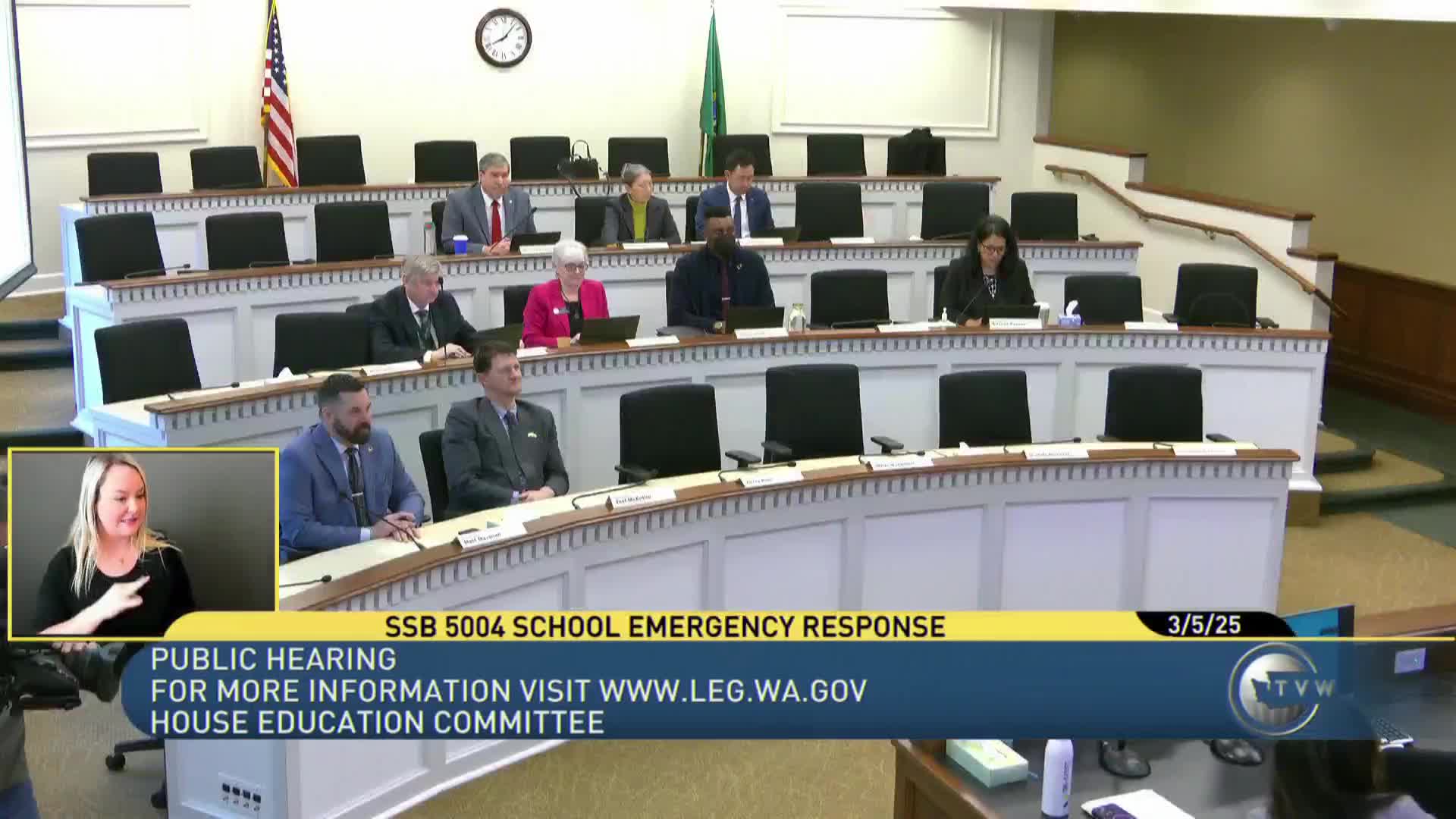
The House Education Committee held a public hearing on Engrossed Substitute Senate Bill 5004, a measure that would require school districts, charter schools and state tribal education compact schools (STECs) to develop emergency response systems that can expedite law enforcement response when there is a threat or emergency at a school.
Damian Morton Snipper of the Office of Program Research summarized the bill’s core requirements, saying systems must be developed in collaboration with local law enforcement, public safety answering points, and school safety staff. The bill lists several components school systems may implement, such as panic or alert buttons that notify school administration and emergency responders, live video or audio feeds accessible to law enforcement and school staff, remote-control door access, or live interactive two-way communications. The staff briefing noted the short title in the bill would allow it to be cited as “Alyssa’s Law.”
Sen. Nikki Torres, the prime sponsor, said the bill is intended to improve response times without imposing an unfunded mandate. Torres described an interim outreach to districts: her office contacted all 295 school districts and received responses from roughly 195. Of those respondents, she said all reported exterior doors that lock; 42 districts lacked key-card access; 107 reported some form of panic or lockdown buttons (some outdated or partially implemented). She told the committee districts must report progress on implementing emergency response systems to the Office of the Superintendent of Public Instruction (OSPI) by Oct. 1, 2025, and OSPI must report to the Legislature by Dec. 1, 2025 on the types of systems districts are using.
Lori Elhaldeff, founder of Make Our Schools Safe and mother of Alyssa Elhaldeff, gave emotional testimony about her daughter’s death in the Feb. 14, 2018 Parkland shooting and urged passage, saying the bill’s principle is simple: “Time equals life.” She testified the systems Alyssa’s Law promotes — panic alert technology linked directly to law enforcement — can reduce response time during an emergency.
Students, school-coalition representatives and local educators testified in support. Student witnesses referenced national and state examples and studies they said show reduced response times and improved outcomes where panic-button systems were in use. Grace Yuan of the Puget Sound School Coalition requested a friendly amendment to recognize existing systems approved by the State Building Code Council; the committee invited her to submit proposed language.
Testimony included questions about whether the bill imposes an unfunded mandate. The sponsor and staff emphasized the measure requires districts to report and consider implementing technologies but does not, in the testimony, appropriate funds for statewide installation. A fiscal note exists, and staff said they could provide more detail separately.
Public sign-in tallies recorded 55 pro, 1 con, and 2 other for the bill. The public hearing concluded and the committee moved to work-session items.