Get Full Government Meeting Transcripts, Videos, & Alerts Forever!
Get email alerts on the Strategic Goals topic
No spam. Unsubscribe anytime.
Collegedale City commission narrows strategic priorities; staff to draft objectives
Summary
At a city workshop, commissioners and participants identified and combined proposals into five strategic goals — including a multimedia communications plan, economic development recruitment, city branding, diversified recreational amenities and expanded greenways — and asked staff to draft measurable objectives for implementation.
The Collegedale City Commission spent a workshop session shaping and prioritizing strategic goals and asked staff to prepare objectives that will guide implementation and any future strategic-plan vendor work.
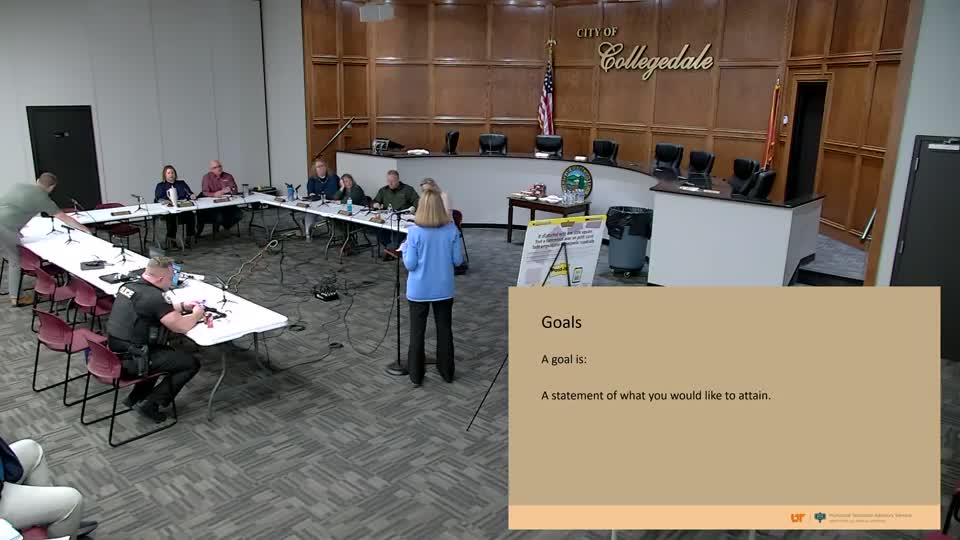
The session's facilitator, a city staff member, said, "A goal is a statement of something you would like to attain," and urged commissioners to write goals that tie to the city's vision, focus on outcomes rather than methods, and be time‑bounded and measurable.
Commissioners and participants offered a range of proposals during the session, then combined similar suggestions and agreed to narrow the list to five priorities. The consolidated items were: create a multimedia communications plan and strengthen city branding; expand economic-development recruitment to attract businesses and restaurants; diversify recreational amenities (citizens suggested items ranging from a putt-putt attraction to expanded greenway connections); develop and enhance biking and hiking trails; and advance The Commons as a mixed-use city center (phase 4), including concepts such as a library with a café and retail space.
The facilitator recommended writing goals to be achievable within a three- to five-year window and using SMART criteria (specific, measurable, aggressive but attainable, results oriented, time bound). She described the next step this way: "staff would work on objectives and then bring those back to you to consider the steps along the way." Participants also discussed using a voting method with five dots per commissioner to rank the priorities at the end of the session.
Commissioners discussed how some goals are large, may move at different speeds, and will be constrained by staff capacity and funding. The facilitator noted that many cities that succeed with goals schedule quarterly check-ins to review progress and suggested assigning a commissioner to champion each goal to streamline staff communication and updates.
The commission also discussed using the goals to inform a paid vendor who would develop a formal strategic plan. Commissioners said hiring outside help for a strategic plan is common but can be expensive; the facilitator said the work already completed would reduce vendor costs by supplying initial direction and community input.
No formal votes or ordinance actions were recorded during the workshop. The commission directed staff to draft objectives tied to the five prioritized goals, to return those objectives for commission review, and to consider community feedback as part of any strategic-plan vendor process.
Next steps noted at the meeting include staff drafting measurable objectives for each of the five goals, reporting back to the commission (the facilitator recommended quarterly updates), and determining whether to engage a vendor to translate the goals into a multi-year strategic plan and implementation steps.