Get Full Government Meeting Transcripts, Videos, & Alerts Forever!
Get email alerts on the Public Safety Fire Accreditation topic
No spam. Unsubscribe anytime.
Cape Coral Fire Department reports compliance, outlines gaps ahead of 2029 reaccreditation
Summary
Acting Fire Chief Mike Russell told the City Council the department remains in compliance with the 250 core competencies required for accreditation but identified service gaps — especially in data capacity and response-time benchmarks — and outlined a strategic plan aimed at addressing them before reaccreditation in 2029.
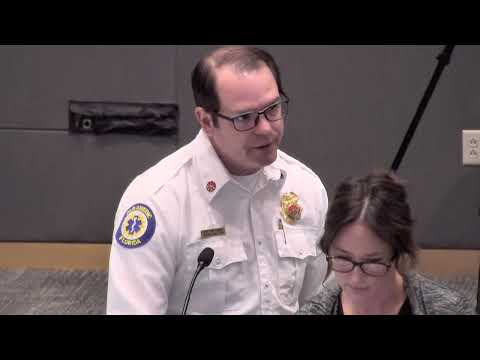
Acting Fire Chief Mike Russell told the Cape Coral City Council on Feb. 26 that the fire department remains in compliance with the 250 core competencies required by the Commission for Fire Accreditation International and is moving to implement peer-team recommendations received after its initial accreditation.
The update, given during the Committee of the Whole meeting, summarized accreditation work dating to 2021, the peer-team visit in December 2023 and the department’s subsequent action plan. “We remain in compliance with the 250 core competencies as required by the accrediting body,” Russell said.
Russell and Accreditation Manager Kirsten Lynch described accreditation as an ongoing business practice rather than a one-time project. Russell said the department has implemented 11 of 16 peer-team recommendations and rejected one after review by a consultant. He said staff had submitted an annual compliance report — a reaccreditation requirement — and would next complete a community-driven strategic plan and update the Community Risk Assessment and Standards of Cover.
The chief identified data capacity as a key remaining gap. He said the department has no dedicated data analyst or staff trained to extract and manage operational data. “Data is an area that we struggle in. We do not have any persons dedicated to data,” Russell said, and added that improved record systems and staffing would inform decision‑making.
Council members pressed on operational items raised in the report. Councilmember Bill Steinke asked whether improved training facilities and hydrant maintenance could move the city’s ISO public‑safety rating; Russell said an ISO review had not yet been scheduled but the department recently asked the city auditor for a mock review to identify points that might be gained. Councilmember Killring asked about dispatch times and staffing; Russell said some delay components are controllable and that retaining dispatch staff and completing the new CAD implementation (Hexagon) would help.
Russell also highlighted specific response-time benchmarks and station workload data in the annual compliance report. He said Station 2 remains the busiest and Station 13 had reduced load on Station 5. He said monthly program appraisals, quarterly reviews and continual evaluation are part of the department’s ongoing compliance cycle.
Next steps Russell listed included finishing the community strategic plan, updating the Community Risk Assessment and Standards of Cover to reflect vertical growth and evolving commercial activity, continuing succession planning for accreditation leadership, and preparing for reaccreditation in 2029.
The council thanked Russell and staff for the accreditation work and asked for follow-up on the ISO mock review and the data-staffing plan. Russell said he would discuss budget items from his action plan with the City Manager for possible inclusion in future budgets and that assigned program managers were responsible for implementing each recommendation.