Get Full Government Meeting Transcripts, Videos, & Alerts Forever!
Get email alerts on the Streets Paving topic
No spam. Unsubscribe anytime.
City staff present street-scan results and pavement-condition inventory; next steps include preservation strategy and budgeting
Summary
City staff reviewed a recent street-scan inventory, explained pavement-condition index (PCI) ratings across Collegedale streets and recommended refining preservation choices (mill-and-pave vs. preservation treatments) against available budgets.
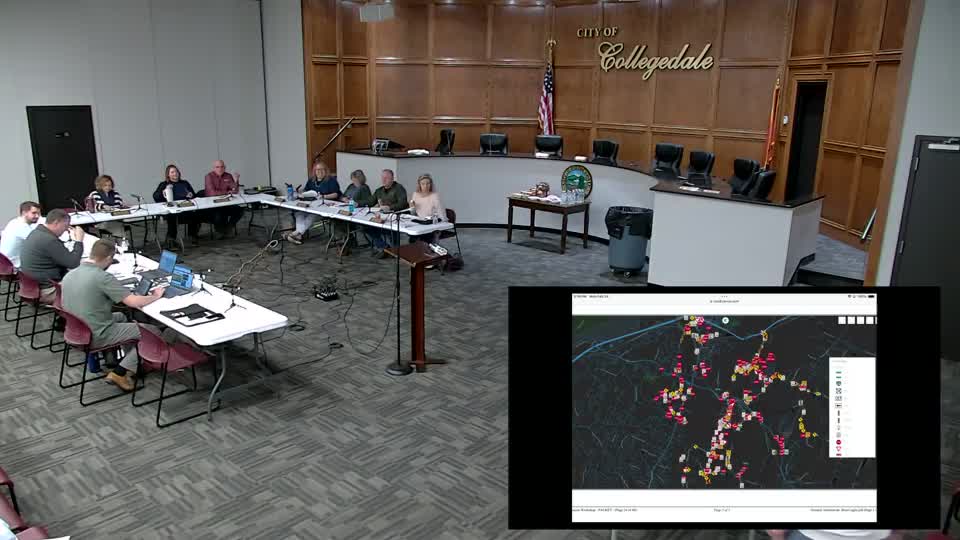
City public‑works staff presented results from a recent automated street scan that produced a pavement-condition index (PCI) map and an inventory of about 1,200 regulatory and warning signs across Collegedale.
The scan assigns PCI scores by segment and factors in pavement distress (alligator cracking, rutting, transverse cracking) and street function (arterial, collector, local). Staff said the data can be paired with budget scenarios to produce a prioritized list of streets for maintenance or resurfacing in coming budget cycles. A full Excel export of the scan attributes—including length, square yards and condition scores—was available for review.
Why it matters: Staff said arterial streets deteriorate faster because of traffic volume and need a different treatment cadence than local roads. The presentation recommended considering preservation options such as sealcoating, micro‑surfacing or mill-and-pave and developing a decision tree that matches road-fixing techniques to condition, priority and budget. Staff said last year’s paving program did not exhaust the budget for the current fiscal year and that June–July is a standard season for contracting paving work to reduce mobilization costs.
Next steps and common questions: Commissioners asked about curb rebuilds when a reconstruction is needed (staff said curb replacement should be included when the road structure and drainage are rebuilt), the review frequency (contract for a three-year scanning cycle was discussed), and how to deliver the scan data (staff offered a view-only Excel export of attribute tables). Staff said they will continue to refine the program to generate lists tied to specific budget amounts and recommended a combination of preservation and reconstruction depending on each segment’s condition and role in the network.