Get Full Government Meeting Transcripts, Videos, & Alerts Forever!
Get email alerts on the Strategic Planning topic
No spam. Unsubscribe anytime.
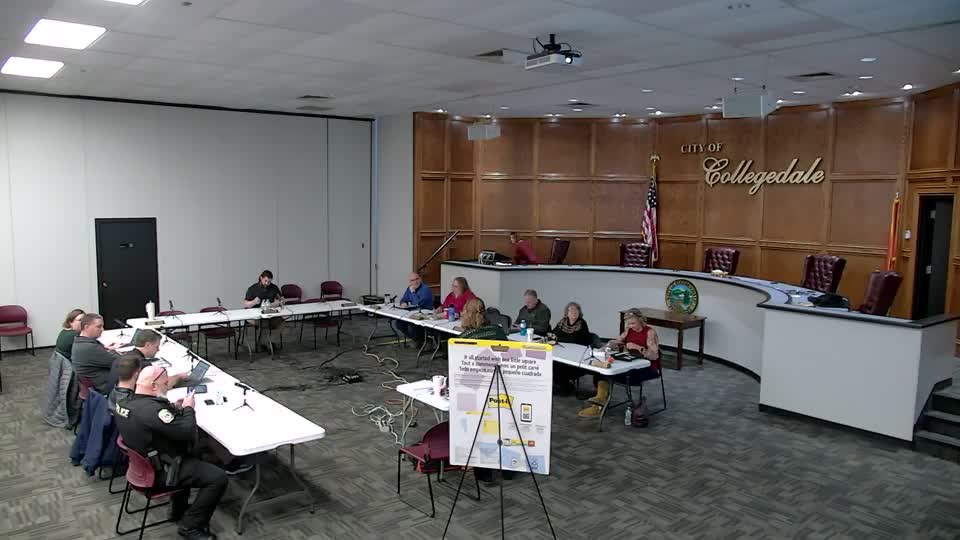
Collegedale commissioners, staff draft mission and vision at strategic planning workshop
Summary
Collegedale commissioners and city staff spent a workshop session drafting a mission statement and a forward-looking vision, reviewed local demographic data, and completed a SWOT exercise to guide upcoming budget and goal-setting work. The commission set a follow-up session for Feb. 24 to finalize goals.
Collegedale commissioners and city staff met in a workshop led by Hana Rogers of the Municipal Technical Advisory Service to draft a mission statement and a vision and to begin a SWOT (strengths, weaknesses, opportunities, threats) analysis that will inform the city’s budget and goals for the coming year.
Rogers told the group the planning work is intended to “communicate priorities” to staff and to make commission direction clearer as the city enters budget season. She led participants through examples and then had commissioners and trustees suggest wording, refine phrases and combine ideas into a single working mission and a draft vision.
During the workshop the group reviewed Census-based figures used to inform planning: a 2023 population estimate of 11,476 for Collegedale, a homeownership rate read as 43.5 percent, about 17 percent of residents age 65 or older, and educational attainment with roughly 40.7 percent holding bachelor’s degrees or higher. Rogers and participants discussed how local college enrollment, rental housing and retiree populations affect those statistics and planning priorities.
Commissioners and participants drafted the following working mission during the workshop (presented to the group as a single draft): “Collegedale is the community of choice that offers the highest quality of life for our citizens. The city provides a safe environment, healthy public spaces, and collaboration. We are innovative, attractive to businesses, financially responsible, and encourage sustainable growth.” The text was developed line-by-line from multiple participants’ suggestions and read back to the group for final wording.
For the vision statement the commission produced a working draft that the group read aloud and refined: “The vision of Collegedale is to provide the greatest quality of life to residents by offering a desirable community with safe neighborhoods, a thriving city center, desired amenities, economic growth, carefully planned development and through excellent services.” Participants discussed adding specific references to parks, greenways, the airport and partnerships with local institutions but chose a shorter statement that could be expanded later.
Workshop participants used the SWOT exercise to surface recurring opportunities and threats. Frequently cited opportunities included greenway and trail expansion, partnerships with Southern (the local college) and McKee (local business support cited during the session), underutilized airport assets, grant funding, volunteer capacity among retirees, and potential new retail and restaurants that could capture local spending. Threats raised by multiple speakers included the risk of staff turnover and competing governments recruiting city employees, severe weather events and other emergency-response costs, the prospect of state policy changes that could reduce local revenue (sales- and property-tax actions were mentioned), lagging infrastructure if growth accelerates, and periodic criminal incidents that affect public perception.
Commissioners also discussed internal strengths and weaknesses. Strengths cited included a professional public safety presence, active parks and recreation programming (Little Debbie Park and Veterans Park were mentioned), the municipal airport, strong community partnerships and an engaged staff. Weaknesses highlighted were the need for improved communications and an easier-to-use city website, limited in-house grant-writing capacity, and the small size of the city relative to the scale of some proposed public–private investments.
Tim (participant) shared an early draft during the session: “to enhance the quality of life of our citizens and to be a community of choice. We will provide professional quality public service and safety management resources, financial responsibility, focused on economic growth, offering a healthy active, activities in our community.” Rogers repeatedly emphasized that the purpose of the workshop is to give staff clear policy priorities to use when preparing the draft budget: “It communicates priorities,” she said.
At the end of the session the commission agreed to continue goal-setting at a follow-up workshop. Staff and commissioners agreed to reschedule remaining goal work and related budget discussion for Feb. 24, with a proposed 6 p.m. continuation to allow public attendance and to provide staff time to prepare a written report of today’s outcomes.
The workshop was conducted as a planning session; no binding votes or ordinance actions were taken. Staff will prepare a written report summarizing the drafted mission and vision, the SWOT findings, and proposed topics for the Feb. 24 meeting so commissioners can prioritize goals and direct capital investments ahead of the March budget presentation.