Get Full Government Meeting Transcripts, Videos, & Alerts Forever!
Get email alerts on the Airport Development topic
No spam. Unsubscribe anytime.
Developer Jay Jolly seeks city’s $500,000 contribution for Collegedale airport hangars; TDOT grant, private investment outlined
Summary
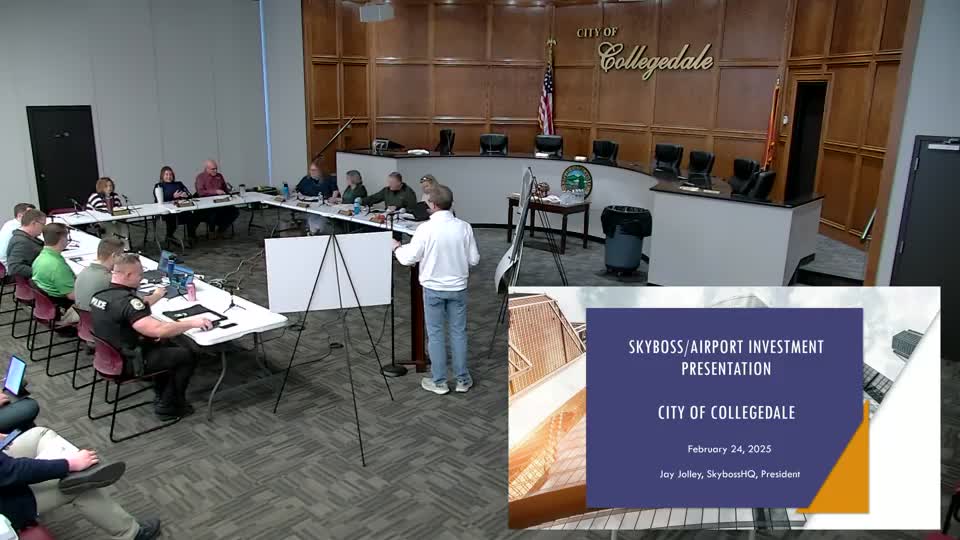
At a Collegedale City workshop, Jay Jolly presented detailed plans and financials for two private hangars and associated site work at Collegedale Airport, asking the city to contribute an estimated $500,000 to match TDOT and private investment. No vote was taken at the workshop.
Jay Jolly, president of Sky Boss HQ, urged Collegedale commissioners at a workshop to approve about $500,000 in city site-work funding to enable two private hangars and related improvements at Collegedale Airport.
Jolly said the project pairs a Tennessee Department of Transportation (TDOT) economic-development grant, a private investment from Sky Boss, and an expected city contribution. "The grant is for $1,285,000, of which 90% comes from TDOT and 10% has to come from the city or the airport operations," Jolly said, summarizing terms in the April 16 business letter he submitted to staff. He framed the central question for the commission: "Should the city invest a half a million dollars in the airport for the construction of this project?"
Why it matters: Jolly said the two hangars would increase hangar rental and fuel sales—key revenue streams for the airport’s enterprise fund—and create local jobs and an estimated multi-year economic impact. He said TDOT has agreed to fund an airport layout plan and that the grant must be used for economic development that brings private investment.
What was proposed and who would pay: Jolly described two Sky Boss entities: SkyBoss MX, a 3,600-square-foot maintenance hangar focused on experimental aircraft, and SkyBoss HQ, a roughly 10,560-square-foot management hangar that would house 7–10 aircraft and provide a members’ lounge and concierge services. Jolly put SkyBoss’s private investment at $3,662,000 (about $2.6 million in construction plus start-up costs) and described additional TDOT and city funding that together he said would push total investment “to $5.3 plus million.” He said the TDOT grant approved in July 2023 carries a five-year shelf life and requires the project demonstrate economic development benefits.
Details, timelines and commitments: Jolly said the project includes site work the city would perform—excavate and certify a building pad—and estimated the city’s contribution at about $500,000. He presented a range of cost probabilities for the city portion: a 25% chance the cost would be $400,000 or less, a 50% chance at $500,000 or less, a 75% chance at $600,000 or less, and a cap of about $700,000 in his view. He said pre-engineered metal buildings were priced and being held until March 7 at the quoted price; missing that window could raise building costs by 15–20%.
Jolly said SkyBoss MX’s total investment would be $1,160,500 (about $760,000 construction and $400,000 for two-to-three years of startup costs), with a projected three-year economic impact about $2.2 million. He said SkyBoss HQ’s private investment would be about $2.5 million with a three-year economic impact around $2.33 million.
TDOT role and requirements: Jolly described TDOT as a key financial and planning partner: TDOT agreed to invest about $350,000 for a new airport layout plan (ALP) and to contribute the grant’s 90% share toward the proposed site work. He said the ALP will identify projects for the next eight years and that typical TDOT participation on those projects would be 90–95% with a city or airport 5–10% match.
Revenue and operations context: Jolly said Collegedale Airport is operated as an enterprise fund and must be self-sustaining. He provided operating figures: a current operating budget he described at about $850,000, about 73 hangars and 18 tie-downs, roughly 103 aircraft based at the airport, and a long hangar wait list (64 people). He said the airport recorded roughly 13,500 aircraft operations over 12 months and that increasing transient traffic would raise hangar rent and fuel sales.
Supporters and local operators: Taylor Newman, who operates flight training and charter services, said returning maintenance and flight‑school businesses to Collegedale had boosted activity and that some charter and maintenance operations could locate at Collegedale if hangar space becomes available. Newman described a fleet that operates regionally and said jets and turboprops use significantly more fuel than piston aircraft, increasing airport fuel revenue if larger aircraft basemake Collegedale a base for charter operations.
Next steps and outstanding items: Jolly said he had received civil drawings from Garver (the engineer), was reviewing contractor budgets, and planned to start site work around June 2 with a pad turnover about Aug. 1 and building delivery in August if the timeline holds. He asked staff to confirm whether the current drawing set is sufficient for bidding to avoid further delays. No formal commission vote occurred during the workshop; Jolly asked commissioners to consider the half‑million contribution in advance of a future decision.
Caveats and open questions: Commissioners and staff raised procedural and financial questions about bidding, permitting, and whether the city should lend or bond the funds (the airport enterprise fund can take loans, Jolly said, but debt service would crowd out other maintenance). Commissioners also asked for clarifications about project contingencies, the TDOT audit and performance requirements, and how the city’s investment would be protected under the negotiated 40‑year ground lease that Jolly said had been approved earlier.
Outcome: This workshop was informational; commissioners asked to receive updates. Jolly asked to be kept apprised of the March 7 pricing deadline and to meet with city staff to determine whether existing drawings could be used to proceed to bidding.
Ending: Commissioners did not take a vote at the workshop. Staff and the developer agreed to continue coordinating on final drawings, procurement timing and grant conditions so the commission could consider formal action at a later meeting.