Get Full Government Meeting Transcripts, Videos, & Alerts Forever!
Get email alerts on the Beach Recreation Reef Safety topic
No spam. Unsubscribe anytime.
CRA debates marking and buoying artificial reefs; staff to return with options on safety, exclusions and equipment
Summary
The CRA discussed a proposed deployment of 48 artificial reef modules, scheduled for late March weather permitting, and debated whether to mark the reefs with buoys, install vessel‑exclusion buoys, or add tie‑up points; staff was asked to return with options and testing plans.
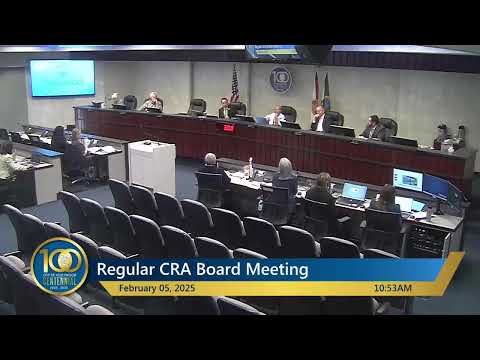
Hollywood City — Members of the Community Redevelopment Agency on Feb. 5 held an extended discussion about planned artificial‑reef modules off Hollywood Beach and whether the city should mark or buoy them for safety and tourism.
The board heard a deployment update from the CRA and beach‑safety staff: "We have the 48 modules... we actually have a barge on schedule, sometime towards the last week in March weather permitting," Susan Goldberg told the board while introducing beach safety staff. Joyce Furman, chief of Marine Beach Safety, told the board cameras and cabling will be deployed ahead of the modules and that modules sit about 600 feet offshore in roughly 8 to 10 feet of water, satisfying the minimum coverage requirement she cited.
Why it matters: the reef modules are intended to create new nearshore habitat and a tourism draw, but they also introduce navigational and swimmer‑safety questions — how and whether to mark them affects boaters, snorkelers and lifeguard response.
Chief Furman warned of safety tradeoffs. "People will want to get to the reef. We're going to be advertising it. There's going to be a 24 hour camera showing it," she said, and added that some swimmers might not bring flotation devices or dive flags. Furman said the city has discussed vessel‑exclusion buoys and marker buoys but cautioned that marker buoys can create a "false sense of security" for inexperienced swimmers and could attract vessels closer to the structures.
Furman summarized operational concerns: the reef modules include a metal ring for placement; temporary buoys and workout buoys used previously have lasted only a few months and can be washed ashore. She said the lifeguard service currently operates two jet skis positioned near Hollywood Boulevard for rapid response and that additional craft or storage would be needed if lifeguards were expected to cover multiple, marked reef sites.
Board members were split. Board Member Gruber, who routinely swims and snorkels off the shore, said marking the reefs would help both snorkelers and boaters find and avoid the structures, reducing the risk of drift and unexpected boat strikes. "For it to be marked... so the people that are going there know exactly where it is," Gruber said.
Vice Chair Quintana and Board Member Schuham expressed concern that visible buoys could entice inexperienced swimmers and create more rescues. Quintana said the city should treat the artificial reefs "just like our natural reef" and rely on experienced snorkelers, while Schuham warned of ongoing maintenance requirements and displacement of buoys in rough conditions.
Several board members asked staff to return with options rather than take immediate action. Board Member Biederman and others suggested exploring hardware that could clip to the reef modules' lift rings rather than anchor separate exclusion buoys that disturb the seabed; Biederman also urged upgrades to lifeguard response equipment and suggested planning storage locations for watercraft tied to reef response (he cited Keating Park as a possible site for additional storage).
The board requested a staff report with alternatives, including types of marker buoys, vessel exclusion buoys, anchoring/tie‑up hardware for the modules, expected maintenance schedules and equipment needs for lifeguards. Chief Furman offered to test options and provide video evidence for the board to review.
No formal vote was taken. The board gave staff direction to research buoy types, maintenance implications, vessel‑exclusion options and lifeguard equipment needs and to return with recommendations and demonstrations.
Details presented at the meeting: 48 reef modules planned; first camera cabling to be installed from the beach, then water cabling; modules sited about 600 feet offshore in 8–10 feet of water; barge window scheduled for a seven‑day weather‑dependent period in late March. The board explicitly discussed the legal and operational distinction between a marker buoy for the reef itself and a separate vessel‑exclusion line used to keep boats away from the reef.
Next steps: staff will compile buoy options, maintenance expectations and required equipment for lifeguard response and return with a recommendation and pilot options for board review.