Get Full Government Meeting Transcripts, Videos, & Alerts Forever!
Get email alerts on the K12 Schools topic
No spam. Unsubscribe anytime.
Hollywood City Commission approves first reading of K‑12 performance‑standards ordinance after months of debate
Summary
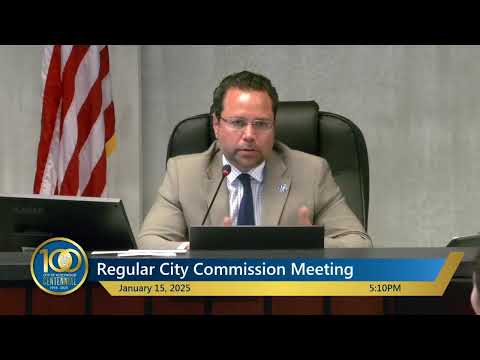
The Hollywood City Commission voted 5–2 on first reading Jan. 15 to adopt a text amendment establishing performance standards for K‑12 schools after lengthy debate over site size, traffic management and distance separations from certain adult‑oriented businesses.
The Hollywood City Commission voted 5–2 on first reading Jan. 15 to adopt a text amendment that adds performance standards for K‑12 schools, after a multihour public discussion about site size, traffic and separation from adult‑oriented uses.
The ordinance, introduced by Department of Development Services staff and presented by Andrea (Department of Development Services staff), lays out criteria for special‑exception reviews of private K‑12 schools and clarifies how a recent change in state law affects reuse of existing facilities.
Why it matters: Commissioners said the performance standards are intended to protect neighborhoods from traffic, stacking and other impacts while giving staff an objective checklist for reviewing school proposals. Opponents including Commissioner Gruber said the rules still make it hard for new private schools to open inside Hollywood and urged a separate, expedited approach for small “micro‑schools.” Proponents said the standards bring transparency about what the city expects from school operators.
Most important facts
- The ordinance is a text amendment to Articles 2 and 4 of the Zoning and Land Development Regulations addressing K‑12 schools and performance standards. Andrea said the ordinance clarifies how state law allowing reuse of certain existing facilities interacts with city code.
- Key standards discussed include minimum parcel size (staff had proposed about 1 acre for standalone K‑12 sites), whether schools must be in freestanding buildings, traffic and pick‑up/drop‑off operations to be kept on site “as demonstrated by the school operations plan,” and a 1,000‑foot separation from pre‑existing bars, lounges, gun shops, smoke shops and adult‑entertainment establishments.
- During debate, commissioners softened the separation language from a categorical “shall not be within 1,000 linear feet” to a discretionary “may not be within 1,000 linear feet.” An earlier amendment to relax the draft requirement that schools be in freestanding/standalone buildings was briefly approved, then the maker rescinded that amendment before the final vote, leaving the freestanding language unchanged for now.
- The ordinance passed first reading on a 5–2 roll call: Commissioners Clary, Biederman, Schuham, Vice Mayor Quintana and Commissioner Hernandez voted yes; Commissioner Gruber and Mayor Josh Levy voted no.
What commissioners said
Andrea, Department of Development Services staff, summarized the purpose: “The state statute says that you cannot be within a mixed use structure. But the state statute would allow for someone to go within a horizontal mix of uses, like a strip mall, but not a residential‑commercial structure under the state law.”
Commissioner Gruber, one of the two no votes, said: “I am not fine with any of this... I am not going to support it,” arguing the rules would constrain neighborhood and faith‑based schools and that the commission should carve out micro‑schools to be permitted by right.
Commissioner Hernandez, citing state law on residency restrictions for convicted sex offenders, answered a student‑ambassador’s question by reading the relevant statute and noting that “pursuant to Florida Statutes, 775.215... a person does not violate the subsection... if he or she is living in a residence that meets the requirements... and a school ... is subsequently established within 1,000 feet of their residence.”
Process and next steps
- This vote was the ordinance’s first reading. Staff and legal will return the item for a second reading and final adoption, with the text on the 1,000‑foot separation using the modified “may not” phrasing that the commission approved.
- Commissioners asked staff to return with additional options on the freestanding‑building requirement and to draft a separate, expedited approach to define and permit micro‑schools by right in limited circumstances; several commissioners signaled support for staff to research micro‑school definitions and a possible standalone ordinance.
Context and background
The commission began reviewing K‑12 performance standards after a Planning and Development Board review in March and subsequent state law changes that clarified where schools may be placed without local regulatory limits. The city sought external counsel to confirm the proposed language complies with state and federal law before bringing the item back.
Ending
Commissioners split over the balance between protecting neighborhoods from traffic and other impacts and preserving opportunities for new and religious private schools. The ordinance moved forward with a revision that makes the 1,000‑foot separation discretionary, and staff will bring clarifying language and options for the freestanding‑building requirement and the micro‑school issue at second reading.