Get Full Government Meeting Transcripts, Videos, & Alerts Forever!
Get email alerts on the Recycling Education topic
No spam. Unsubscribe anytime.
Commission presses staff on recycling contamination, compost outreach and landscaper enforcement
Summary
Commissioners recommended beefing up resident education, reopening the composting pilot’s outreach, and exploring yard-waste carts while urging more enforcement against landscapers who blow clippings into streets and drains.
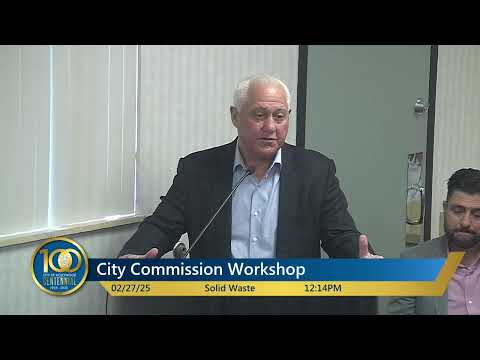
At the Feb. 27 workshop commissioners emphasized education, enforcement and clearer customer sign-up for composting and recycling programs.
Commissioner Quintana framed the session as an opportunity to bring residents ‘‘along with us’’ and pointed to the city’s $19 million solid-waste bill as a countywide and household-level issue. Commissioner Schuham and others urged staff to push composting and to use schools and youth ambassadors as channels for public education.
Staff noted recycling contamination remains a problem: Joseph Kroll said the city collected about 6,140 tons of recyclables in FY24 but that contamination reduces the tonnage ultimately processed. To address that, staff distributed bilingual door-hangers explaining what can and cannot be recycled and a new courtesy-notice program to inform residents when contamination or excessive piles caused collection issues.
Commissioners pressed staff to streamline compost-pilot enrollment after several commissioners and one participant reported delays in signup and delivery of compost buckets. The compost pilot is subsidized by a city set-aside of $50,000 and a private contribution of $110,000 from Waste Pro for education; as of the workshop 17 households had signed up. Vice Mayor Quintana and Commissioner Schuham suggested school garden projects, demonstrations and in-person field trips as higher-impact outreach than mailed materials alone.
Several commissioners described landscaper behavior as a visible source of yard clippings entering drains and alleys. Commissioner Hernandez requested more aggressive enforcement and vendor outreach; staff confirmed there are existing ordinances for landscapers to haul debris, and commissioners asked staff to increase on-site enforcement, targeted education to landscaping vendors and direct notices when crews are observed leaving waste in the right-of-way.
On yard-waste collection mechanics, opinions differed. Some commissioners supported reintroducing green carts for weekly curbside yard-waste in non-alley neighborhoods; staff said carts carry procurement and replacement costs (roughly $55,000–$60,000 cited as a program total in discussion) and operational trade-offs because yard waste may include large palm fronds and other materials that do not fit easily in 95-gallon carts. Commissioners asked staff to analyze costs and operational impacts of green carts, bagging programs and weekly versus biweekly pickup and to return with recommendations.