Get Full Government Meeting Transcripts, Videos, & Alerts Forever!
Get email alerts on the Waste Pro Services topic
No spam. Unsubscribe anytime.
City staff outline Waste Pro services, budget numbers and a small composting pilot
Summary
Presenters reviewed Waste Pro’s current service levels, the city’s FY24 expenditures and revenues for solid waste, and an ongoing one‑year composting pilot that so far has had limited resident sign-up.
City staff detailed the services Waste Pro provides under the current contract and the city’s recent solid-waste revenues and expenditures during the Feb. 27 workshop.
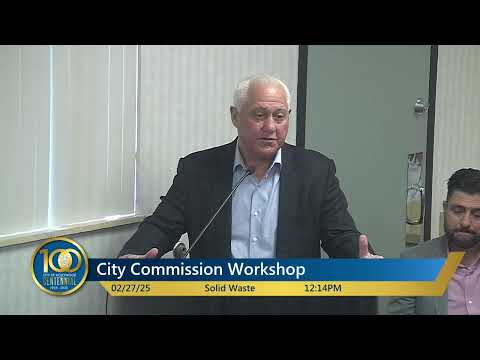
Tony Theroux, the city’s environmental services manager, told the commission the Waste Pro contract (effective Oct. 1, 2019) covers twice-weekly garbage collection for many residents, weekly recycling collection, weekly yard-waste collection and monthly bulk pickup; Waste Pro also provides illegal dump pickups, cart deliveries and containers for city-sponsored events. Theroux said the company contributes $110,000 annually to the city for education and recycling efforts and that the contract includes liquidated-damage provisions for performance problems.
Staff presented fiscal-year 2024 figures: total solid-waste expenditures of about $19.33 million and a revenue estimate tied to a $47 monthly residential fee that would produce roughly $19.55 million. Line items cited by staff included roughly $10.0 million paid to Waste Pro, approximately $3.7 million for garbage disposal, $665,000 for bulk and yard-waste disposal and about $495,000 for recycling processing; commercial franchise fees were reported at about $5.7 million for FY24 and flow to the general fund. Staff also said liquidated damages vary year to year and affected last year’s bottom line; staff produced a FY24 bottom-line figure of about $20.6 million.
Joseph Kroll (presenter listed on the agenda) said residential recycling totaled about 6,140 tons in FY24, residential garbage about 44,690 tons and residential bulk about 20,938 tons. All city-collected material is brought to a Pembroke Road transfer station (Waste Connections) and then hauled to final disposal, often to a landfill near St. Cloud, Fla.; staff noted St. Cloud’s landfill captures landfill gas and runs a generation system that produces electricity for the grid.
Staff also described a 2024 one-year composting pilot: the city set aside $50,000 to subsidize resident participation and, as of the workshop, 17 households had enrolled. Theroux said participants generated material that otherwise would have gone to landfill; staff emphasized the pilot’s administrative steps and some early signup delays; several commissioners urged staff to ‘‘reset’’ outreach so residents can more easily enroll.
Representatives of Waste Pro, Waste Connections and Waste Management were in the room; Waste Pro’s Ken Varr told commissioners his firm has added routes, worked closely with city code enforcement and upgraded staffing after earlier service issues. Waste Connections and Waste Management representatives described transfer and processing roles: Waste Connections aggregates city loads at Pembroke Road before hauling to Central Florida; Waste Management said yard waste typically has beneficial reuse and can be priced lower than other materials.