Get Full Government Meeting Transcripts, Videos, & Alerts Forever!
Get email alerts on the Dementia Research topic
No spam. Unsubscribe anytime.
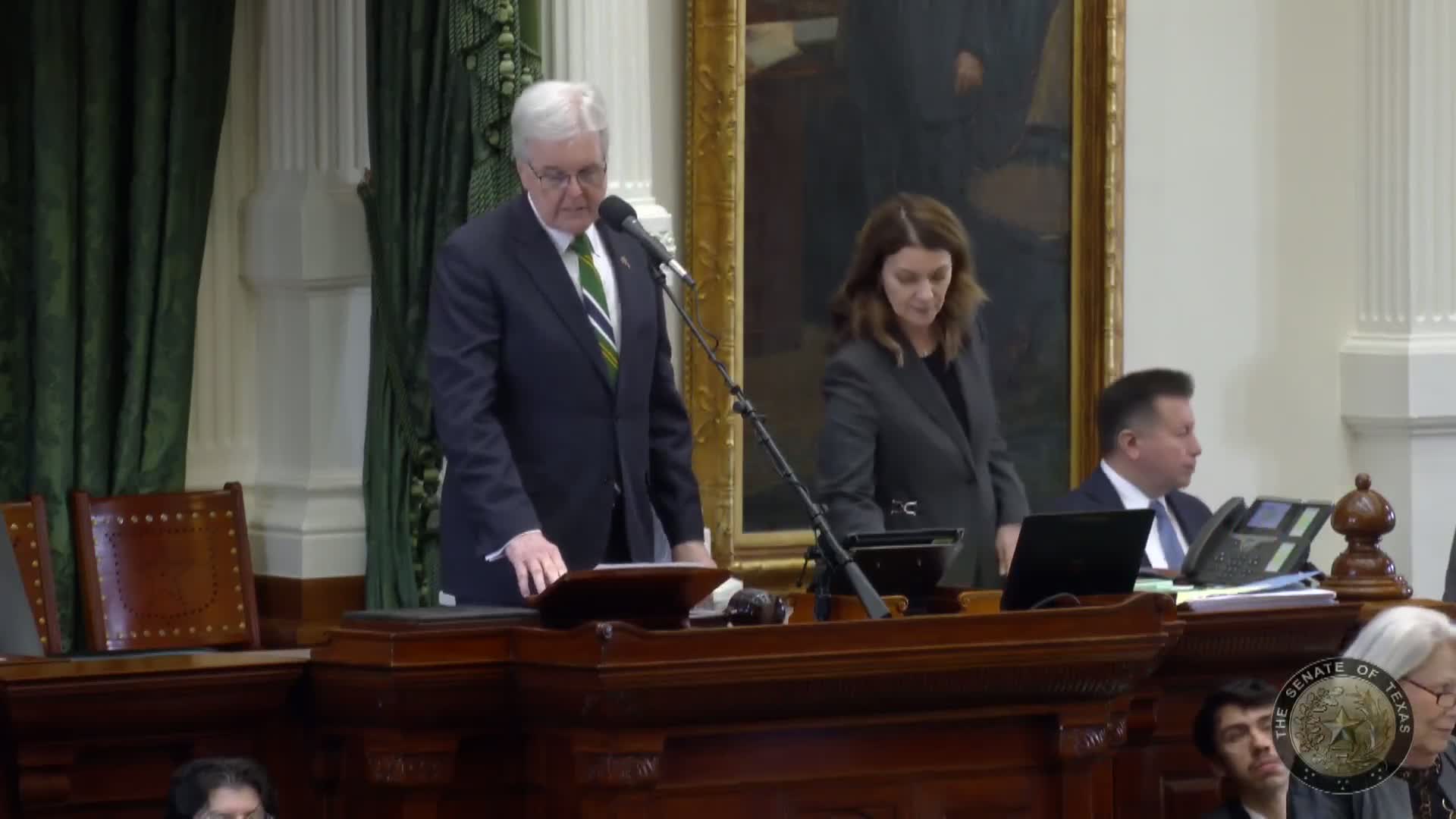
Texas Senate creates Dementia Prevention and Research Institute, sends constitutional amendment to voters
Summary
The Texas Senate on March 5 passed a bill to create the Dementia Prevention and Research Institute of Texas and approved a companion constitutional amendment to fund it with a $3 billion transfer and a $300 million annual spending limit, sending the amendment to the November ballot.
The Texas Senate on March 5 approved legislation to create the Dementia Prevention and Research Institute of Texas and passed a companion constitutional amendment that would create a dedicated Dementia Prevention and Research Fund and transfer $3 billion into it, subject to voter approval.
Senator Hoffman, author of the committee substitute for Senate Bill 5, told colleagues the institute would “accelerate research into dementia, attracting top talent to our state, and creating high quality jobs,” and that the measure was modeled on the Cancer Prevention and Research Institute of Texas (CPRIT). The bill and the companion committee substitute to SJR 3 together would establish an oversight committee, peer review and advisory panels, grant-making authority for research and facilities, and conflict-of-interest rules for awards.
Why it matters: backers said the institute aims to position Texas as a national leader in dementia research and prevention and to reduce long-term public and private costs tied to Alzheimer’s and other dementias. The legislation names statutory oversight and auditing requirements, places the institute under the Texas Sunset Act, and makes full operation contingent on voters approving the constitutional amendment that funds the program.
Key provisions and funding The committee substitute for SB 5 creates the Dementia Prevention and Research Institute of Texas (DPRIT). It establishes an oversight committee (members appointed by the governor, lieutenant governor and speaker), a peer review committee to evaluate grants, and program and higher-education advisory committees. Grants may fund research into causes, prevention, treatment and rehabilitation, development of therapies and pharmaceuticals, facilities and equipment, and prevention programs. The measure includes strict conflict-of-interest rules, requires annual reporting and independent financial audits, and makes the institute subject to sunset review (scheduled for 09/01/2035 unless extended by law).
The companion constitutional measure, committee substitute to SJR 3, places $3,000,000,000 in a new Dementia Prevention and Research Fund and limits appropriations from that fund to $300,000,000 per fiscal year (except unexpended balances carried forward). That amendment will appear on the November ballot for voter approval; the bill’s substantive provisions take effect 12/01/2025 only if voters approve the amendment.
Numbers discussed on the floor Senator Hoffman and other speakers cited state and national estimates discussed during debate: Texas Department of State Health Services data noted about 459,000 Texans diagnosed with Alzheimer’s disease; state Medicaid costs for Alzheimer’s patients were stated as nearly $4,000,000,000 in 2024. The sponsor also referenced national projections about rising dementia incidence as the U.S. population ages.
Questions and floor debate Senator Menendez and Senator Hinojosa asked whether the institute’s research scope would cover caregiving burdens and specific links such as the connection between Down syndrome and Alzheimer’s; Hoffman replied the bill intentionally keeps eligible research broad and would let panels of experts set priorities. Senator Campbell (a physician) urged investment in scientific and technological approaches to prevention and treatment. Senator Hancock delivered a personal statement about his father’s experience with dementia and said he weighed fiscal priorities in casting his vote.
Votes and next steps On a roll call for final passage of the committee substitute for SB 5, the Senate recorded 30 ayes and 1 nay; the measure passed to engrossment and final passage. The companion committee substitute to SJR 3 likewise passed on final reading by 30 ayes and 1 nay and will appear on the November ballot for voter approval. If voters approve SJR 3, appropriations from the new fund will be available under the limits and processes established in SB 5.
Ending With both measures approved by the Senate, the institute’s creation now depends on the constitutional amendment’s approval by Texas voters; if approved, the institute would be authorized to begin hiring and awarding grants under the statutory framework in SB 5.