Get Full Government Meeting Transcripts, Videos, & Alerts Forever!
Get email alerts on the Environmental Litigation topic
No spam. Unsubscribe anytime.
Texas AG office briefs Senate committee on Rio Grande settlement progress and pending environmental suits
Summary
Deputy Attorney General Austin Kinghorn updated the Senate Committee on Natural Resources on progress toward resolving Rio Grande Compact litigation and on the office—s environmental enforcement docket, saying many suits remain pending as the U.S. Department of Justice transitions to a new administration.
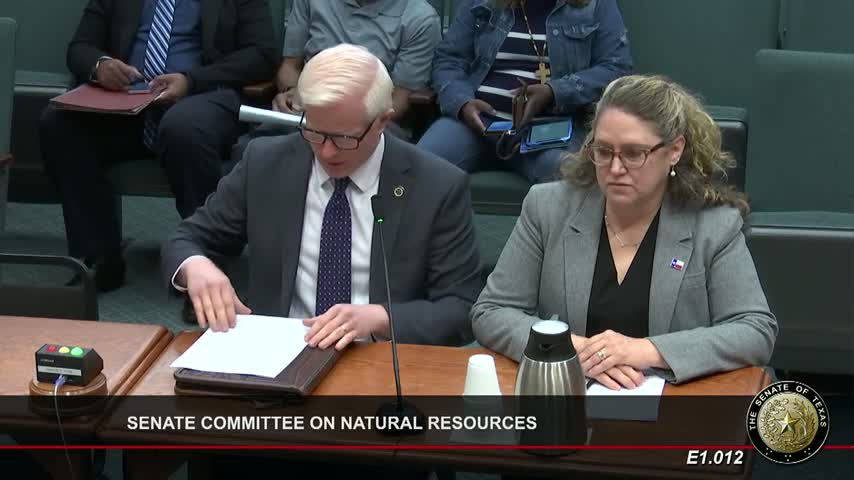
Austin Kinghorn, deputy attorney general for civil litigation in the Texas Office of the Attorney General, told the Senate Committee on Natural Resources & Economic Development on the committee—s organizational hearing day that his office has made progress toward settling long-running litigation arising under the Rio Grande Compact and is managing dozens of environmental suits challenging federal regulation.
Kinghorn said he and members of the Environmental Protection Division were in Pittsburgh last week for mediation in the Rio Grande Compact litigation, a dispute that began in 2013 when Texas sued New Mexico over upriver groundwater pumping. "Last week, we made substantial progress in Pittsburgh toward technical solutions that will allay The United States' concerns and allow the compact states to move forward and put this lawsuit to rest," Kinghorn said.
The deputy attorney general told senators that all three compact states—Texas, New Mexico and Colorado—have agreed to terms on how to share Rio Grande water, but that the United States, which is not a compact party, has been slowing a final settlement. He said the office—s goal is to reach agreed judgments that secure lasting outcomes for Texas.
Kinghorn also reviewed the OAG—s broader environmental docket. He said the office filed more than 100 lawsuits against the Biden administration overall and that 31 of those suits came from the Environmental Protection Division. "We did not sue the EPA simply because it was President Biden's EPA," Kinghorn said. "We sued because Attorney General Paxton believes that environmental regulation in Texas belongs to Texans."
Committee members asked whether litigation will remain active after the change in federal administration and whether any cases have been closed. Kinghorn said one case had settled when the DOJ dropped an appeal, while the remaining environmental cases largely remain pending. He described a preferred strategy of negotiating agreed judgments with the new federal leadership, but said that, if necessary, rulemaking reversal would follow the longer notice-and-comment administrative process.
Kinghorn said the office is reviewing its docket to identify cases that should be resolved on terms that produce lasting legal clarity rather than simply being dropped when federal leadership changes. "We want to find every opportunity we can to enact lasting and permanent change based on the resolution in these cases," he told the committee.
No formal action was taken during the update; the session proceeded to consider bills on the committee agenda.