Get Full Government Meeting Transcripts, Videos, & Alerts Forever!
Get email alerts on the Medicaid Integrity topic
No spam. Unsubscribe anytime.
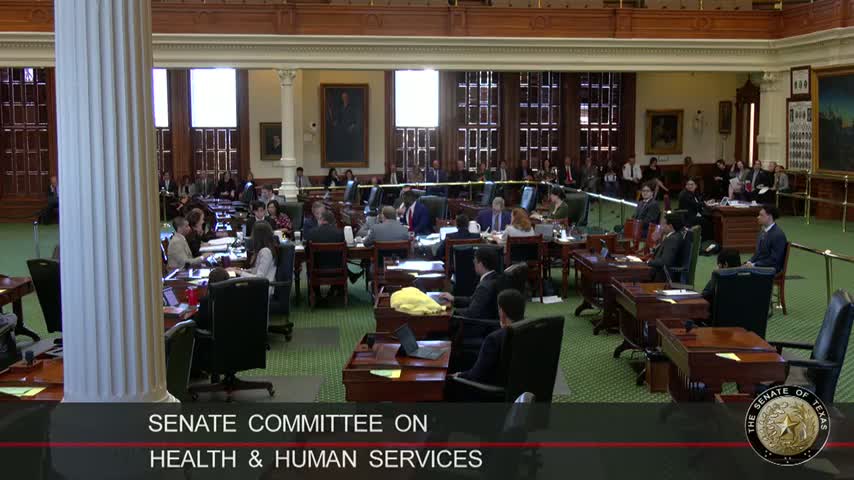
Committee hears SB 961 on strengthening Medicaid eligibility verification and provider fraud provisions; bill left pending
Summary
Senate Bill 961 would codify verification processes to reduce Medicaid fraud and waste, require cross‑checks of eligibility factors and limit self‑attestation; sponsors said the bill also clarifies legal standards for prosecuting provider fraud. The committee heard invited witnesses and agency resource staff and left the bill pending.
Senate Bill 961 was laid out to the Health & Human Services Committee as a package of proposals to strengthen Medicaid eligibility verification, reduce fraud and clarify prosecutions of provider wrongdoing.
The sponsor described Medicaid as one of the state's largest safety‑net programs, serving roughly 4.3 million Texans, and said program integrity requires elimination of some self‑attestation and more frequent cross‑checks of electronic data (for example, IRS and vital‑records matches) to confirm eligibility. The sponsor said provider fraud cases had highlighted gaps in the standard for criminal prosecution and the bill seeks to clarify existing legal language so that the Office of the Inspector General and the Attorney General can pursue cases of knowingly false claims.
Invited witnesses included Carolyn Walton of the Texas Public Policy Foundation and HHSC resource witnesses. Carolyn Walton urged passage as a way to preserve program integrity and protect care quality for enrolled Texan populations. HHSC representatives described existing data matches with the IRS, Social Security Administration and vital statistics, explained continuous 12‑month eligibility protections for children and postpartum women and said data matches occur monthly or annually depending on the source. Agency staff noted practical limits on detecting income such as one‑time gambling winnings, which may appear in IRS data on an annual basis and flag a case for worker review when the match is processed.
Committee members asked questions about emergency Medicaid for pregnant women, the effect of verification on timely enrollment and how the agency notifies enrollees about what income must be reported. The chair said the committee will work with the agency on substitute language to align verification timing with data‑source schedules and to reduce fiscal impacts where appropriate. The bill remains pending for public testimony later in the hearing.