Get Full Government Meeting Transcripts, Videos, & Alerts Forever!
Get email alerts on the Affordable Housing Development topic
No spam. Unsubscribe anytime.
Council approves subsidy for Azalea Gateway phase 1 after debate over affordability sharing and environmental remediation
Summary
City Council approved a financial subsidy for phase 1 of the Azalea Gateway redevelopment (former Raytheon site), a 340-unit project with 102 affordable/workforce units and a negotiated 50-year affordability term; vote was 6-1 after discussion about Live Local legislation, subsidy of 120% AMI units, and environmental remediation obligations.
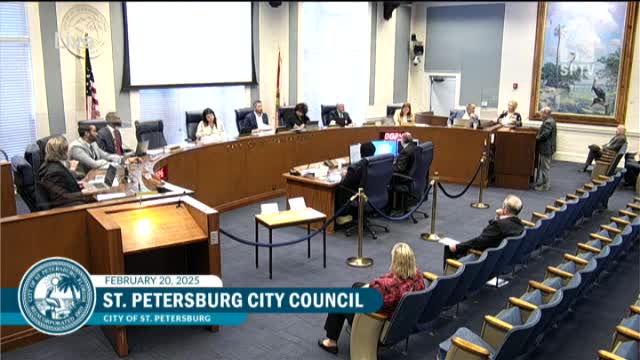
City Council voted 6-1 Feb. 20 to approve a financial subsidy request for phase 1 of the Azalea Gateway Apartments, a multi-phase redevelopment of the former Raytheon site near Tyrone Mall that would ultimately include about 1,000 units, with 300 units restricted as affordable or workforce housing.
Mark Van Lew presented the plan, saying phase 1 would include 340 units total, with 102 units restricted as affordable or workforce housing (51 at 80% AMI and 51 at 120% AMI) and a negotiated 50-year affordability term. The developer team combines Porter Azalea Land and the Falcone Group under an LLC called Azalea Gateway Apartments; staff estimated per-unit subsidy requests consistent with recent projects and explained that phase 1 carries additional infrastructure costs that would serve later phases.
Councilmember Stephen Floyd cast the lone no vote and urged caution: he said he supported building on the site rather than leaving it undeveloped but opposed subsidizing units at 120% AMI with city money and expressed concern about environmental remediation and the ordinance changes that allowed industrial-to-residential conversions under the Live Local Act. "The combination of ... environmental concerns, and the Live Local change at the developer's request, it's too much for me," Floyd said, adding he did not support subsidizing higher-cost workforce units.
Supporters, including Councilmember Brandy Gabbard and Council Chair Copley Gerdes, said the state'level Live Local legislation opened opportunities to redevelop underused industrial land and that the project would return long-dormant property to productive use with a mix of unit types and connectivity to transit and nearby services.
Environmental remediation questions were addressed by Greg Schultz of Stantec, the project's environmental engineer. He said groundwater cleanup remains Raytheon's long-term responsibility under FDEP oversight, while development-related soil impacts are minimal and will be managed with engineering controls, vapor venting systems beneath buildings, and coordination with FDEP.
The resolution authorizing the subsidy passed 6-1; the clerk recorded yes votes from six councilmembers and a single no from Floyd, with one councilmember absent. Staff and the developer said permits are targeted for approval by September, with construction starting late 2025 and completion of phase 1 around December 2027.