Get Full Government Meeting Transcripts, Videos, & Alerts Forever!
Get email alerts on the Utilities Water Billing topic
No spam. Unsubscribe anytime.
St. Petersburg council adopts new leak-adjustment and high-read policies after widespread storm-related billing complaints
Summary
City Council on Feb. 20 adopted three resolutions creating procedures for leak adjustments during flood events, for handling high meter reads when no leak is found, and changes to the utility bill review committee after multiple residents and businesses reported sudden, large water bills following Hurricanes Helene and Milton.
City Council unanimously approved three resolutions Feb. 20 aimed at speeding relief for customers who received unusually large water bills after Hurricanes Helene and Milton.
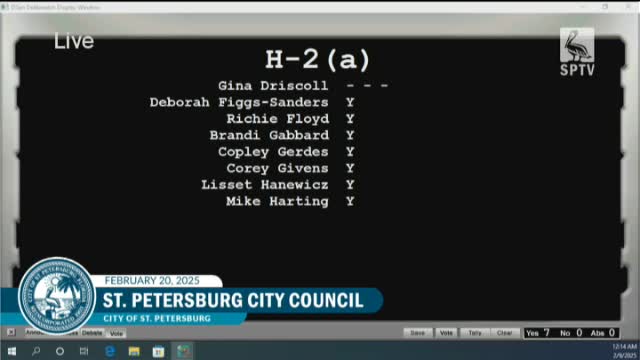
The measures create (1) a policy for leak-adjustment relief for involuntary leaks during a flood event, (2) a policy for reviewing high water-meter reads when no leak can be found, and (3) changes to the city's Utility Bill Review Committee. Council adopted all three measures in a single vote; the clerk announced the items passed unanimously with one councilmember absent.
The move follows lengthy public comment in open forum, during which homeowners and business owners described spikes in usage and slow response from utility customer service. "Imagine my surprise when I received my utility bill in December of $1,439.31," resident Michelle Denley told council, saying she had not lived in her home for three months after the storms. Barquette Realty CFO David Lance said his commercial account jumped from about $356 to more than $9,000 on one bill.
Other speakers described similar patterns: a business owner said autopay complications had nearly caused multiple automatic withdrawals; a resident said his analog meter had been replaced with a wireless meter two years earlier and questioned whether submerged digital meters could be misreading usage. "I would love to hear the theories as to why flooding would cause high water use and then, without any intervention once the water receded, the water usage would stop," said Robert Craven, who reported a single bill over $1,500 when normal usage runs around $250.
Councilmembers and staff said the package of resolutions is intended to address both mechanical meter concerns and billing-process failings by clarifying criteria for credits and creating a more formal review track. Councilmember Brandy Gabbard, who pledged follow-up for at least one speaker, urged staff to keep constituents informed as the new procedures are implemented.
The council did not announce any immediate, across-the-board credit amounts; the adopted policy sets a framework for staff to evaluate individual cases and instructs the Utility Bill Review Committee on new procedures and documentation requirements. City staff and utility managers told council they would contact affected customers and work to improve communications and meter-replacement processes.
Residents who testified asked for clearer guidance on replacing meters and for faster customer callbacks; council members and staff said they would track implementation and report back to committees. The new resolutions take effect immediately and the staff-managed committee will handle incoming appeals under the revised rules.