Get Full Government Meeting Transcripts, Videos, & Alerts Forever!
Get email alerts on the School Nutrition And Food Labeling topic
No spam. Unsubscribe anytime.
Committee adopts substitute for SB 25 to expand school nutrition rules and tighten advisory‑committee conflicts
Summary
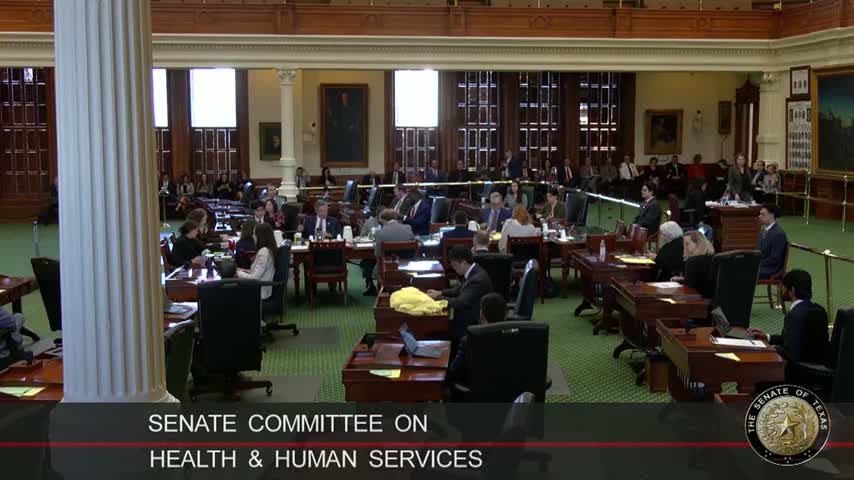
The Senate Committee on Health & Human Services on the record adopted a committee substitute for Senate Bill 25 that expands nutrition and physical‑education requirements and tightens conflict‑of‑interest rules for a new nutrition advisory committee.
The Senate Committee on Health & Human Services on the record adopted a committee substitute for Senate Bill 25 that expands nutrition and physical education requirements and tightens conflict‑of‑interest rules for a new nutrition advisory committee.
The committee substitute, explained on the floor by Senator Hall, extends the bill’s physical‑education requirement and nutrition curriculum mandate to charter schools, all Texas public high schools and public universities, corrects drafting errors in the original text and amends who the governor may appoint to the advisory committee. "An advisory committee member is not allowed to maintain an ownership interest in a pharmaceutical, food, or beverage company," Hall said during the layout. "A person related to an advisory committee member within 3 degrees of consanguinity is not allowed to maintain an ownership interest in a pharmaceutical, food, or beverage company."
The substitute also provides a specific list of banned artificial colors, chemicals and additives that manufacturers may reference when labeling covered products. It replaces a prior approach that tied labeling to whether a substance was banned in other countries; sponsors said that could create instability if foreign lists changed. The measure gives manufacturers a transition runway until Jan. 1, 2027, and limits enforcement to the attorney general rather than creating a private right of action, according to the author’s layout.
Committee discussion was brief and largely supportive. Senator Sparks moved adoption of the substitute; the clerk recorded seven ayes and no nays. The committee then reported the substitute favorably with the motion that "Senate Bill 25 do not pass, but the substitute adopted in lieu thereof do pass and be printed." The chair thanked committee staff for extensive stakeholder outreach and drafting work.
The bill’s text as presented applies the labeling requirement to products developed or copyrighted on or after Jan. 1, 2027. The committee did not adopt additional changes on the floor; sponsors said they will continue stakeholder engagement before floor consideration.
The committee left detailed implementation questions, including enforcement mechanics and the final labeled ingredient list, to subsequent drafting and rulemaking.