Get Full Government Meeting Transcripts, Videos, & Alerts Forever!
Get email alerts on the Historic Preservation topic
No spam. Unsubscribe anytime.
Council splits on Euclid Church appeal after months of debate; adaptive‑reuse appeal fails to win approval
Summary
After a lengthy quasi‑judicial hearing with more than 50 public speakers, council voted 4–4 on an appeal of a CPPC denial of adaptive‑reuse for the Euclid Church; the motion to grant the appeal failed and a map‑amendment vote was not moved.
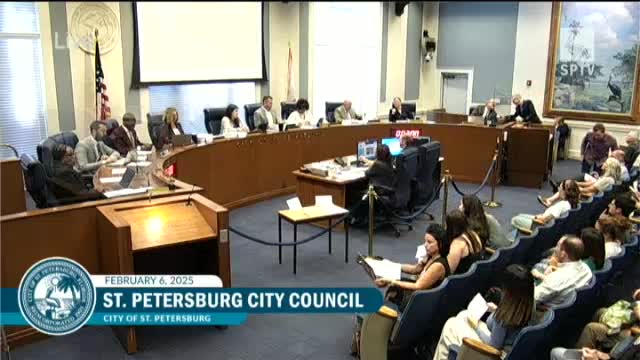
A divided city council failed to overturn a Community Planning and Preservation Commission (CPPC) decision on Feb. 5 after a marathon quasi‑judicial hearing over proposed adaptive reuse of the historic Euclid Church on Tenth Avenue North.
Derek Kilborn, manager for Urban Planning and Historic Preservation, explained the process: because the building is a locally designated landmark the CPPC heard a bundled certificate of appropriateness and an adaptive reuse proposal that included special‑exception uses (an event/meeting hall and a bed‑and‑breakfast) and a preemptive future land‑use map amendment request tied to a potential future increase in corridor FAR. CPPC approved the certificate of appropriateness for exterior changes but denied the adaptive‑reuse request for the meeting hall and bed‑and‑breakfast. The denial was appealed to council.
Applicant representatives said the owners, Noam and Irene Krasnanski, had purchased a severely deteriorated landmark and proposed restorations financed through an event venue business model, off‑site parking agreements and other vendor arrangements. Architect Paul Reese and attorney Todd Pressman presented plans for interior restoration, sound mitigation and a proposed reconfigured on‑site parking layout. The applicants submitted letters of intent from nearby property owners and vendors for off‑site parking and transportation (including a preferred local trolley operator) and argued the proposed uses had historic precedent at the site.
Opponents — led by neighbor Michelle Gehrig and supported by multiple residents and the registered‑opponent petition — argued the proposal would introduce a commercial, high‑intensity use into a residential interior, worsen parking and traffic, increase unamplified and amplified noise late into evenings, and risk short‑term rental activity. Opponents said the CPPC carefully weighed the adaptive reuse criteria and raised concerns that off‑site parking arrangements were nonbinding and vulnerable to revocation.
After more than three hours of public comment and cross‑examination, council considered the appeal. A motion to grant the adaptive‑reuse appeal (i.e., to overturn the CPPC decision) failed in an 4–4 vote (Driscoll, Curtis, Gibbons, Hanowitz voted no; Fig Sanders, Floyd, Gabbard and Harding voted yes). Council did not advance a separate motion to approve the map amendment; staff noted the map amendment was tied to approval of the adaptive reuse and, without motion, that element was not approved. Staff advised the applicants they could revise and return with a modified application after the required appeal/waiting period.
The hearing drew extensive public turnout and testimony both for and against the project; city staff urged any future revisions to address parking guarantees and measurable noise‑mitigation commitments. The CPPC’s denial therefore still stands unless a future council vote overturns it with the required supermajority.