Get Full Government Meeting Transcripts, Videos, & Alerts Forever!
Get email alerts on the Stormwater Management topic
No spam. Unsubscribe anytime.
City advances Salt Creek pump station and floodplain restoration as part of Basin C stormwater work
Summary
Council unanimously approved accelerated design‑build work for the Salt Creek pump station project intended to increase hydraulic capacity, add a bypass outfall and create a restored wetland to reduce flooding in the Basin C/Lake Maggiore area.
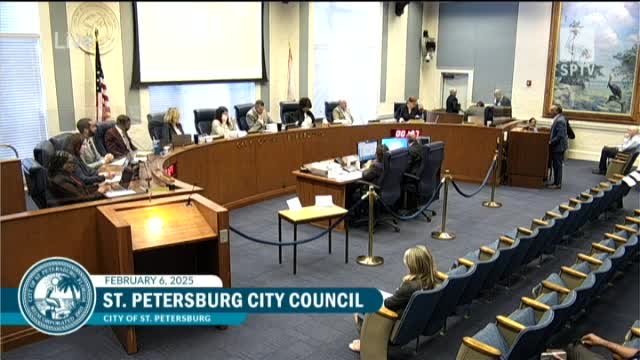
City council on Feb. 5 authorized the next phase of the Basin C stormwater work around Salt Creek and Lake Maggiore, including a progressive design‑build pump station and related channel improvements, city staff told the meeting.
Brijesh (Engineering and Capital Improvements) described Basin C as one of the city’s largest stormwater basins and said unusually intense rainfall during the recent hurricanes caused prolonged and record staging in the basin. Council approved the design‑build procurement and initial funding to advance a pump station at an 18th Avenue site, a discharge force main across 18th Avenue and Third Street to an outfall beyond the Third Street Bridge, and dredging/maintenance work in Bartlett Lake to increase hydraulic capacity.
Staff said the project team is also proposing creation of a depressed wetland on property west of the pump station to expand floodplain storage and improve water quality. Brijesh said the project scope was broadened after the storms to increase pump capacity and add a bypass pipeline because the existing channel is hydraulically constrained and cannot be widened without major roadway impacts. He described a multistep project approach (dredging, channel cleaning, pump station and bypass line) and said staff is seeking grant funding to cover a portion of construction costs; prior grant awards have helped advance early phases.
Councilmembers asked about potential downstream impacts, whether a flood gate at the outfall would shift water into other neighborhoods and about impacts to historic roadway features such as “Thrill Hill.” Brijesh and staff said the proposed flood gate would not raise high‑tide levels inland because the gate is at the outfall and the outfall ties directly to Tampa Bay; they also said the proposed bypass aligns with areas where the channel widens and that the project will provide net hydraulic benefit to the local neighborhoods that experienced the worst stage during the storm.
Council unanimously approved the measure and directed staff to return with further design details and grant‑related materials. Brijesh said construction phasing will be informed by permitting and funding, and the team will seek to sequence work to maximize flood‑risk reduction as components are completed.