Get Full Government Meeting Transcripts, Videos, & Alerts Forever!
Get email alerts on the Municipal Finance topic
No spam. Unsubscribe anytime.
North Port commission reviews citywide user-fee study; staff to model budget scenarios
Summary
Consultant presented a user-fee study covering more than 500 fees across city departments; commissioners debated cost recovery for parks and recreation, fire/EMS rates, utility franchise taxes and asked staff to model revenue and service-impact scenarios for the budget cycle.
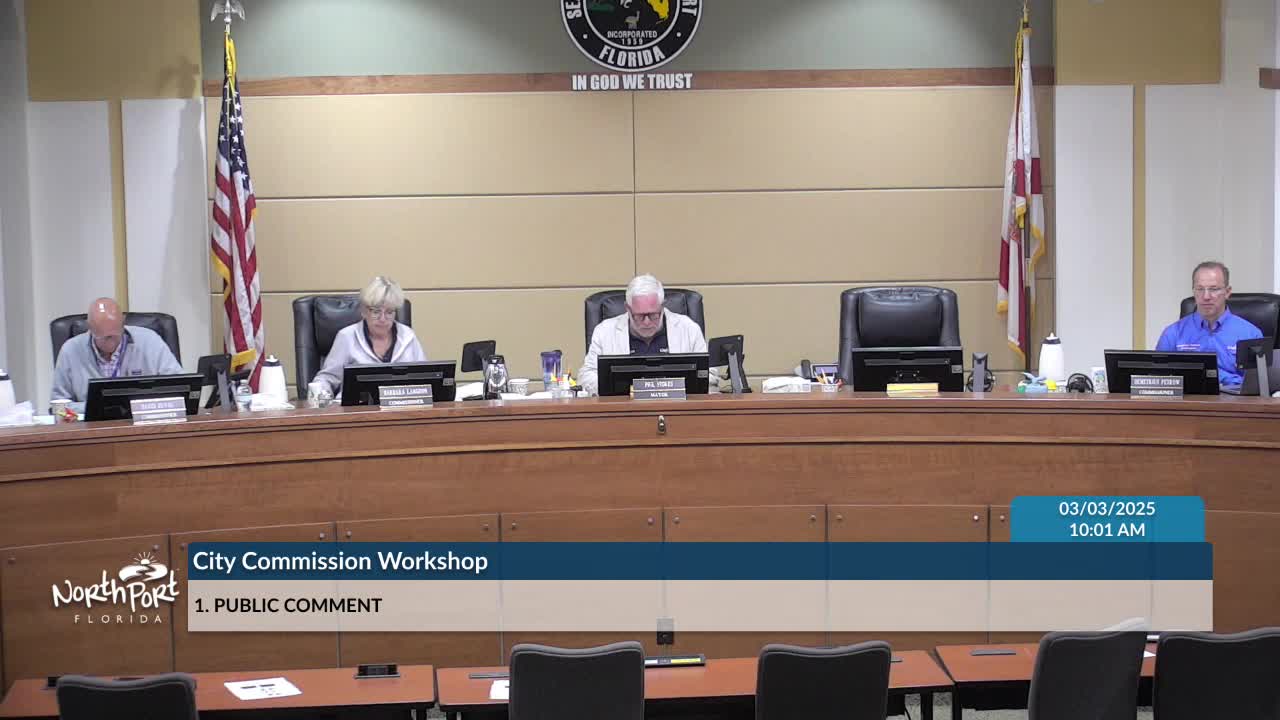
North Port commissioners spent a workshop session March 3 reviewing a consultant'prepared user-fee study that examined more than 500 fees across city departments and asked staff to model what adopting the recommendations would mean for the coming budget.
The consultant, Dennis Gorrell, summarized the study'methodology and findings, saying user fees "are fees that fund services that provide a private benefit" and explaining the study calculated "the full cost of providing each service" by building labor, department overhead and citywide indirect overhead into per-service cost estimates.
Commissioners and staff focused discussion on parks and recreation, fire and emergency medical services, utility user fees and the franchise tax the city collects on electric bills. Finance Director Kim Williams and City Manager Fletcher joined the presentation and discussion.
The study broke its review into department groups. Highlights the consultant gave included: citywide (9 fees, current average cost recovery ~24% -> proposed ~27%), utilities/user fees (17 fees, current ~49% -> proposed ~66%), roads and drainage (14 fees, current ~50% -> proposed ~67%), police user fees (13 fees, current ~42% -> proposed ~51%), fire inspection and development fees (146 fees, current ~88% -> proposed ~87%), EMS (7 fees, most proposed to rise slightly), and parks and recreation (194 fees; current overall department recovery ~22.66%, target roughly 25%). The consultant said some fee increases were small, largely indexed to a 2.7% CPI figure used across many schedules.
Commissioners debated two recurring themes: (1) the policy of how much of a service'cost should be borne by a user versus the community through taxes, and (2) whether the city should pair any fee increases with internal efficiency reviews. Commissioner Langdon cautioned against simply copying neighboring municipalities' rates without considering local cost and service-level differences, saying he was not "comfortable charging what other municipalities charge without considering cost of service delivery or quality of those services." Several commissioners and the manager said efficiency and operational choices should be considered as part of the budget conversation.
Parks and recreation drew extended comment. Commissioners asked for clearer accounting of the large, facility'specific assets (the Aquatic Center, Warm Mineral Springs and two community centers) and asked staff to produce profit-and-loss or cost-center reporting that captures maintenance and capital implications. Commissioner Langdon asked for a depreciation or maintenance-cost view so the commission can see the full public cost of assets that serve a limited number of users; commissioners noted prior city investments (the consultant and commissioners referenced an upcoming roughly $10 million restoration for Warm Mineral Springs and an earlier $5.5 million acquisition) and said those costs affect policy choices about whether to subsidize or shift costs to user fees.
Fire and EMS fees were described as "unique" by the consultant because EMS billing often relies on insurer payments that do not fully match allowable charges; the consultant presented a market comparison showing North Port's basic life-support and advanced-life-support fees generally in line with nearby jurisdictions. Fire inspection fees (development-related) were reported near peer-city averages, and the consultant said most inspection fees are already recovering a high share of cost.
Several commissioners raised the franchise-tax on electric bills (the city'collected franchise/utility-related revenue the city manager said totals roughly $11 million) and suggested revisiting the city'role and rate as FPL and other utilities change their charges. Commissioners discussed the trade-offs involved in lowering a utility surcharge while maintaining revenue to avoid raising property taxes.
The consultant told the commission the development services portion of the study was deferred because a new unified land development code and a new permitting system ("Acela" in discussion) have changed workflows; he recommended waiting roughly a year from the code implementation to capture accurate time estimates and system impacts before finishing development fees analysis.
No formal vote was taken. City Manager Fletcher and staff agreed to bring fee-adoption scenarios and revenue-impact analyses into the regular budget process. At the close of discussion staff said they would "explore what the changes would look like based on the consultant recommendations" and present options during the budget timeline, including phased or partial adoption scenarios and explanations of service-level implications.
Commissioners asked staff to return with (at minimum) revenue estimates tied to recent usage levels where possible, P&L or cost-center views for the four facility-specific assets cited for deeper review, and options that combine fee adjustments with potential efficiency or service-level changes.
The workshop adjourned without public comment or formal action; staff will incorporate the consultant'recommended fee schedule changes and the commissioners' direction into the upcoming budget work and return with more detailed scenarios and fiscal impact numbers.