Get Full Government Meeting Transcripts, Videos, & Alerts Forever!
Get email alerts on the Backyard Chickens topic
No spam. Unsubscribe anytime.
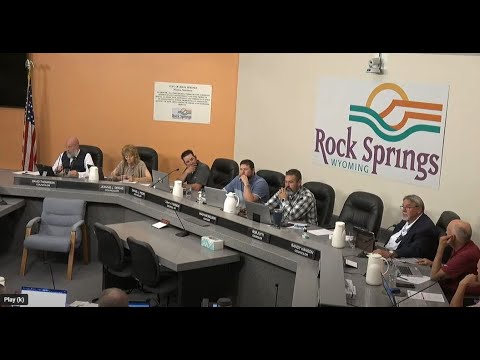
Rock Springs council hears hours of public comment on proposed backyard-chicken ordinance; first reading only
Summary
The Rock Springs City Council on March 4, 2025, heard more than a dozen public comments both for and against a proposed ordinance to allow backyard chickens. Council held a first reading and did not vote; members agreed to form a committee to refine the ordinance language before the next meeting.
Mayor Max Mickelson and the Rock Springs City Council on March 4 opened an extended public-comment period on a proposed ordinance to allow backyard chickens within city limits, hearing dozens of speakers and holding only a first reading of the measure.
The proposal drew a sizable turnout: Mayor Max Mickelson counted about 21 people who raised hands in favor and six opposed before the public-comment portion began. Residents who spoke in favor said backyard chickens provide family food, educational opportunities for children and household benefits such as composting, reduced food waste and pest control. Opponents cited the ongoing avian-influenza outbreak and biosecurity concerns.
Why it matters: the ordinance would change local rules on animals, affect animal-control workload, create permit and fee requirements and intersect with state-level “food freedom” and cottage-food policy. Council members said the ordinance needs more technical detail before final votes to balance public-health concerns, property rights and enforcement capacity.
Public comment highlights included:
- Amanda Margrave, Ward 4 resident: “I reviewed the language in the Proposed Change and I agree wholeheartedly with the language that is in the proposed ordinance change.” She told council she collected roughly 300 online responses showing 77% support among respondents.
- Madhu Anderson, Rock Springs resident (opposed): “I strongly oppose the proposal to allow backyard chickens within the Rock Springs city limits due to the serious public health risks posed by the ongoing outbreak of highly pathogenic avian influenza.” Anderson cited reported detections in other Wyoming counties and noted hospitalizations tied to human cases in North America.
- Rhonda Zincanella (pro): said the draft ordinance’s requirement that coops be enclosed would reduce risk from wild birds and therefore lower avian-flu risk.
- Matt Grant (pro): summarized calls to other Wyoming municipalities, reporting small numbers of chicken-related animal-control calls in Laramie and Lander (about four last year) and higher but manageable counts in Casper (22), and said odor/noise complaints were typically mitigated by bedding and cleaning.
Council discussion and staff clarifications
Council members raised questions about enforcement, fees and zoning. Councilor Thompson, citing his law-enforcement background, asked whether coops would count as permanent structures and how animal-control fees and kennel licensing would apply. City staff clarified several points from the draft and current ordinances:
- Permit and fees: the draft included a $25 permit fee in discussion; council members mentioned $25 and $50 as proposed options during public remarks. A kennel license (for larger numbers of animals) is currently set at $500 annually for properties exceeding threshold counts.
- Building and zoning: city staff (Mr. Beckwith) said a coop would be considered a structure for the city’s zoning code and require a site plan approved by the planning-and-zoning administrator; however, building permits are not required for structures under 250 square feet, so many coops would not need a building permit.
- Sales and vendor rules: staff explained that eggs used only for personal consumption would not require a vendor’s permit; selling eggs as a recurring business would require a home-occupation/business license and applicable vendor rules.
- Revenue and funds: staff said permit fees would be deposited to the general fund, which supports animal-control services.
Public-health context
Speakers referenced state and federal agencies and recent cases: the Wyoming Livestock Board and the U.S. Department of Agriculture’s Animal and Plant Health Inspection Service were cited, and one commenter referenced a state health officer warning residents to avoid wild birds and monitor poultry for symptoms. Several pro-chicken speakers argued that avian-influenza risk is primarily associated with wild waterfowl and that enclosed coops and good husbandry reduce risk; opponents countered that backyard flocks pose biosecurity challenges and that human infections, while rare, have occurred.
Council next steps
Council did not take a final vote. Councilor Thompson proposed and council approved forming a mixed committee of council members—some pro, some hesitant—to refine ordinance language and address technical points on fees, enforcement, setbacks, coop design and whether neighbor permission should be required. Mayor Mickelson said the committee aims to produce amended language for the next council meeting; if that work is not completed, the ordinance may be tabled at the next meeting to allow more public input.
Ending note: the ordinance is at first reading only and will return to council after committee review and any additional public input. The council asked residents to continue to submit written information and local examples for staff and the committee to review.