Get Full Government Meeting Transcripts, Videos, & Alerts Forever!
House Judiciary reviews wide-ranging juvenile justice bill, sparks debate over domestic-violence and registration changes
Summary
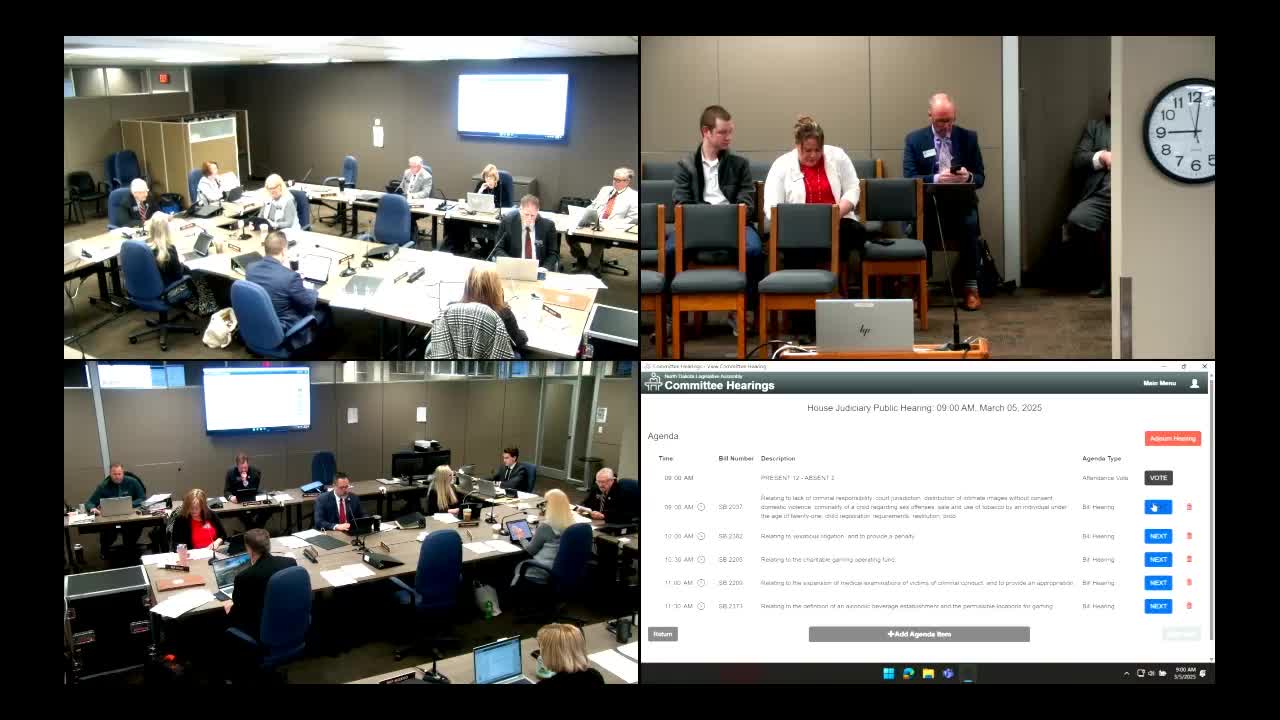
The House Judiciary Committee opened a hearing on Senate Bill 2037 on March 12 in Bismarck, where prosecutors, human-services directors and advocacy groups debated a package of changes to how North Dakota treats juvenile delinquency, sex-offender registration, domestic-violence enhancements, tobacco citations and certain collateral consequences.
Bismarck — The House Judiciary Committee opened a hearing on Senate Bill 2037 on March 12, as prosecutors, human-services officials and advocates debated revisions to how North Dakota treats juvenile delinquency, registration for sex-related offenses, domestic-violence enhancements, tobacco citations and certain collateral consequences.
The bill, drafted by a Commission on Juvenile Justice work group and presented to the committee by Derek Steiner, an assistant state’s attorney for Cass County, would put several new juvenile-specific rules into statute while leaving many adult-code sections intact. Steiner told lawmakers the bill would, among other changes, explicitly allow assessment of criminal responsibility for children age 10 and older and make offender-registration decisions for juveniles discretionary in many cases.
“We thought it would be better just to treat juveniles by charging out simple assault and leaving out that domestic-violence connotation, for anything other than being in a dating relationship,” Steiner told the committee, explaining the group’s effort to reduce what he called inappropriate application of adult enhancement provisions to sibling-on-sibling and parent-child incidents. He also described amendments intended to (1) preserve juvenile court jurisdiction for certain tobacco infractions and (2) add a “Romeo-and-Juliet” age-gap adjustment so consensual contacts between similarly aged minors are not automatically escalated to class-A felonies.
Why it matters: proponents described the bill as a targeted effort to reduce what they called unequal application of adult criminal statutes to children, to clarify collateral consequences for youth and to preserve confidentiality and…
Already have an account? Log in
Subscribe to keep reading
Unlock the rest of this article — and every article on Citizen Portal.
- Unlimited articles
- AI-powered breakdowns of topics, speakers, decisions, and budgets
- Instant alerts when your location has a new meeting
- Follow topics and more locations
- 1,000 AI Insights / month, plus AI Chat