Get Full Government Meeting Transcripts, Videos, & Alerts Forever!
Get email alerts on the Juvenile Justice Reform topic
No spam. Unsubscribe anytime.
House Judiciary reviews wide-ranging juvenile justice bill, sparks debate over domestic-violence and registration changes
Summary
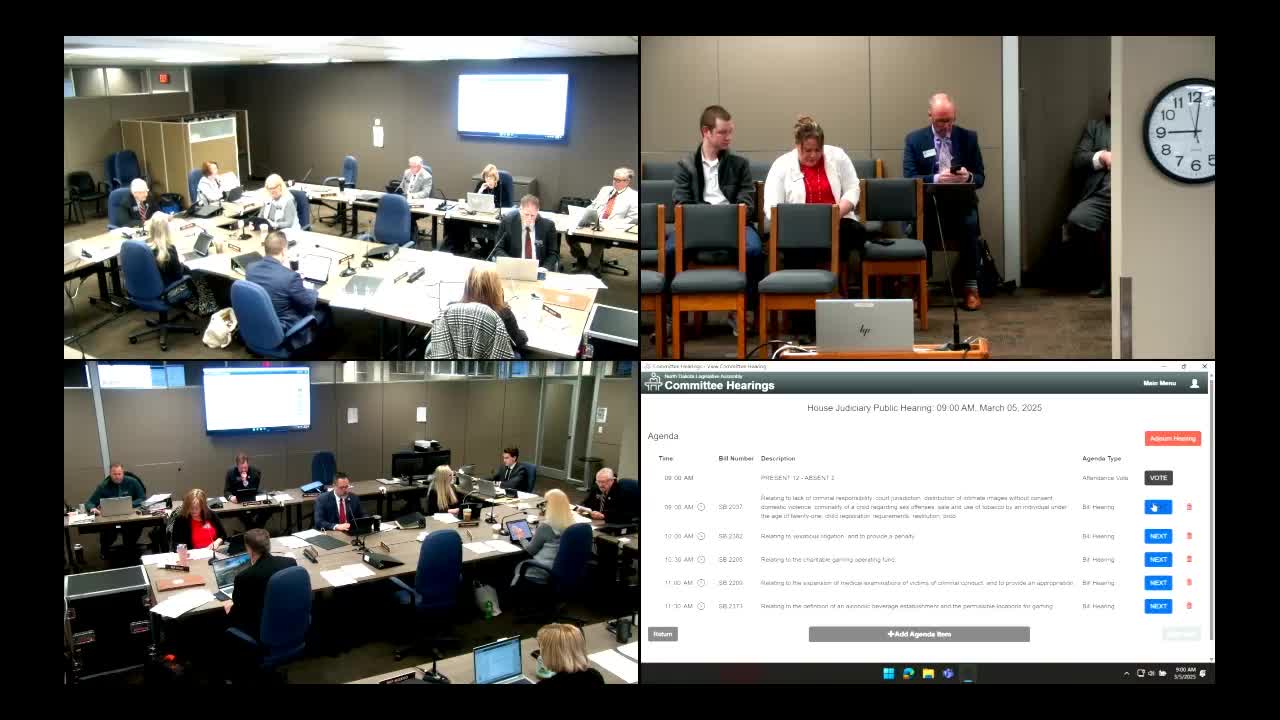
The House Judiciary Committee opened a hearing on Senate Bill 2037 on March 12 in Bismarck, where prosecutors, human-services directors and advocacy groups debated a package of changes to how North Dakota treats juvenile delinquency, sex-offender registration, domestic-violence enhancements, tobacco citations and certain collateral consequences.
Bismarck — The House Judiciary Committee opened a hearing on Senate Bill 2037 on March 12, as prosecutors, human-services officials and advocates debated revisions to how North Dakota treats juvenile delinquency, registration for sex-related offenses, domestic-violence enhancements, tobacco citations and certain collateral consequences.
The bill, drafted by a Commission on Juvenile Justice work group and presented to the committee by Derek Steiner, an assistant state’s attorney for Cass County, would put several new juvenile-specific rules into statute while leaving many adult-code sections intact. Steiner told lawmakers the bill would, among other changes, explicitly allow assessment of criminal responsibility for children age 10 and older and make offender-registration decisions for juveniles discretionary in many cases.
“We thought it would be better just to treat juveniles by charging out simple assault and leaving out that domestic-violence connotation, for anything other than being in a dating relationship,” Steiner told the committee, explaining the group’s effort to reduce what he called inappropriate application of adult enhancement provisions to sibling-on-sibling and parent-child incidents. He also described amendments intended to (1) preserve juvenile court jurisdiction for certain tobacco infractions and (2) add a “Romeo-and-Juliet” age-gap adjustment so consensual contacts between similarly aged minors are not automatically escalated to class-A felonies.
Why it matters: proponents described the bill as a targeted effort to reduce what they called unequal application of adult criminal statutes to children, to clarify collateral consequences for youth and to preserve confidentiality and juvenile-court handling for low-level matters such as certain tobacco offenses. Opponents focused on a narrower—yet consequential—proposal to restrict when the domestic-violence enhancement would apply to juveniles.
Major provisions and debate
- Criminal responsibility: The bill would explicitly reflect existing practice that children 10 years of age or older can be assessed for criminal responsibility. Steiner said the change “puts it just written in law clear as day” alongside companion legislation about competency.
- Domestic violence: Under the bill, the domestic-violence enhancement would not apply to juveniles except when the juvenile and victim were in a dating relationship or had a child in common. Supporters said that change avoids mandatory-arrest consequences and felony-level enhancements for incidents such as sibling-on-sibling or child-on-parent assaults; they argued such cases are often better handled as simple assault in juvenile court. Seth O’Neil of the North Dakota Domestic and Sexual Violence Coalition urged the committee to retain broader domestic-violence coverage for juveniles, warning it would remove a prosecutorial tool in cases such as family group assaults.
- Sex-offender and child-offender registration: The bill would make many registration decisions permissive rather than mandatory. Prosecutors could request the court consider registration for adjudicated juveniles who exhibit predatory conduct or a qualifying mental abnormality, but courts would have to find the same statutory factors before ordering registration. Steiner said the change recognizes the different context of peer-to-peer conduct (for example, two high-school students exchanging intimate images) versus adult predatory conduct.
- Tobacco and CHINS jurisdiction: The proposal would leave penalties for children under 14 unchanged but move many 14-to-17-year-old tobacco infractions into juvenile-court jurisdiction (rather than treating them as adult infractions), giving juvenile courts the authority to impose age-appropriate responses rather than an adult traffic-style ticket. Steiner said the wording also required cleanup amendments so CHINS (child in need of services) jurisdiction remains available when necessary.
- Firearms and collateral consequences: The bill limits some firearm-prohibition consequences for juveniles by removing nonviolent felonies from automatic firearm-disability periods, while keeping prohibitions for violent felonies and violent misdemeanors. The draft also adds a new statutory subsection that lists collateral consequences—firearm restrictions, registration possibilities, driving-privilege suspensions and extracurricular suspensions—so youth and attorneys can see them consolidated.
Service capacity and funding
Lynn Fleet, director of the RSR Human Service Zone, supported the bill’s intent but warned the changes could increase the number of youth referred to child-welfare and human-service placements. “There is an extremely limited number of placement options for these youth in North Dakota,” Fleet said, adding that youth with severe behavioral-health or cognitive needs may require placements or services that are scarce in the state. Fleet and Steiner noted Health and Human Services requested an appropriation on the Senate side—up to $300,000—for contract evaluations tied to expanded competency or criminal-responsibility assessments.
Opposition and narrow objections
Seth O’Neil urged the committee to amend or remove the domestic-violence carve-out for juveniles (the provision on page 3, lines 19–21 of the bill as presented), arguing the change would “remove a tool of the tool belt for prosecutors” in some family-violence cases. Tobacco-prevention advocates, including Heather Austin of Tobacco Free North Dakota, said technical language mistakes in the tobacco sections had been largely fixed by Steiner’s amendment and expressed conditional support for those fixes.
Procedure and next steps
Committee members asked about interstate models and whether other states maintain a wholly separate juvenile criminal code; Steiner and others said most states use adult-code references and modify application to juveniles rather than creating a fully separate code. The committee took testimony and discussed amendments; no final committee vote on Senate Bill 2037 is recorded in the hearing transcript.
Administration and legal references
Steiner and witnesses cited existing juvenile-court rules and specific cross-references in statute (for example, a cleanup discussing subsection 2 of 12.13103). Health and Human Services signaled a need for appropriations to meet evaluation and placement demand if the bill increases evaluation requests or shifts caseloads.
Ending
The hearing produced both broad support for reforming how certain adult penalties attach to juveniles and targeted opposition from victim-service advocates on the domestic-violence carve-out. Committee members and witnesses flagged follow-up needs: technical cleanups to tobacco language, transition language on registration phrasing, and fiscal planning for expanded evaluation and placement needs. The committee closed the hearing with no recorded action taken on the bill during that session.