Get Full Government Meeting Transcripts, Videos, & Alerts Forever!
Get email alerts on the K12 Student Safety Victim Protection topic
No spam. Unsubscribe anytime.
Bill would require safety plans and possible separation when a student victim faces an offender at school
Summary
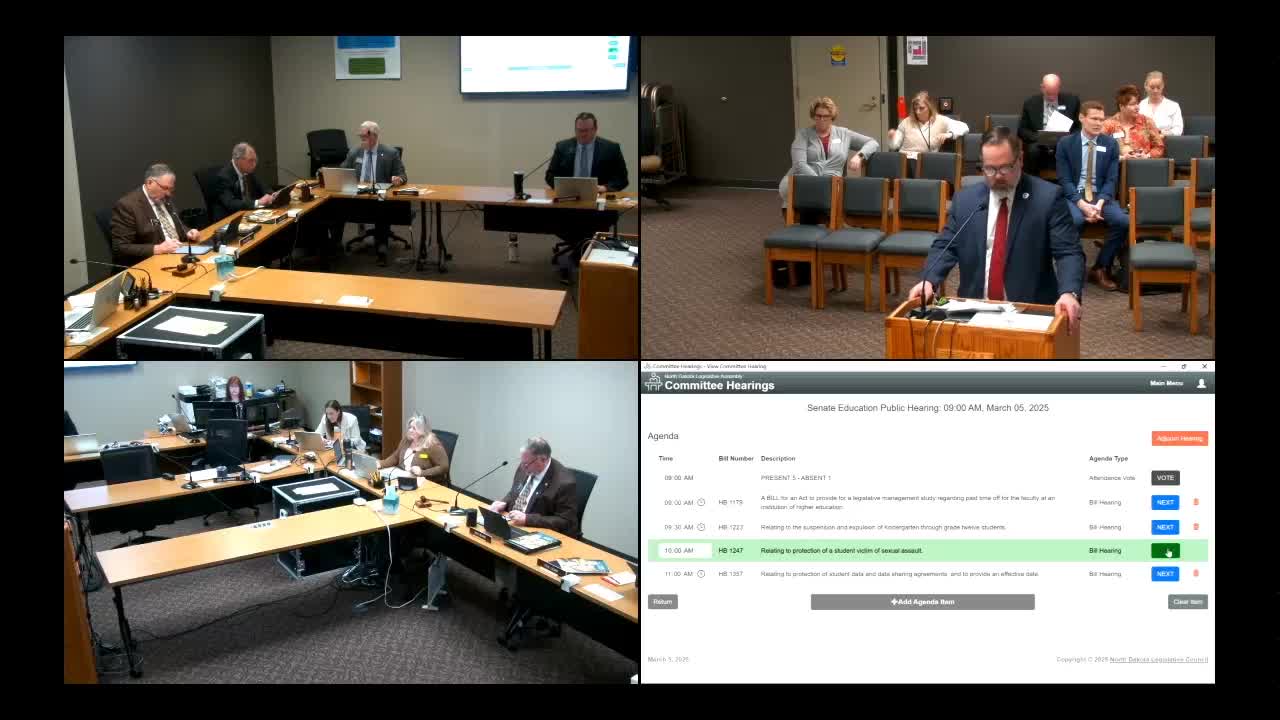
Representative Dan Johnston told the Senate Education Committee House Bill 1247 is intended to protect student survivors of sexual assault by requiring school districts to implement safety plans and, when necessary, separate victims from responsible students to prevent retraumatization.
Representative Dan Johnston introduced House Bill 1247, saying the measure responds to cases in which alleged perpetrators remain in the same school building as victims of sexual assault and can retraumatize survivors. Johnston described the bill as intended to give school districts tools — including safety plans and alternative placements — to protect victims and preserve the educational environment.
Multiple witnesses testified in support and recommended amendments to sharpen the bill. Alexis Dion spoke on behalf of her daughter, describing the lasting psychological and academic harm her daughter experienced after being targeted, threatened and assaulted by a classmate; Dion urged the committee to support any measures that allow a victim to continue their education without daily contact with the offender.
Chrisann Norby Jonner, in‑house counsel for the North Dakota School Boards Association, testified in support of the amended bill and the safety‑plan process, noting districts commonly must comply with court orders such as protection orders and that resources and building layouts vary widely; she said flexibility in how separation is implemented is necessary and urged maintaining due process for students subject to expulsion.
Greg Kosowski of the Children’s Advocacy Centers recommended a series of specific amendments heard by the committee: replace “assault” with a broader category “offense” to include non‑contact offenses that can be equally traumatic; use a neutral term such as “responsible student” rather than “convicted student” so the provision covers adjudicated juveniles as well as adult convictions; require consideration of the victim's input when developing a safety plan; require appropriate supervision when a responsible student participates in virtual education; and schedule periodic reviews of safety plans to reassess safety and adjustments.
Neutral and opposing witnesses raised implementation concerns and suggested additional language. Lynn Fleet (Human Service Zone Director) and other human‑services and juvenile‑court representatives said expulsions or transfers can create barriers to education, especially in rural areas where alternative schools or transportation are limited, and asked that the bill reflect coordination with juvenile justice, child welfare and local providers. The State Court Administrator’s office and an assistant state's attorney proposed amendments to clarify information‑sharing procedures: juvenile court would provide dispositional orders in juvenile cases (and the state's attorney would provide judgments in adult cases), and the bill should require victim consent before sharing certain victim information with schools. Prosecutors and juvenile court staff emphasized victims’ consent and confidentiality when sharing records.
Committee members asked about timelines (some prosecutions can take many months), how protection orders are enforced within school settings (including extracurricular activities and off‑site educational activities), and how the proposal interacts with expulsion and juvenile justice processes. Several witnesses recommended a durable, revisitable safety‑plan model that includes input from victims, school staff, child‑protection and mental‑health professionals, and law enforcement.
Ending: The committee closed the hearing after extensive testimony and suggested amendments; no final committee vote occurred. Witnesses and agencies agreed that if the bill advances it should be amended to specify who shares court information with schools, how victims’ privacy is protected, how durations are determined, and how districts should coordinate with local child‑welfare and justice partners.