Get Full Government Meeting Transcripts, Videos, & Alerts Forever!
Get email alerts on the Insurance Mandates Cost Benefit topic
No spam. Unsubscribe anytime.
Committee hears bill to change cost-benefit process for insurance mandates; business and insurers oppose removing PERS pilot
Summary
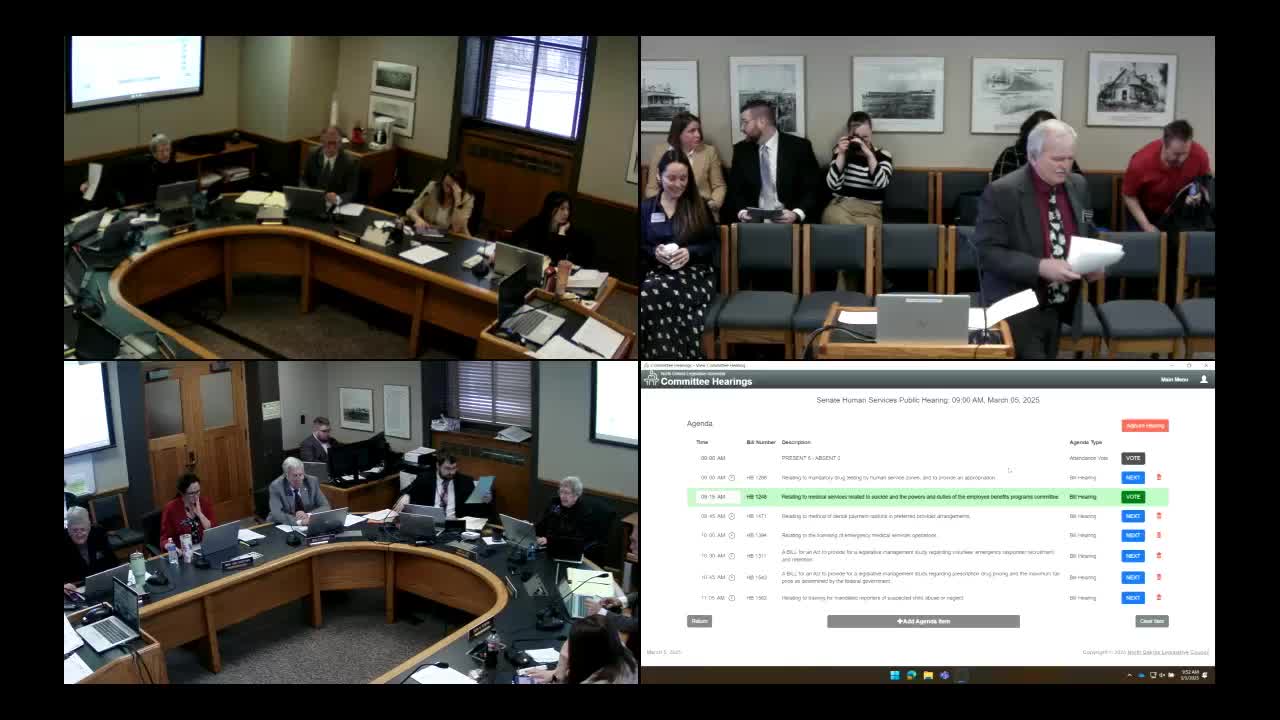
Representative Robin Weisz told the Senate Human Services Committee that House Bill 1248 would change how the state studies and moves health insurance mandates into law, extending PERS pilot timeframes and altering who is required to carry forward pilot results into permanent law.
Representative Robin Weisz (District 14) told the Senate Human Services Committee that House Bill 1248 is intended to streamline and clarify the state’s handling of health insurance mandates and their associated cost-benefit analyses. The bill would repeal a section of existing law and extend the Public Employees Retirement System’s (PERS) pilot review period to allow more time — moving some pilot data collection from one biennium to two — and would remove the current requirement that a PERS pilot be used before a mandate is applied to the commercial market in some cases.
“We initially passed the law that said they just require that prior to if the committee determines it's an insurance mandate, these have a cost benefit analysis,” Weisz told the committee. “But as time went on, we kept adding things ... it was becoming unworkable.” He described the bill as intended to give PERS “an extra biennium. So they really have 3 years to assess that.” Weisz said the measure would also remove the automatic duty for PERS to introduce continuing legislation after a pilot concludes; under the bill, PERS would have the option to introduce a bill but would not be required to do so.
Rebecca Fricki, executive director of PERS, testified in a neutral capacity. She told the committee PERS supports the pilot concept but recommended that the pilot period be extended so the PERS board has three years of data rather than one. Fricki said the PERS board is neutral on repealing the mandate process but acknowledged the administrative burden PERS previously raised in discussions with the bill sponsor.
Industry and business groups urged caution. Andrea Fenig, vice president of government affairs for the Greater North Dakota Chamber, said her members are opposed to removing the pilot requirement for the private sector because mandates increase costs for employers. “The current practice of requiring a pilot project period allows all stakeholders together, utilization and cost analysis information that's critical to decision making,” Fenig said.
Megan Ruby of Blue Cross Blue Shield of North Dakota said the PERS pilot provides “a thoughtful, logical, and a measured method of gathering information.” Blue Cross urged the committee to keep the PERS pilot period or to extend any pilot periods so both PERS and the commercial market can collect multiple years of real-world data before the Legislature enacts mandates that could increase premiums for consumers.
Representative Weisz said he supports retaining a PERS trial for items that would affect PERS benefits and that the bill’s intent is to reduce procedural confusion and duplicated studies. Committee members questioned whether removing the PERS gateway might lead to more mandates headed directly to the commercial market without a period of study. The committee did not take a recorded vote during the morning hearing; witnesses and the sponsor discussed potential technical amendments and timeline adjustments.