Get Full Government Meeting Transcripts, Videos, & Alerts Forever!
Get email alerts on the K12 Discipline And Student Services topic
No spam. Unsubscribe anytime.
Bill would let school boards set expulsion duration by calendar year and require support plans for suspended students
Summary
A representative told the Senate Education Committee House Bill 1223 would allow school boards to set expulsions by calendar year rather than by academic year and require schools to consider students' needs and access to services during suspension or expulsion.
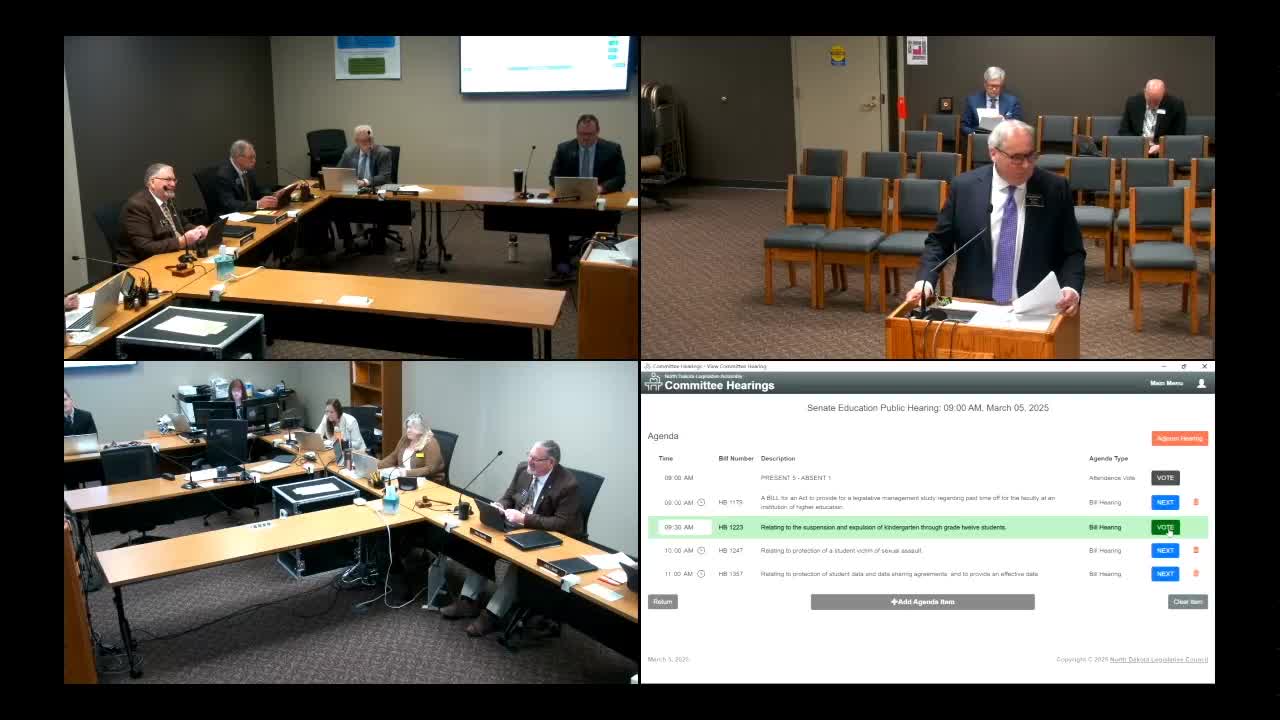
Representative Jonás presented House Bill 1223 to the Senate Education Committee, saying the measure would change the statutory rule that makes expulsions last “until the end of the school year” and instead allow school boards to determine the duration of expulsions on a calendar‑year basis.
Jonás said the change aims to avoid unequal outcomes depending on when an offense occurs in the school calendar: a violent incident in spring can lead to only weeks of removal, while a similar offense in fall can remove a student nearly an entire academic year. The bill would let school districts consider the severity of the offense, the student’s age and disciplinary history, and whether the student is making progress during alternative placement before returning.
The sponsor and supporters emphasized that the measure also directs schools to ensure students who are suspended or expelled continue to have access to educational and behavioral supports — virtual coursework, liaisons, social workers and wraparound services — so students’ right to a free appropriate public education can be addressed while safety concerns are managed. Kevin Howards of the North Dakota Council of Educational Leaders testified in support, describing the bill’s flexibility and the possibility of alternative educational settings.
Protection Advocacy’s legal director, Brad Peterson, testified in opposition. He raised two main concerns: extended removal could deny a student with disabilities access to a free appropriate public education and the bill uses the term “indolence,” which he described as vague and potentially subject to legal challenge; he asked that the term be removed if the committee advances the bill.
Committee members questioned how the measure interacts with existing protections for students with disabilities and how virtual or alternative placements would be supervised. The hearing record included discussion that courts and federal education law can affect how districts deliver services to students who are removed from regular classrooms.
Ending: The committee closed the hearing on House Bill 1223 after testimony from proponents and opponents; no formal committee action occurred during the hearing.