Get Full Government Meeting Transcripts, Videos, & Alerts Forever!
Get email alerts on the Child Welfare Drug Testing topic
No spam. Unsubscribe anytime.
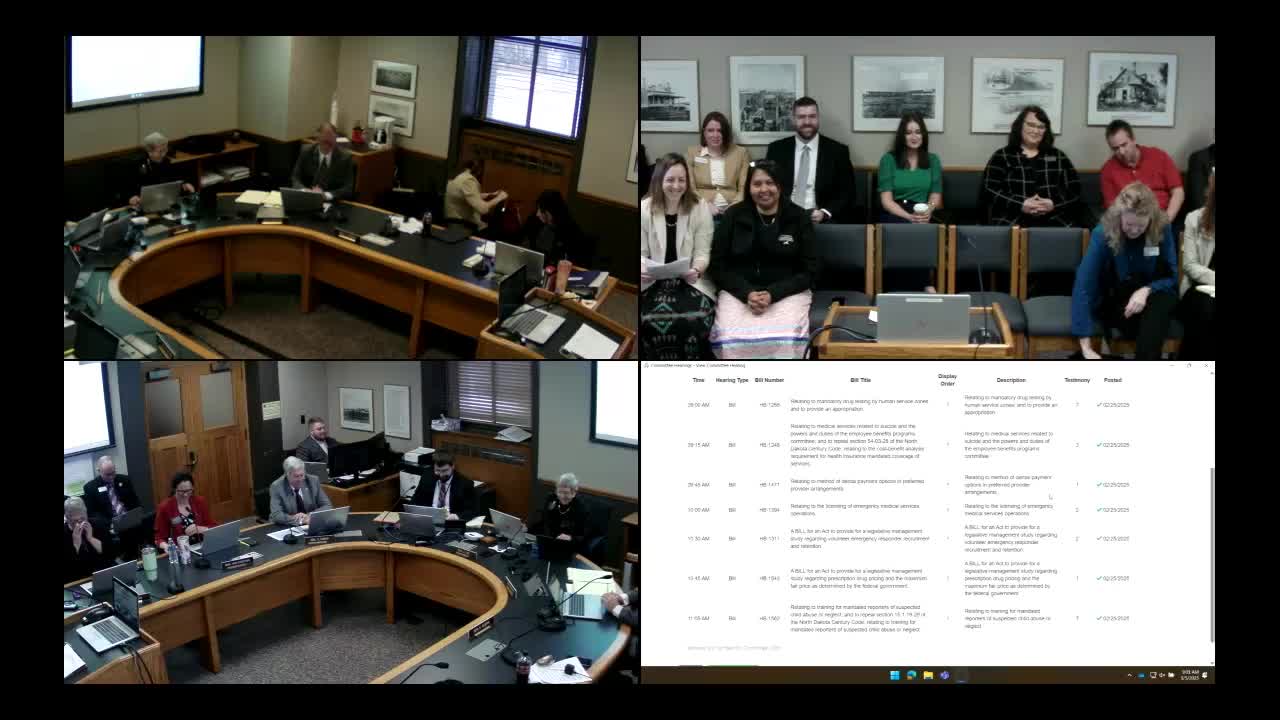
Senate Human Services Committee hears hours of testimony on bill requiring negative drug tests before unsupervised visits
Summary
The Senate Human Services Committee heard extended testimony on House Bill 1268, a proposal that would require parents to have a negative drug test before an unsupervised visit with a child when illegal drug use, the presence of a controlled substance, or drug paraphernalia was a contributing factor in a child’s removal from the home.
The Senate Human Services Committee heard extended testimony on House Bill 1268, a proposal that would require parents to have a negative drug test before an unsupervised visit with a child when illegal drug use, the presence of a controlled substance, or drug paraphernalia was a contributing factor in a child’s removal from the home. The measure includes a $95,000 appropriation to support implementation.
Proponents told the committee the change is aimed at increasing consistency across the state and reducing repeated removals and retraumatization of children. Bailey Greiner, a nurse, foster parent and one of the bill writers, told the committee the measure is meant to ensure “that if drugs are [a] contributing factor to the hurting of a child, then that parent should no longer be using those substances prior to that unsupervised visit.” Greiner said she and other bill authors met repeatedly with human services directors and consulted Preble Medical, a drug-testing contractor, when drafting the bill.
The bill text would allow a human service zone to require additional testing as part of safety planning and explicitly excludes marijuana from the tests covered by the provision. Greiner said marijuana can show positive results for up to 30 days and that exclusion was intended to avoid penalizing parents whose prior recreational use would still register on certain tests. Greiner also moved a friendly amendment to change the bill’s wording from “pass a drug test” to “have a negative” test, saying “negative is measurable” and citing Preble Medical’s procedures.
Tabitha Darris, a registered nurse, foster parent and co-author, described repeated local cases she said illustrated the bill’s intent. She told the committee she had cared for children removed because of parental substance use whose parents were later reunified without testing and that several of those children reentered care. “Mandatory drug testing prior to unsupervised visitations when the illegal use of controlled substances were contributing factor in [a] child’s removal is a step towards ensuring the safety,” Darris said.
Multiple foster parents, a school-based caseworker and a tribal member also testified in favor. Witnesses described rural testing access, the types of tests that may be used (urine five-panel screening, hair follicle tests when appropriate), and turnaround times: testimony cited that hair-follicle testing can take about a week while urine tests typically return results faster. Greiner said Preble Medical’s most comprehensive test costs about $60.
Committee members pressed witnesses on logistics and scope. Senator Rohrs asked how soon a test would be required before a visit; Greiner said the bill leaves timing details to state policy and administrative rules so human service zones and caseworkers can use discretion and accept qualifying tests from rehabs or rural clinics. Senator Hogan raised concerns about the differing tests and variable detection windows for different drugs. Committee discussion clarified that the bill targets illegal controlled substances; it does not, in its current form, include alcohol or fetal alcohol–related concerns.
Witnesses and proponents repeatedly distinguished a statutory mandate from a “policy.” Greiner and others argued a statutory requirement would be enforceable and more consistent across zones, saying some caseworkers currently report they lack the ability to require testing under only a policy framework. Opponents were not recorded during the allotted oral testimony time prior to the committee recess; members asked state and zone staff to return for an afternoon continuation.
No formal committee vote on the bill was recorded during the hearing; the committee recessed and planned to continue testimony this afternoon. The transcript shows discussion and follow-up questions about administrative rulemaking, the role of the Department of Health and Human Services in implementing testing standards, and whether additional appropriations or operational support would be needed for increased supervised visits.
Proponents asked the committee for a due-pass recommendation; committee members sought clarification on turnaround times, the list of drugs covered, and administrative rule development before deciding how to proceed.