Get Full Government Meeting Transcripts, Videos, & Alerts Forever!
Get email alerts on the Higher Education Payroll Benefits topic
No spam. Unsubscribe anytime.
Bill would study paid time off policies for 12‑month university faculty across state system
Summary
A House member told the Senate Education Committee an amended bill would direct a legislative study into paid time off for 12‑month contracted faculty across the North Dakota University System, citing inconsistent institutional policies and financial accountability concerns.
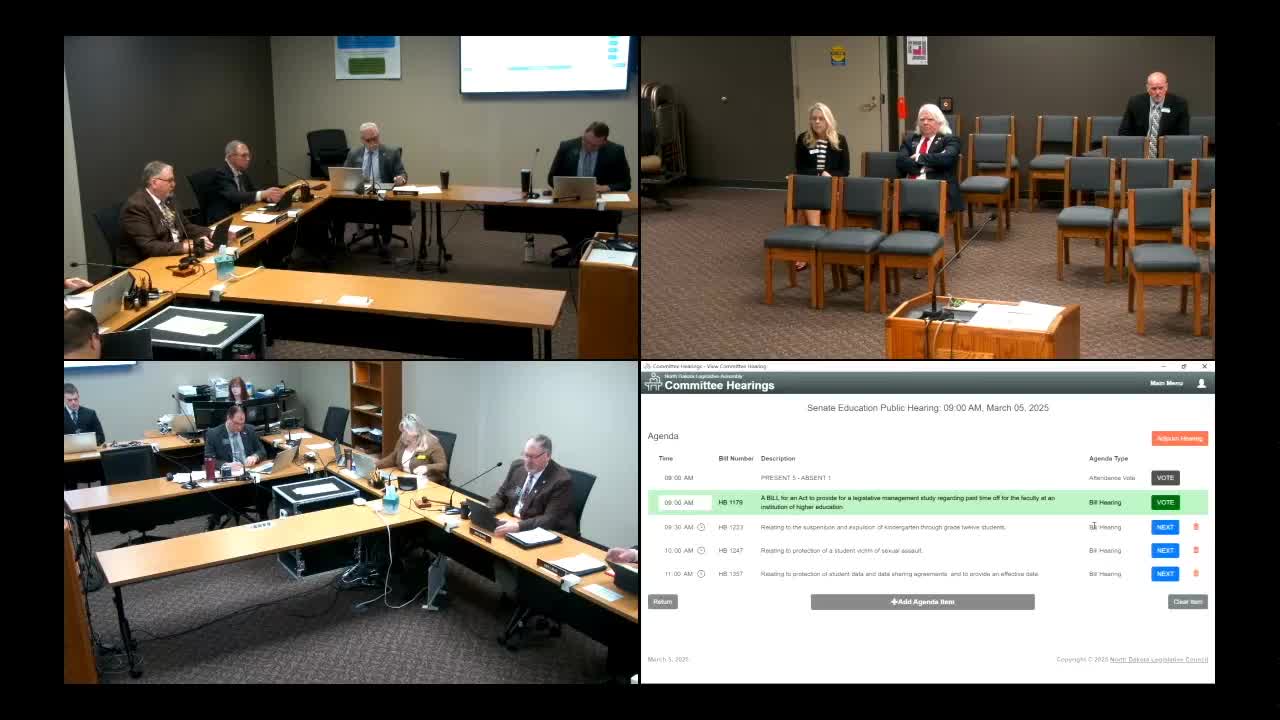
Representative Joshua Murphy introduced an amended House bill to the Senate Education Committee seeking a legislative management study of paid time off policies for 12‑month contracted faculty at institutions governed by the State Board of Higher Education.
Murphy told the committee that the study would collect and compare best practices in North Dakota and neighboring states, and examine disparities within the North Dakota University System. He said some institutions, notably North Dakota State University, currently provide 12‑month faculty with 24 days of annual leave per year under NDSU Policy 130, while other institutions, including the University of North Dakota, provide no official paid time off for some 12‑month faculty.
The bill was amended in the House to direct a study rather than impose a uniform leave requirement. Murphy said the original bill would have required institutions under the State Board of Higher Education to offer 24 days of paid time off to 12‑month faculty, but the House adopted the narrower study approach. During questions, committee members probed how contracts are issued and how tenure or special appointments affect expectations of renewal and rights such as grievance procedures.
Murphy and other witnesses explained that 12‑month appointments vary: tenured or tenure‑track positions generally carry an expectation of renewal and grievance rights, while special appointments on a year‑to‑year contract may not. Committee members asked whether campus governance (university senates, provost and president offices) had considered adopting uniform leave policies; Murphy said efforts had been made but administrations have generally preferred the status quo.
No formal vote was recorded in the Senate committee on House Bill 1179 during the hearing; the committee closed the hearing after public testimony and recessed. The bill as presented directs study and seeks information on financial accountability and consistency across institutions, not immediate changes to institutional personnel policies.
Murphy said he was available for questions and the committee recessed until later business.
Ending: The committee closed the hearing on House Bill 1179 with no recorded committee action at the hearing; the bill proceeds as a study request and may return for amendment or reporting later in the legislative process.