Get Full Government Meeting Transcripts, Videos, & Alerts Forever!
Get email alerts on the Involuntary Mental Health Hold topic
No spam. Unsubscribe anytime.
Committee hears bill to extend involuntary mental‑health hold from 24 to 72 hours
Summary
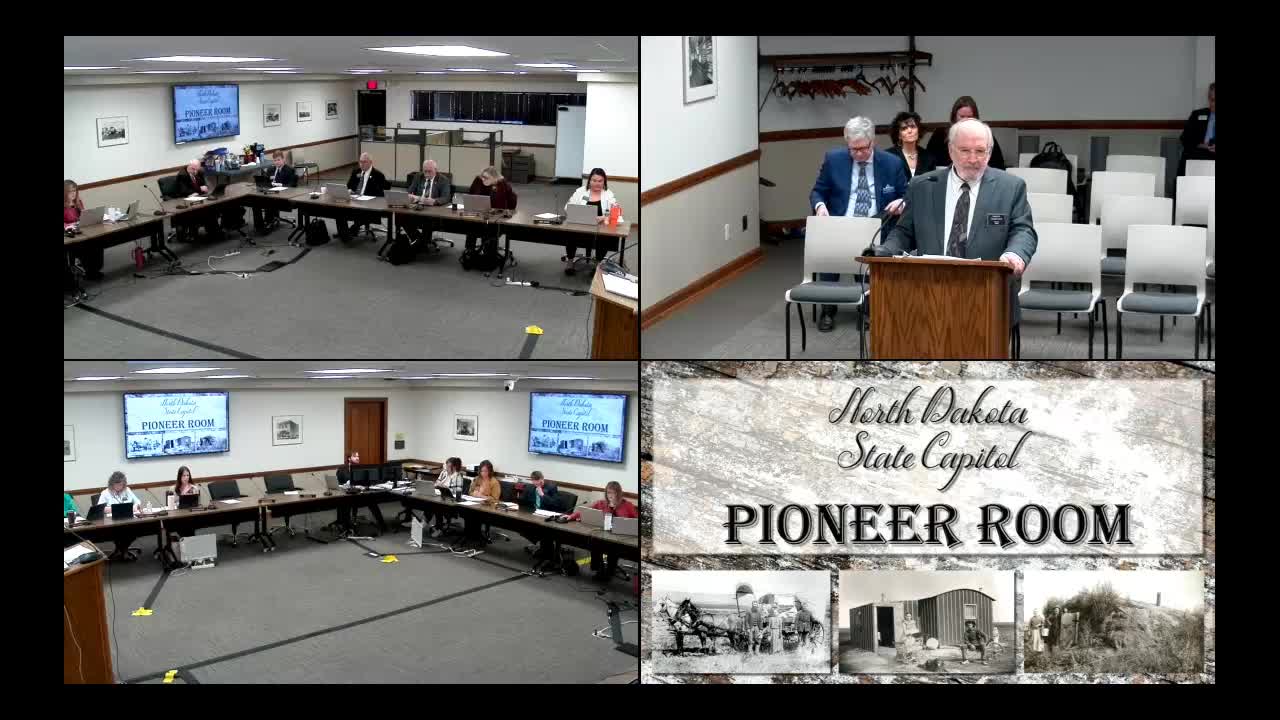
The House Human Services Committee held a hearing on Senate Bill 2,171, which would extend the maximum emergency involuntary hold used for mental‑health or substance‑use assessments from 24 to 72 hours, sponsors and witnesses said Tuesday.
The House Human Services Committee held a hearing on Senate Bill 2,171, which would extend the maximum emergency involuntary hold used for mental‑health or substance‑use assessments from 24 to 72 hours, sponsors and witnesses said Tuesday.
Senator Tim Mathern, sponsor and senator from District 11 in Fargo, told the committee the bill was drafted at the request of mental‑health and law‑enforcement professionals to address delays that often make a 24‑hour hold impractical in rural North Dakota. "There is a need to update the involuntary hold and treatment statute," Mathern said, and he asked the committee for a due‑pass recommendation on the amended bill.
Supporters — including hospital leaders, law enforcement and medical associations — told committee members that travel times, the need for lab tests and current clinical practice make 24 hours insufficient. "No provider is pro hold or commitment. Boy, it is an agonizing process to go through," said Ty Hegland, chief executive officer of Prairie Saint John's, which he described as an acute psychiatric hospital. Hegland said 24 hours frequently expires while a patient is still in transport from rural facilities and that comprehensive psychosocial assessment and medication stabilization commonly take up to 72 hours. "When we have a patient present to our psychiatric hospital, we do a thorough psychosocial assessment. It is a normal standard that it takes 72 hours to do a psychosocial assessment," he said.
Proponents also noted alignment with neighboring states: "Minnesota is 72 hours," Hegland said, and he cited other states with longer holds. Fargo city representatives urged passage, saying a small number of high‑frequency users account for a disproportionate share of emergency calls.
Opponents warned the change would lengthen involuntary detention and increase distress for people who ultimately do not meet commitment standards. "Such changes are not patient centered," said Carlotta McClary, executive director of Mental Health America of North Dakota and the North Dakota Federation of Families for Children's Mental Health. "A patient's needs should trump that of infrastructure." Denise Harvey of the North Dakota Protection and Advocacy Project said patients held involuntarily would have limited ability to contest the detention during the extended period and called the proposal unwarranted.
Committee members asked about costs, local capacity and how the change would be measured. Senator Mathern and witnesses acknowledged that payment sources vary by insurance, Medicaid and individual circumstances; one witness said costs currently can fall on facilities as charity care. Mathern said he would follow up with state's attorneys and county associations to track implementation and interpretation around the state.
The committee record shows the Senate Human Services Committee amended the bill on a 6‑0 vote and the Senate later passed the amended version 45‑0. The House committee held the hearing but recorded no committee vote during the session.
Supporters asked the committee to consider whether the change would reduce repeated emergency responses by law enforcement and improve clinical assessments; opponents urged keeping the 24‑hour limit to protect patients' rights.
The hearing closed with no recorded committee decision; committee members may take further action at a later meeting.