Get Full Government Meeting Transcripts, Videos, & Alerts Forever!
Get email alerts on the Medicaid topic
No spam. Unsubscribe anytime.
Medicaid continues to dominate HHS budget; committee presses on enrollment, FMAP and federal risk
Summary
Sarah Acre, executive director of medical services, described Medicaid's scale, enrollment and federal match considerations; senators asked where possible federal cuts would fall and how the state budgets for provider rates and claims processing.
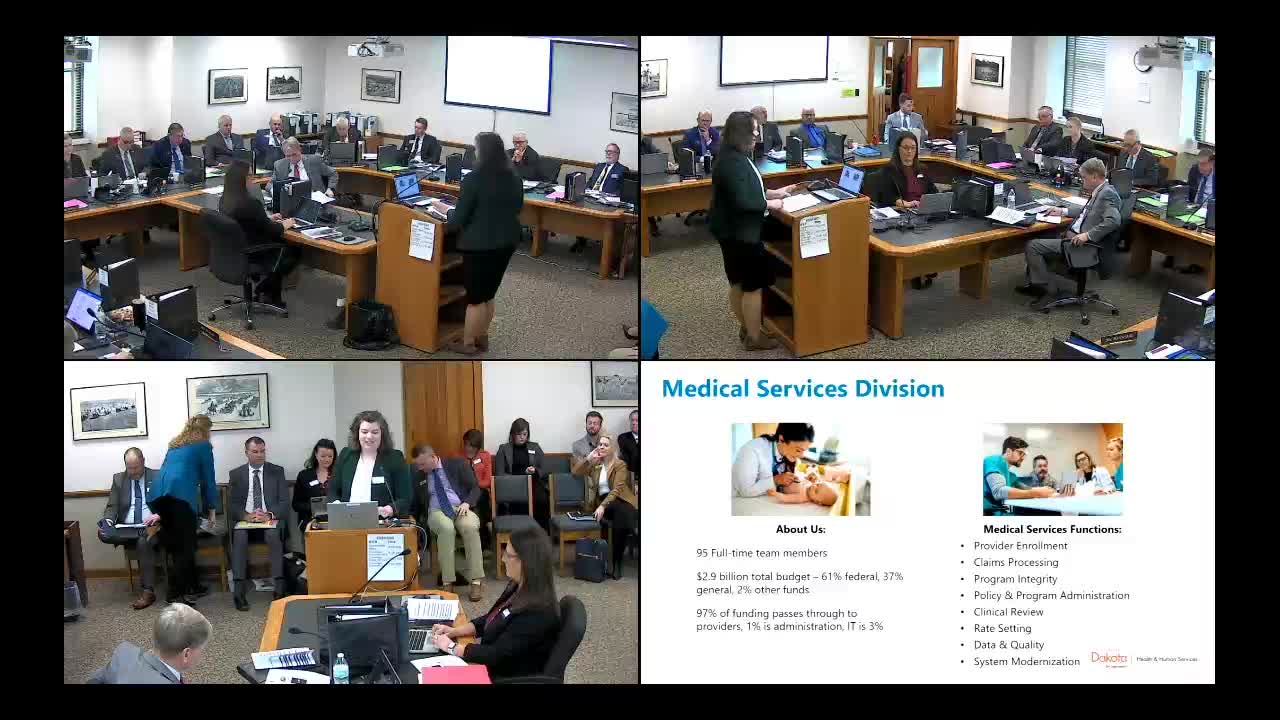
Sarah Acre, Executive Director of Medical Services, told the Senate Appropriations Committee that Medicaid and CHIP account for a large share of HHS spending and outlined enrollment and financing details.
Nut graf: Medicaid drives most HHS spending and touches a large share of North Dakotans. Committee members asked where potential federal cuts would hit the state and sought clarification on claims processing, provider rate-setting and the state's FMAP (Federal Medical Assistance Percentage).
Enrollment and budget Acre said the Medicaid/CHIP biennial budget is about $2.9 billion and that roughly 97% of Medicaid dollars are paid out to providers. State fiscal year 2024 served over 152,000 unduplicated individuals, with monthly average enrollment around 112,000; January 31 enrollment was cited at 108,909. Children make up the single largest group (46% of enrollees); Medicaid expansion adults account for roughly 23,000 enrollees.
Federal match and risk Acre described federal discussion of large potential cuts at the federal level but said no specific legislative proposal has yet been advanced that would detail impacts. She noted the state's FMAP was 50.99% and that the House-projected change to FMAP for the second year of the biennium would be 51% (a roughly 1% change). Committee members asked how different federal proposals (per-capita caps, FMAP adjustments, work requirements) could affect state programs. Acre said the department is monitoring federal developments and is in contact with North Dakota's congressional delegation.
Claims processing and infrastructure Acre described the state's MMIS (claims processing system) as vendor-hosted while staff perform claim reviews as needed, and said claims are typically processed within seven days of receipt. Senators asked about MMIS reliability and whether historical cost-report lags affect rate-setting. Acre said the department uses recent cost reports and inflates forward estimates to set rates and considers known incoming changes (for example, nursing facility staffing requirements) when budgeting.
Value-based initiatives Acre said the Medicaid program has implemented value-based programs with nursing facilities and health systems and intends to expand those initiatives, tying payments to outcomes and quality metrics.
Ending Acre said the department will provide more detailed data and continue to monitor federal policy developments and that Medicaid priorities include bending the cost curve, whole-person care and services closer to home.