Get Full Government Meeting Transcripts, Videos, & Alerts Forever!
Get email alerts on the Information Technology Budget topic
No spam. Unsubscribe anytime.
State IT leaders defend chargeback model, propose hybrid pilot to reduce agency IT rates
Summary
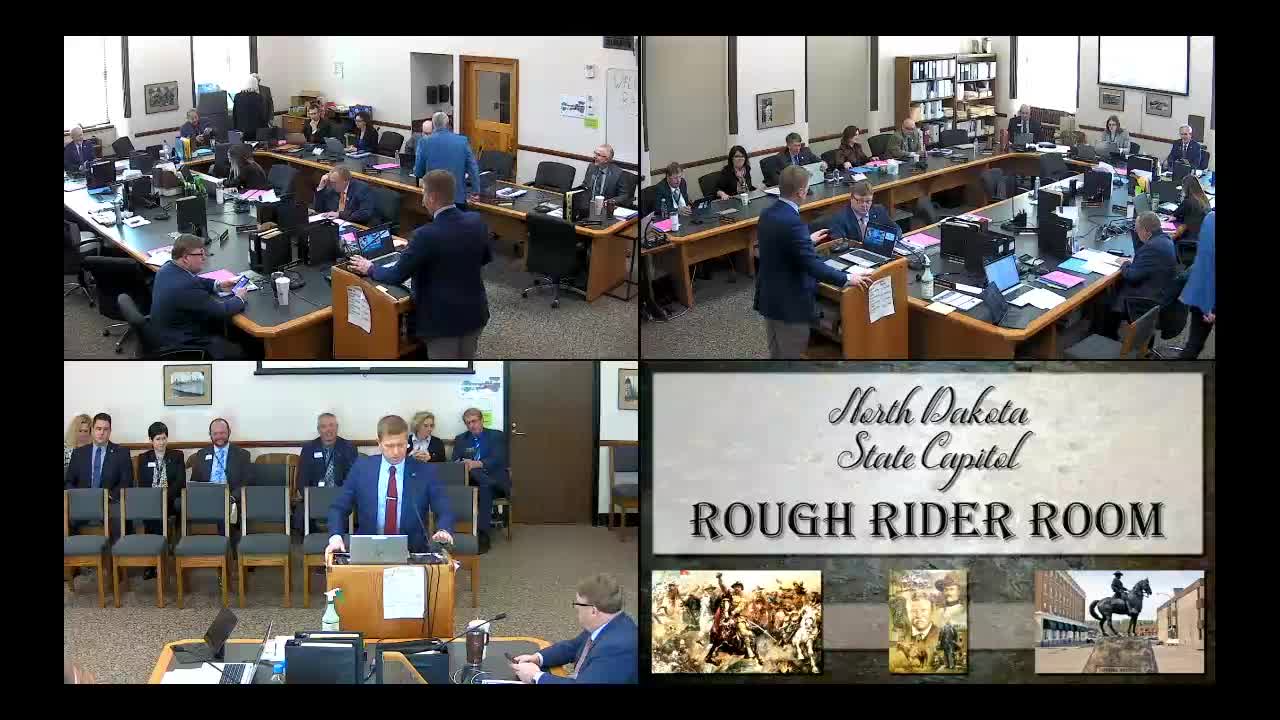
Corey Mach, chief information officer for the state of North Dakota, and Greg Hoffman, deputy CIO and CFO for the state IT department, told the House Appropriations Committee that the agency’s chargeback funding model forces agencies to budget IT costs years in advance and proposed a limited pilot to general‑fund selected services and lower agency rates.
Corey Mach, chief information officer for the state of North Dakota, and Greg Hoffman, deputy chief information officer and chief financial officer for NDIT, gave the House Appropriations Committee a high‑level overview of the agency’s budget, its chargeback rate model and options for moving to a hybrid funding approach.
NDIT provides applications development, data services, infrastructure and desktop support, and cybersecurity for state agencies. Mach explained the agency is financed primarily by chargebacks: agencies are appropriated money and NDIT invoices them monthly for services. “We are funded as part of a chargeback,” Mach said, adding the process requires agencies to know IT costs years before the biennium begins.
Hoffman told the committee how the chargeback is built. NDIT combines vendor costs, staffing, infrastructure and overhead into service fees and publishes rates in April of even‑numbered years; those rates take effect the following July and govern the two‑year biennium. Fees are billed on agreed metrics — per user, per device or per connection — and agencies can drill into invoices electronically. “We have to charge, one agency the same rate for the same service as another agency,” Hoffman said, noting federal accounting rules constrain how rates may be allocated across general, special and federal funds.
Both senior leaders said the chargeback model creates duplicative appropriation signals: the legislature appropriates money to agencies, which then pay NDIT; some of those costs are effectively double‑counted. NDIT proposed identifying systemwide expenses that could be funded with a general‑fund appropriation to reduce agency rates. Mach and Hoffman said they plan to pursue a limited pilot in the next biennium that would general‑fund one or more services and test “show‑back” accounting so federally funded agencies still reimburse their share of costs without driving inconsistent rates.
The committee heard operational details and pain points: setting rates for the 2025–27 biennium started in early 2024, but the rates agencies use to prepare budgets can be based on assumptions made 30–42 months before the last invoice is sent. Hoffman warned vendor pricing volatility can change the forecast; he said recent Hewlett‑Packard notices indicate hardware fees could rise by roughly 9–14 percent. He also described NDIT’s ticketing and intake process for daily support and a queue and prioritization process for larger development projects.
Cybersecurity was a sustained topic. Mach described how NDIT’s security team detected and performed forensics after a multi‑state incident involving PowerSchool — a third‑party student information product — and then coordinated outreach with K–12 district IT offices and DPI to start remediation and account security steps. The agency said federal funding after COVID accelerated its cybersecurity investments and created a “whole‑of‑government” security program.
Committee members pressed for more detail on staffing and funding mixes. Mach said NDIT has roughly 500 employees across its divisions and that the two largest divisions are business applications and technology/desktop support. Hoffman said NDIT keeps limited operating balances consistent with federal OMB 87 rules and that the agency does not operate to generate profit — it must break even. The pair said some work is contracted when internal staff cannot fill needs or incidents require surge capacity.
NDIT also described prior procurement research. Hoffman said a March 2024 request for information for a managed voice service produced only one complete cost proposal; vendor staffing estimates were materially higher than current state staffing costs for the same work. He said NDIT will continue pursuing RFIs to evaluate cost reduction opportunities but that vendor transition costs and multi‑year contracts complicate vendor swaps.
Mach and Hoffman told the committee they will pursue a combination of: (1) agency meetings to get earlier IT planning input, (2) targeted pilots to general‑fund selected services while preserving show‑back to federal and special funds, and (3) continued rate‑setting improvements to reduce surprises for agencies. No formal committee action or vote occurred; the discussion centered on options to simplify funding and reduce rate pressure on agencies.
The Appropriations Committee indicated interest in exploring a pilot and asked NDIT to provide further breakdowns of staffing by division, the portion of spending billed to federal versus state funds, and options for continuing appropriations and selected general‑fund pilots.