Get Full Government Meeting Transcripts, Videos, & Alerts Forever!
Get email alerts on the Behavioral Health topic
No spam. Unsubscribe anytime.
Behavioral health leaders outline statewide network, propose new state hospital and project $300M capital request
Summary
HHS behavioral health leaders described services across public and private providers, progress on overdose and suicide metrics, and a proposed new state hospital with an executive budget request near $300 million and a planned expansion from 122 staffed beds to about 140 beds in the proposal presented to the Senate Appropriations Committee.
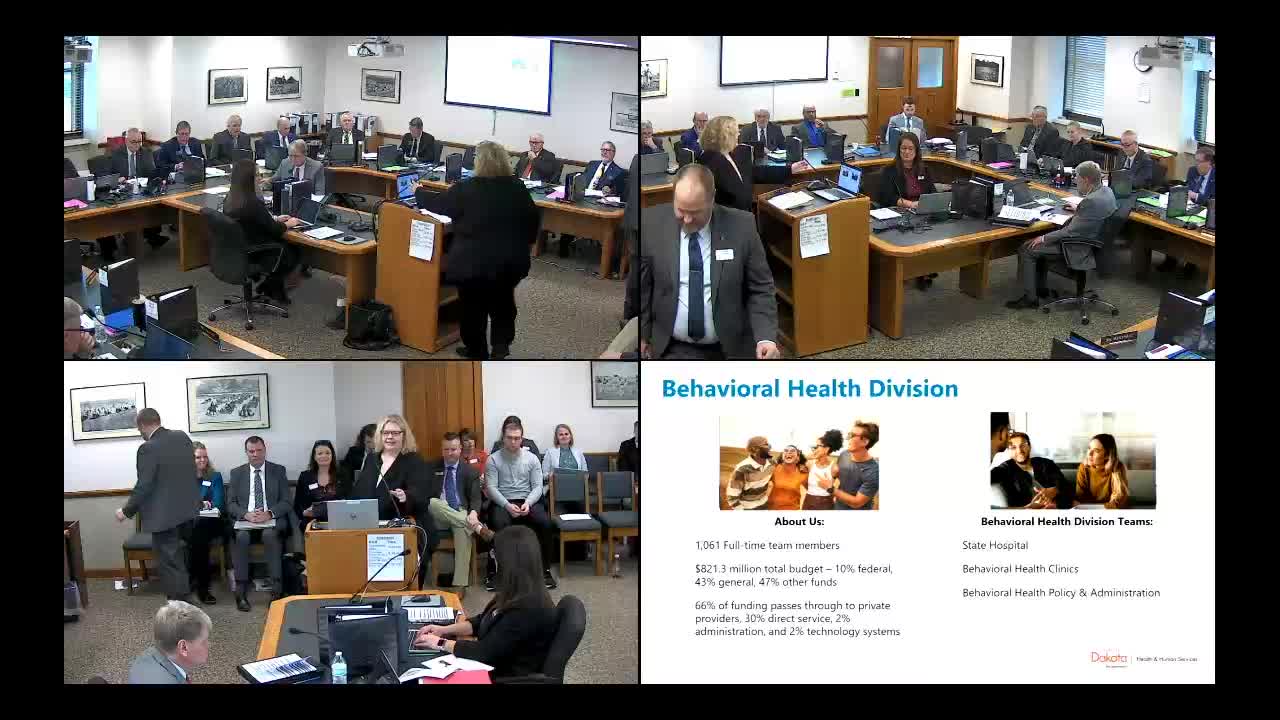
Pam Segnus, Executive Director of Behavioral Health, told the committee the state's behavioral health system combines public and private providers and includes state-specific services that private providers cannot currently deliver.
Nut graf: The committee heard that North Dakota reimbursed between 5,000 and 6,000 hospital days per year to private hospitals for acute psychiatric care and that the state hospital in Jamestown provides specialized inpatient forensic restoration and offender-treatment services not duplicated elsewhere in the state. Segnus described a proposed replacement state hospital project and the operational rationale for modernization.
What behavioral health covers Segnus described an integrated behavioral health division that includes the state hospital, roughly 17 behavioral health clinics (residential and clinic locations), and a policy and administration team. She listed multi-region acute inpatient psychiatric care provided by private hospitals in Fargo, Bismarck, Minot and Grand Forks and noted six psychiatric residential treatment facilities for youth located across the state. The division reimbursed between 5,000 and 6,000 hospital days per year for inpatient care delivered by private providers, Segnus said.
Trends and prevention Segnus told the committee drug overdose deaths decreased to 96 fatalities for 2024 and said suicide rates also declined in 2024. She credited distribution of naloxone (Narcan) and prevention work, and noted declines in underage drinking and an improved state ranking on that measure.
New state hospital proposal Segnus reviewed work on a proposed new state hospital for Jamestown: the proposal in the executive budget request totals about $300,000,000 for the project and the division is seeking efficiencies by consolidating multiple buildings into a smaller footprint. She said the current staffed bed capacity is 122 and the proposed plan would expand staffed beds to approximately 140'141 beds. Segnus described projected operational efficiencies from consolidating facilities (going from six buildings to a smaller single facility) and showed construction cost comparisons and contingency planning used in architectural benchmarking.
Financing and alternatives Committee members asked about financing and alternative bed counts. Segnus said the House had considered a larger version closer to 165 beds funded with a combination of CIF (Capital Improvement Fund) dollars and a line of credit; the version Segnus described to the committee reflects the executive budget request and identified levers that could be pulled to alter project scope and cost.
Questions on operations and authority Senators asked about workforce capacity, per-bed construction costs (construction cost comparators were provided), and jurisdictional questions about civilly committed forensic patients. Jonathan Alm, attorney with HHS, clarified that decisions to release civilly committed "SOTEP" (sexually oriented offender treatment program) patients are made by courts based on clinical recommendations but that courts can issue a release contrary to a physician's recommendation.
Ending Segnus said the division continues operational assessments and staffing projections tied to the proposed bed expansion and that more detailed testimony and cost breakdowns would follow in division hearings.