Get Full Government Meeting Transcripts, Videos, & Alerts Forever!
Get email alerts on the Charitable Gaming Enforcement topic
No spam. Unsubscribe anytime.
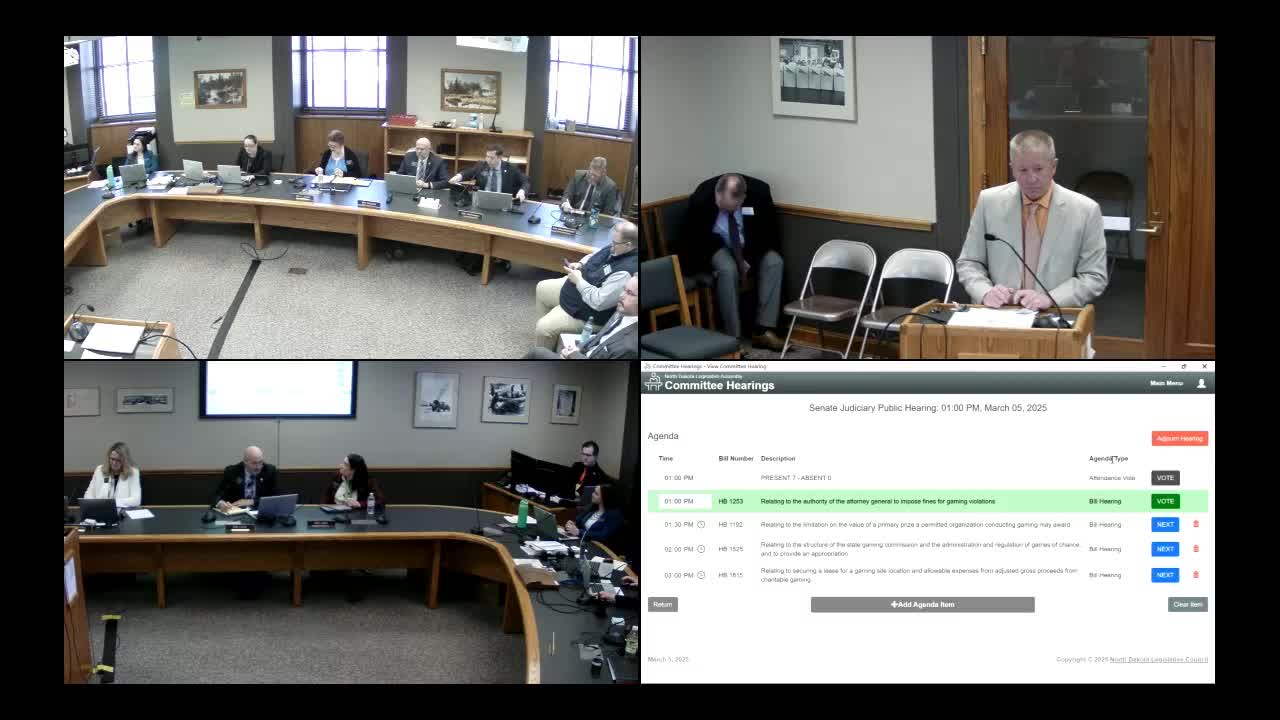
Senate Judiciary Committee recommends due pass on bill letting attorney general levy fines on charitable gaming sites
Summary
The Senate Judiciary Committee voted to give a due-pass recommendation on House Bill 1253, which would let the attorney general impose civil fines of $250–$2,500 on owners of authorized charitable-gaming sites as an alternative or supplement to license revocation.
House Bill 1253, which would allow the attorney general additional enforcement options in charitable gaming cases, received a due-pass recommendation from the Senate Judiciary Committee on a voice vote.
Representative Jim Greenheck, the bill sponsor, told the committee the proposal is intended to give the attorney general —3—2another tool in the toolbox—3—2 for cases where revocation of charitable-gaming privileges is disproportionate to the violation. "The punishment would fit the crime," Representative Greenheck said, describing the measure as a range of responses from a fine alone to fine plus revocation depending on the severity of the offense.
The bill would add a civil-fine option to the enforcement mix for violations at authorized gaming sites. Under the measure as described in committee testimony, fines would range from $250 to $2,500; revocation would remain available for serious or repeated violations. Supporters said the change is meant to avoid unduly punishing charities when a site-owner or employee commits a minor infraction.
Scott Meske of the North Dakota Gaming Alliance said the bill is "a vast improvement" over prior proposals and would give the attorney general—s office flexibility without removing oversight. "Charitable gaming has provided significant benefits to our communities across the state, but it's imperative the industry, charities, and sites alike operate transparently and within the rules," Meske said.
Deb McDaniel, director of the Attorney General's charitable-gaming division, told senators the gaming division already conducts audits and investigations and has processes for notices of violation and administrative hearings. McDaniel described the office—s audit workload: "We usually do about 100 audits in a fiscal year," and said completed audit records are open to the public and can be provided to the gaming commission or legislative inquiry.
Committee members questioned whether the proposed fines could spur criminal charges in some cases, and witnesses said criminal prosecution would remain separate. McDaniel said criminal matters would be handled by law enforcement and prosecutors if warranted, and the attorney general's office can pursue administrative hearings for civil enforcement.
Votes at a glance: Senator Merdahl moved a due-pass recommendation on HB1253, seconded by Senator Castaneda. The committee recorded the motion as carried; Senators Paulson, Castaneda, Cory, Luke, Myrtle, Brownberger and Chair Larson voted aye. Senator Merdahl will carry the bill.
The committee heard several supporters from the hospitality and gaming industries and charitable-gaming groups who said the civil-fine option would prevent an unduly harsh penalty that primarily harms the charity rather than an owner or employee. Opponents raised questions about due process and asked for administrative rulemaking detail; McDaniel and other witnesses said the office would develop rules and rely on investigations and prior history to calibrate fines.
The committee closed the hearing after discussion and recommended the bill move forward with a due-pass endorsement.