Get Full Government Meeting Transcripts, Videos, & Alerts Forever!
Get email alerts on the Maternal Health topic
No spam. Unsubscribe anytime.
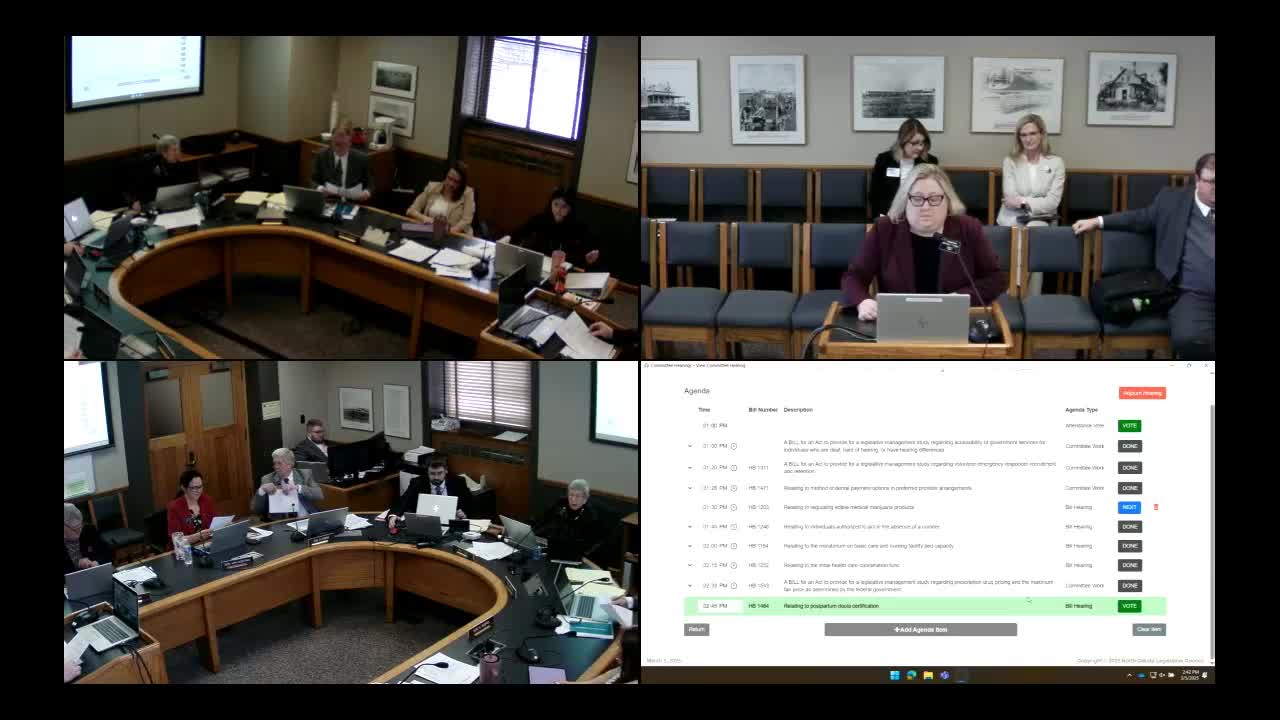
Lawmakers debate postpartum doula certification and Medicaid coverage; sponsor proposes study
Summary
Representative Gretchen Dobrevich asked the committee to convert House Bill 1464 into a study after the Medicaid coverage and fiscal note were removed. Stakeholders split: the American College of Obstetricians and Gynecologists supported Medicaid coverage, while local doula groups warned against restricting certification to a single organization.
Representative Gretchen Dobrevich (District 11) asked the Senate Human Services Committee to consider amending House Bill 1464, which originally proposed postpartum doula certification and Medicaid reimbursement for postpartum doula services, into an interim study examining how to develop doula services in North Dakota.
Dobrevich said the governor’s budget did not include a doula program and that amendments in the House removed a $280,000 biennial fiscal note. Under the amended bill language she presented in committee, the bill would create a registry and a report to legislative management but would not create an immediate Medicaid reimbursement program. “Without a formal program and third‑party funding, passage becomes an unfunded mandate,” Dobrevich said, and she proposed an interim study to define certification, education needs and resources required to establish Medicaid coverage in a way that is sustainable.
Medical and maternal‑health groups spoke in support of Medicaid coverage in principle. Christina Sambor with the American College of Obstetricians and Gynecologists said ACOG views doula care as improving maternal mental health and infant outcomes and urged including doula services in Medicaid so low‑income families can access support. “Obstetricians and gynecologists see the benefits of these services and would encourage the state to find ways to make them widely available,” Sambor said.
Local doula organizations and practicing doulas urged caution about certification language. Megan Hare, a certified birth and postpartum doula and president of the Bismarck Doula Community, said the group opposes limiting certification to a single organization and warned that hard certification requirements without payment mechanisms would limit access in rural areas. “Restricting this flexibility could limit access to care for many families, particularly in our rural areas where the supply of professionals is already limited,” Hare said.
Other doulas and advocates supported a study as a practical next step. Willow Toritch, a birth and postpartum doula, told the committee she would prefer a pause to a hastily drafted bill and proposed a collaborative interim process including the department, legislative staff and active doulas to design a practical model.
Outcome: The sponsor said she would work with the committee on amendment language and is willing to convert the bill to a study if that better advances the goal of making postpartum support available to vulnerable families.
Ending: Committee members asked the sponsor and stakeholders to develop draft study language; the hearing record closed with several senators expressing interest in an interim review of certification, service availability and funding options.