Get Full Government Meeting Transcripts, Videos, & Alerts Forever!
Get email alerts on the Education topic
No spam. Unsubscribe anytime.
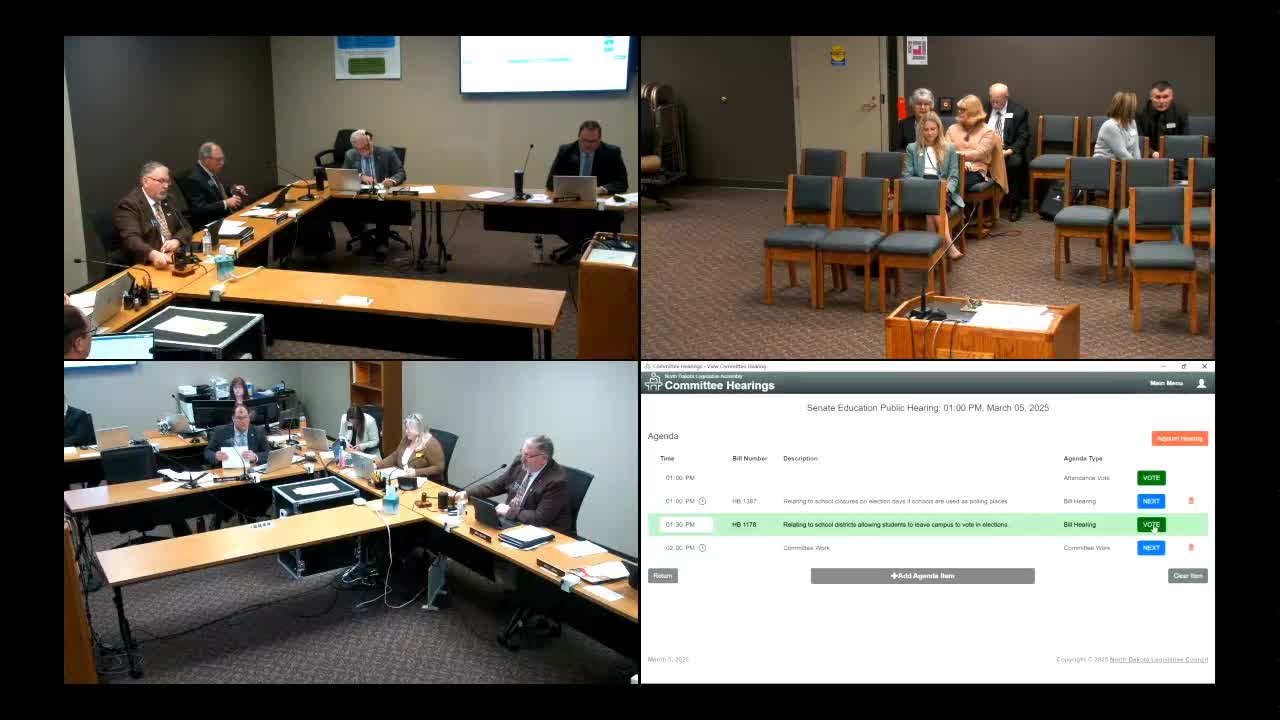
Committee recommends do‑not‑pass on bill directing districts to adopt policies allowing 18‑year‑olds to leave campus to vote
Summary
The Senate Education Committee voted 6–0 to recommend a do‑not‑pass on House Bill 11‑78, which would have directed local school boards to adopt policies allowing students 18 and older opportunities to leave campus to vote; committee members and witnesses debated operational complexity, parental roles and student civic engagement.
The Senate Education Committee voted to recommend a do‑not‑pass on House Bill 11‑78 after hearing testimony from the bill sponsor, students and state election officials.
Representative Anna Novak presented the bill and told the committee it "essentially directs all local school boards to adopt their own policy to allow students 18 years of age and older the opportunity to vote in elections." Novak said the bill preserves local control by instructing each district to write its own policy rather than imposing a one‑size‑fits‑all approach.
Student witness Sofia Dostel, identified in testimony as the idea’s originator, described barriers she observed for eligible high‑school voters: "the lack of a voting policy in our public schools has made it difficult, if not impossible, for many eligible voters to participate," and she urged the committee to adopt the bill to "remove barriers" and help cultivate lifelong civic participation.
North Dakota Secretary of State Michael Howe told the committee his office supports the bill and cited turnout figures he said underscore the need to encourage voting: "We had 20% voter turnout in the June 2024 primary" and "63% turnout in the November general election," he said, urging efforts to increase first‑time and young voter participation.
Amy DeCook of the North Dakota School Boards Association said the association did not oppose the bill and noted local policies already allow students to be excused for appointments; she said the bill’s language permits school boards to set parameters and conditions for absences.
Committee members debated practical concerns: several senators said districts already have attendance and absence policies that can handle excused absences for voting or appointments and questioned whether a statutory requirement was necessary. Senators raised equity issues for families who cannot take time off work and operational complexity for large districts where students’ schedules vary widely. One committee motion to recommend a do‑not‑pass carried with a roll call of 6 yeas, 0 nays; the clerk recorded the committee outcome as "do not pass" on House Bill 11‑78.
Ending: The committee’s do‑not‑pass recommendation sends the bill back to the calendar; committee members suggested the secretary of state and school boards could collaborate on guidance or a model policy as an alternative to statutory language.